





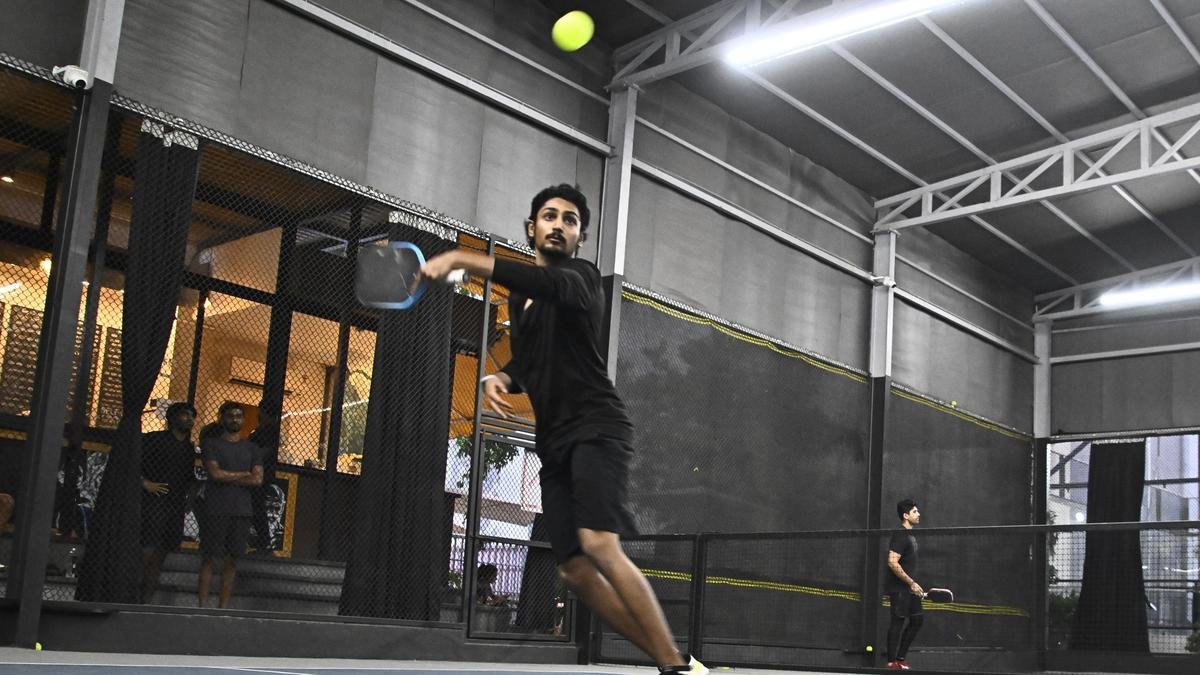
On a weekday evening at Hyderabad Paddle Park, courts are rarely empty. By 5pm, a steady rhythm of play sets in. A plastic ball snaps across the net, paddles rise and fall, and players rotate in tight cycles of waiting and action.
Pickleball, which began as a casual social sport, has found several takers in the city.
“Earlier there were only 8 to 10 courts in the city. Now you can find courts in different localities,” says Dorlodhu Pradeep, part time coach at Hyderabad Paddle Park.
While Jubilee Hills has emerged as a hub with Hyderabad Paddle Park and The Kitchen drawing steady evening crowds, Madhapur’s Ayyappa Society houses Pickle Yard is a favourite among IT professionals. Gandipet’s Cross Court Sports offers a larger sports campus environment. Other frequently-visited spaces include Dink N Dash and the Pullela Gopichand Academy.
Most venues have moved indoors, a shift warranted as much by Hyderabad’s heat as by demand. Air conditioned courts have also pushed the sport into a premium bracket.
What is pickleball?
Pickleball is a paddle sport that borrows the ethos of tennis, badminton and table tennis. It is played on a court the size of a badminton doubles court, but significantly smaller than a tennis court. Players use solid paddles instead of stringed rackets and a perforated plastic ball that behaves unpredictably after the bounce. In most formats, the ball must bounce once before volleys, and points are typically scored only by the serving side.
Doubles is the most common format in Hyderabad, with four players sharing a court. Its simple structure makes it viable to play in a social setting.
The name pickleball has competing stories. One popular explanation links it to a dog named Pickles. Another traces it to the “pickle boat” in rowing, a crew made from leftover members of other teams. Both versions circulate widely in online discussions and community forums.
How Hyderabad warmed up to the game
The city’s introduction to pickleball happened through short form videos on social media, and corporate groups looking to engage in new activities got hooked.
Pickleball courts have been finding increasing patronage across the city
| Photo Credit:
Siddhant Thakur
Some players concur that though the sport appears at first, its intricacies begin to surface in minutes. Darla Jyotirmayi, a finance professional from Nanakramguda who travels to Jubilee Hills to play regularly, recalls the first impression: “We kept seeing it online and finally decided to try it. “Though it seemed simple at first, we discovered it wasn’t.”
Another player, Garikapati Madhavi, an engineer from Kukatpally trying the sport for the first time, describes a similar disconnect: “Online videos never show how hard it is to judge the bounce. You think you know where it will go, and then you miss it completely.”
This gap between perception and reality has also contributed to the growth of the sport, as players return to better their game.
Who is playing?
Spend an evening across courts and the mix of players is striking. There are corporate teams trying the sport for the first time, IT professionals arriving straight from work, and teenagers with tennis backgrounds playing with competitive focus.
At Pickle Yard, Gaurav Jha, a digital marketer from Ayyappa Society, Madhapur, first discovered pickleball during a corporate outing: “My boss explained the rules and I just joined.” Soon, he realised the complexities of the game as he kept missing the ball. “I struggled to connect with it,” he recalls. It took him five to six matches to get comfortable with the sport.
At The Kitchen, Jubilee Hills, Chandravela Yash travels from KPHB, a 30 to 50 minute commute, to play. A competitive tennis player, he adapted faster than most but remains cautious about assumptions. “Tennis helped me adjust,” he says. “But the dink is the hardest shot and consistency matters.”
Kannur Gopi, from Begumpet, represents the most committed end of the spectrum. A regular player at the same venue, he has moved from casual play to competitive tournaments in less than a year.
He estimates spending up to ₹40,000 across court bookings, equipment and shared costs. His carbon fibre paddles, priced at around ₹6,000, need replacement every three to four months due to aggressive play. “Most other sports are cheaper,” he says. “But once you start, it is hard to stop.”
The cost
Court prices vary according to venue and time. Smaller facilities charge around ₹700 per hour, while the charge is higher at premium indoor venues. At Hyderabad Paddle Park, court time is about ₹1,500 per hour. At The Kitchen, it is ₹1,600 per hour. Equipment adds another layer, with entry level paddles starting at ₹1,500 to ₹2,000 and advanced carbon fibre paddles costing more. A standard session is typically split among four players, which reduces individual cost but requires coordination or willingness to join rotating groups.
The learning curve
Many experienced players state that indoor balls are slower and lighter, while outdoor balls are faster and heavier. Neither behaves intuitively for new players. Wrist control is another initial hurdle. Small technical errors affect consistency more than power does.
Court shoes are recommended due to constant lateral movement. Running shoes increase the risk of ankle strain.
At Hyderabad Paddle Park, Dorlodhu Pradeep emphasises a thumbrule that applies to any sport or fitness routine. “Most injuries happen when players skip warm ups. People only take it seriously after they get hurt.” He adds that correcting wrist movement alone can transform a beginner’s game.
Newcomers typically take two or three sessions to get comfortable with the game if they have prior racket sport experience, and longer if they do not. A better understanding of the game happens over weeks.
For now, pickleball sessions have transformed into community activities that revolve around a court.
(The writer is an intern with The Hindu)
Published – July 07, 2026 08:30 am IST


