



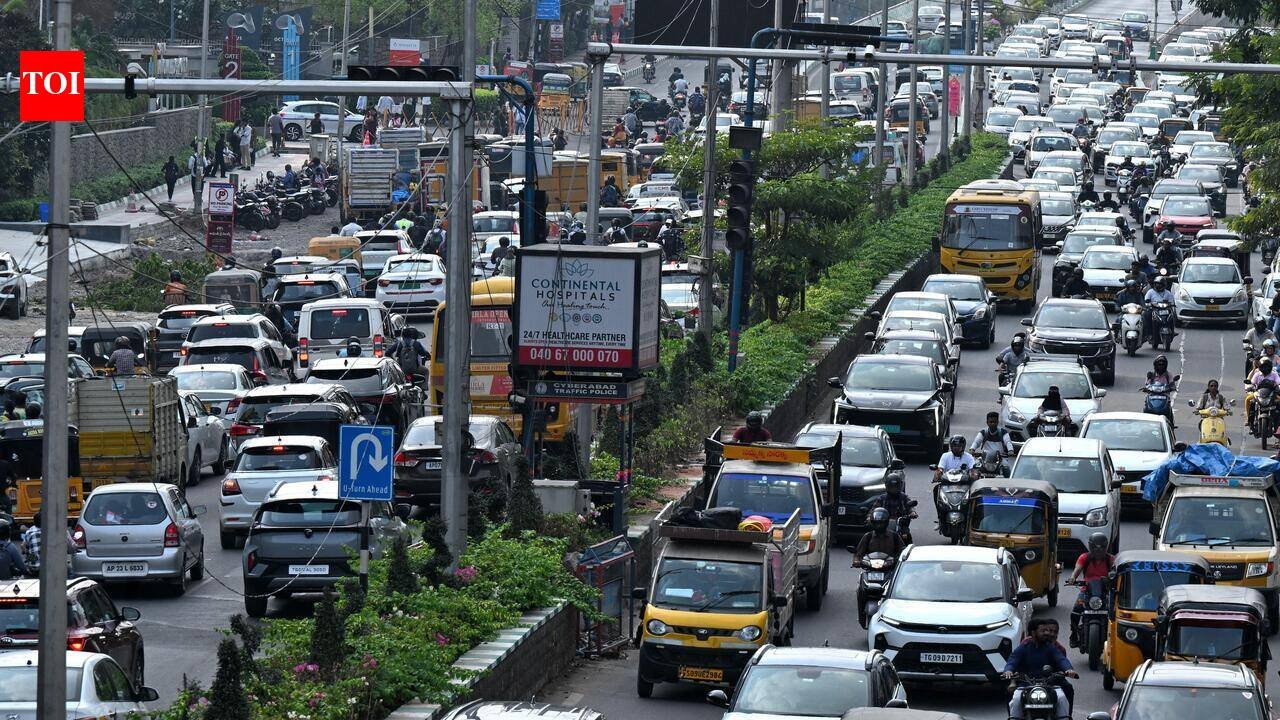
Hyderabad: Traffic congestion and rising nighttime temperatures are together costing city residents nearly 200 hours every year, according to two recent studies. While clogged roads eat into Hyderabadis’ time, rising nighttime temperatures are increasingly robbing them of sleep.According to the latest TomTom Traffic Index, Hyderabad commuters lose around 123 hours a year to traffic congestion, equivalent to more than five full days. The city recorded a congestion level of 55.5%, while the average time required to cover 10 km was 32.37 minutes. During the evening rush hour, the average speed fell sharply, with a 10-km journey taking 39.5 minutes.The worsening traffic situation has been attributed to the rapid growth in the city’s vehicle population — estimated at 80 lakh — without a corresponding expansion of the road network or public transport capacity.“The vehicle population in Hyderabad has doubled over the past decade, while public transport has increasingly taken a back seat. Ideally, traffic speeds in a metropolitan city should be around 25-30 kmph, but in Hyderabad, average speeds are barely 15 kmph and can drop to as low as 10 kmph during evening peak hours,” said T Sathyanarayana Reddy, a retired engineer from the Central Road Research Institute.Hotter nights take away sleepBut the city’s time loss does not end when commuters reach home. An analysis by US-based Climate Central, covering 1,338 cities worldwide, found that Hyderabad residents lose an estimated 75 hours of sleep every year because of high nighttime temperatures.Of these, around seven hours are directly attributable to climate change, indicating that rising global temperatures are already having a measurable impact on sleep in the city.The figure is significantly higher than the global average of 56 hours of sleep lost annually because of high ambient temperatures. The analysis, which examined the period from 2020 to 2025, also found that southern India is among the regions experiencing some of the highest levels of heat-related sleep loss.Climate Central’s analysis found that people in southern India lose between 70 and 90 hours of sleep annually because of higher nighttime temperatures. The findings highlight the growing impact of warmer nights, particularly in densely built urban areas where concrete structures and asphalt surfaces retain heat and slow cooling after sunset.Researchers noted that access to air conditioning remains closely linked to income and is highly unequal across South Asia. However, even people with access to cooling are not entirely insulated from the effects of hotter nights.“Several factors, including work schedules, stress, health, caffeine consumption, light, noise, bedroom conditions and humidity, influence both the amount and quality of sleep. However, the analysis shows that climate change and rising nighttime temperatures are increasingly adding to the factors that interfere with adequate sleep,” researchers said.


