



Key events
‘I am here to win,’ Orbán says after casting his vote
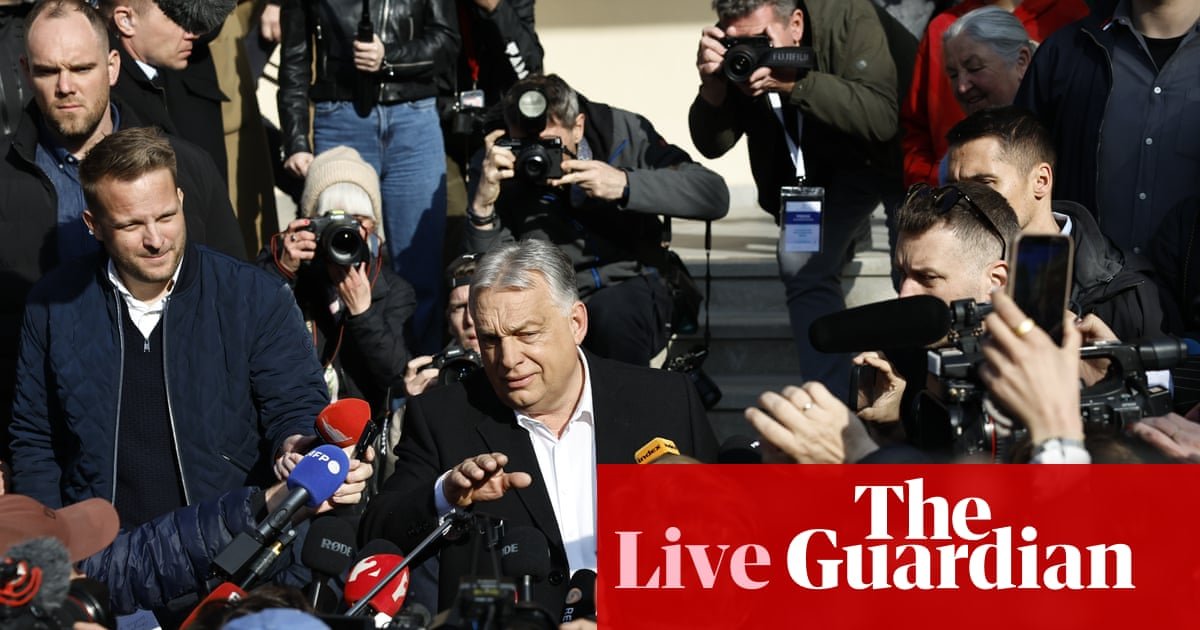
The Hungarian prime minister, Viktor Orbán, cast his vote early this morning in Budapest, accompanied by his wife, Anikó Lévai.
Talking to journalists after the vote, the Fidesz leader, who could lose his position after 16 years in power, insisted he was “here to win,” stressing he “likes to win.”
He also dismissed the possibility of results being contested by the EU, saying “they have to accept the intention and the will and expressed opinion of the people.”
“They can’t disrespect the Hungarian people,” he said.
Asked to compare today’s vote to the historic election in 1990, he said “the context is different.”
“The question is not to [establish] democracy or not, but how to operate the democratically elected government.”
He then said:
“We are heading towards major crises – not one, but several, coming together. So I think we need strong national unity to … resist the energy crisis, the financial crisis, the economic crisis [coming] towards us.”
Responding to a suggestion this could be his last election, he insisted: “I am a young man!”
Orbán also said it would have to be a “big” defeat for him to resign from the leadership of Fidesz.
No election silence, but there are some restrictions on campaigning
Unlike many other countries, Hungary does not really have an election silence period, so some campaigning activity can still take place today.
But there are some caveats and restrictions that effectively mean that no more major events (that’s why both candidates held their final rallies last night) are permitted and no campaigning can take place near polling stations (specified as 150 meters from the main entrance). All posters in place before the polling day can remain there, too.
Having said that, people still come up with creative ways to make their views known to others: earlier today I saw a van driving in central Budapest, blasting Fidesz’s campaign song on full volume.
What to expect when during the night?
The voting has started at 6am this morning, and will close 7pm local time (6pm UK).
We should get some new polls with data from this week – not exit polls! – around then, but it’s worth taking them with more than a pinch of salt. I will bring you the numbers, but take them with caution.
Despite all the excitement around this election, the situation is so tight and the polls are so all over the place that we would be well advised to wait for the official numbers before drawing any definite conclusions.
First partial results should start coming in the first 60 minutes after the polls close, and we should get to about a half of all votes counted by 10pm local time, and over 90% as we approach midnight. So strap in, this rollercoaster may need a few hours to get to its final stop.
If the result is particularly tight, we could then get into tricky situation as the last bit – the overseas votes – won’t be counted until, erm, Saturday.
Pre-election day polls suggest Tisza win but lots of questions remain
While here was no shortage of polls before the election day, they were a bit all over the place – largely depending on their, erm, affiliation and proximity to the ruling party.
The more independent pollsters appeared to suggest that Péter Magyar’s Tisza party was on course for a victory, but the margin of that win – again – was not entirely clear with wildly different numbers on offer.
The consensus view appeared to be that they held around 10 percentage points lead coming into the final weekend.
But, but, but… there is a lot of complexity in the Hungarian electoral process that mean we need to be pretty careful about interpreting these numbers.
It’s a mixed system, which was repeatedly reformed and redrawn by Orbán in a way that critics say resulted in a baked-in advantage for his party. But the top line is that there will be 106 MPs elected in single-member constituencies, and 93 from national party lists, decided with some pretty complex electoral maths behind it and a 5% party threshold to get in.
So, as difficult as it is going to be, we may have to be more careful than usual about drawing conclusions early in the night.
Magyar ends campaign in Debrecen as he attacks Fidesz’s positions
Meanwhile, Tisza’s leader Péter Magyar closed his campaign in Debrecen, Hungary’s second-largest city.
His rally gathered unexpectedly high number of supporters given the city has always been a Fidesz stronghold and seen as an pretty ambitious target for Tisza leader’s campaign.
András Bíró-Nagy of Policy Solutions in Budapest told me that Magyar’s decision to campaign in traditionally Fidesz parts of Hungary in the last days of the campaign seemed to suggest he was confident of making gains there.
Orbán’s party, Fidesz, has governed in Debrecen for 28 years, making it “the Fidesz capital of Hungary,” but “Orbán had to go there [earlier in the week] because even pro-government pollsters are indicating that the city might be up for grabs,” he said.
He said that Magyar’s decision to hold his last rally there was “very symbolic” and suggests “he feels that he can win even there … and if he makes it, it will mean the change of government [nationally], for sure.”
Orbán’s last rally showed key messages cut through with his supporters
Jakub Krupa
in Budapest
Viktor Orbán finished his electoral campaign at a rally in front of the Matthias Church in the centre of the Buda Castle District last night.
It wasn’t that busy as you would perhaps expect for the last rally of the campaign, but a few thousand people gathered there to express their hopes that Orbán will be re-elected for the fifth consecutive term.
But Orbán’s key messages – his criticism of Europe’s support for Ukraine and warnings about the dangers of changing the government amid looming global uncertainty – appeared to land well, with many of his supporters enthusiastically reacting to his speech.
Curiously, Hungary’s foreign minister Péter Szijjártó, who is at the centre of controversy over his contacts with his Russian counterpart Sergei Lavrov, also appeared on stage.
And a group of counterprotesters managed to briefly hold up a banner mockingly saying “It’s the end, comrades” before the prime minister’s supporters got it down.
Budapest is heavily leaning towards the opposition, but the rally served its purpose to close the campaign on a high, with strong visuals of Orbán in front of the Saint Stephen’s monument, in a place seen as particularly symbolic to the Hungarian state’s history.
Hungarians vote in hard-fought election that could oust Viktor Orbán after 16 years
Ashifa Kassam and Flora Garamvolgyi in Budapest
In the campaign, Orbán – the EU’s longest-serving leader – has trailed in the polls as he faces an unprecedented challenge from Péter Magyar, a former elite member of Orbán’s Fidesz party.
The challenge to Orbán’s power has sent rightwing leaders from across the globe scrambling to rally behind him. This week, JD Vance turned up in Budapest for a two-day visit, the US vice-president telling reporters that his aim was to “help” Orbán win.
The US president, Donald Trump, has also repeatedly endorsed Orbán, most recently on Friday, when he vowed on social media that he would bring US “economic might” to the country if Orbán is re-elected. Months earlier, leaders including Italy’s Giorgia Meloni and Israel’s Benjamin Netanyahu also made it clear that they were backing Orbán.
The result will be closely watched by the Maga movement and the global far right, many of whom have long cited Orbán as an inspiration and sought to follow his playbook.
Hungary votes as the future of Viktor Orbán’s 16-year rule hangs in balance
Jakub Krupa
Hello from Budapest where Hungarians are voting in a closely contested election that could oust Viktor Orbán after 16 years in power and potentially reshape the central European country’s relations with the EU, Moscow and Washington.
Pre-election day polls appeared to suggest that Péter Magyar of the centre-right Tisza party could be on course to win the election, ending Orbán’s era, much criticised for weakening the rule of law and civil liberties, and raising hopes of a more pro-European government in Budapest.
But it’s still a long way to go before that happens. For what it’s worth, ignoring the noise, Orbán seemed pretty confident about the outcome in his final campaign appearances.
We will bring you all the latest in the coming hours with first-hand reports from polling stations, all the necessary background, and then – obviously – the results and reactions to the vote.
The voting closes 7pm local time (6pm UK).
Stay with us for all the latest from Hungary.
It’s Sunday, 12 April 2026, it’s Jakub Krupa here, and this is Europe Live from Budapest, Hungary.
Good afternoon.


