



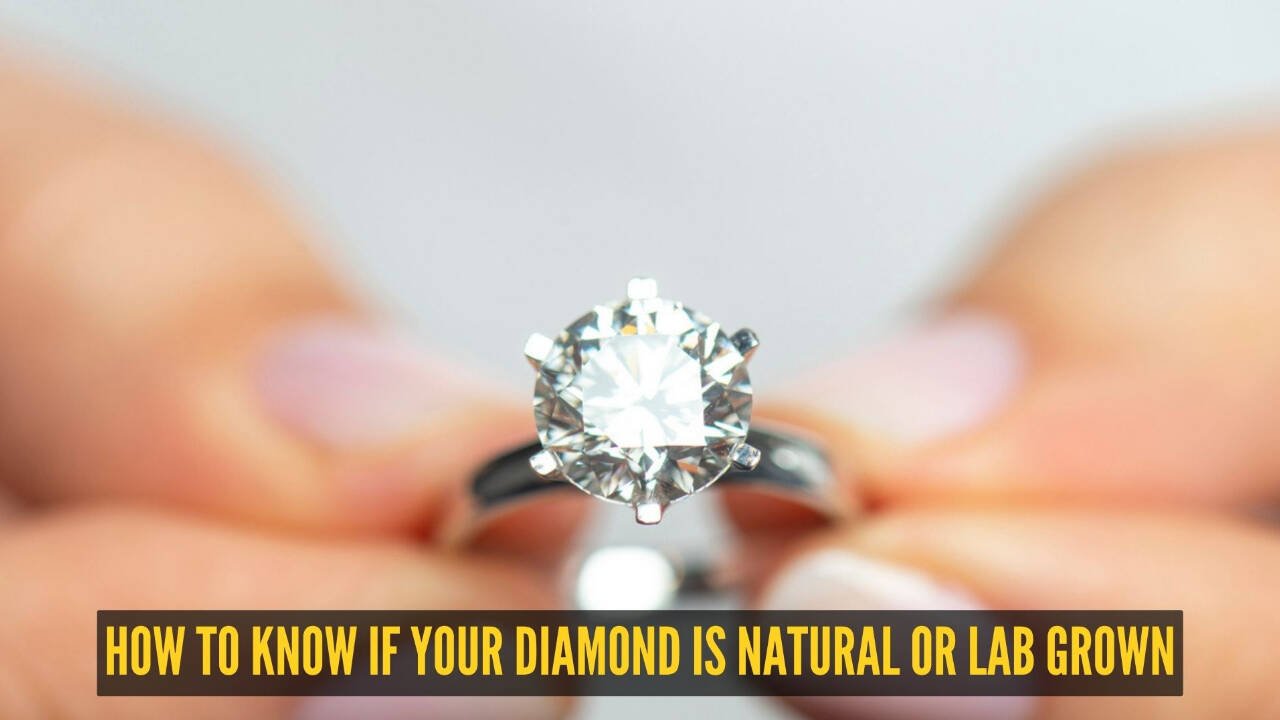
Someone has just given you a diamond.Maybe you knew it was coming. Maybe you didn’t. Perhaps it arrived in a little jewellery box on your birthday, or maybe it was handed to you on a day you never thought you’d remember for the rest of your life.Whatever the occasion, you probably did what most people do when they receive a diamond. You looked at it from every possible angle. You held it up to the light. You watched it sparkle.And then, perhaps later, a thought popped into your head.Is this a natural diamond or a lab-grown one?It’s not the sort of question everyone feels comfortable asking the person who gave them the jewellery. You don’t want to sound as though you’re questioning the gift. And you certainly don’t want the other person to think you’re trying to figure out how much it cost.But being curious about your diamond is completely normal.After all, diamonds aren’t everyday purchases for most of us. They’re expensive, they’re often tied to big moments in our lives, and they can carry enormous sentimental value. If you’re going to wear one for years, it’s understandable that you’d like to know a little more about it.The confusing part is that you probably won’t be able to work it out simply by looking at the stone.A natural diamond and a lab-grown diamond can look almost exactly the same to the naked eye.That’s because a lab-grown diamond isn’t a fake diamond.It’s a real diamond.The difference is where it came from.One formed naturally, deep beneath the Earth’s surface, over an extraordinarily long period of time. The other was grown by people in a laboratory using technology that recreates the conditions needed for diamonds to form.So, how do you know which one you’ve got?Well, there are a few things you can check.
First, go looking for the certificate
Before you do anything else, find the box your diamond came in.Have a look through the paperwork.If there’s a grading report from a recognised gemological laboratory, that’s probably the easiest place to start. A proper report will generally state whether the diamond is natural or laboratory-grown, along with details about its carat weight, colour, clarity and cut.If you have a report number, you may also be able to verify it through the laboratory’s online database.This is particularly helpful if the diamond was bought from a reputable jeweller.Of course, there is every chance the certificate has disappeared.Maybe it was put somewhere “safe” and is now impossible to find. Maybe the person who gifted you the jewellery never gave you the paperwork in the first place.It happens.Don’t worry. The diamond can still be checked.
There’s sometimes a tiny clue hiding on the diamond itself
This is one of those things most people never think about.Some diamonds have a microscopic laser inscription on their girdle. That’s the narrow edge around the diamond.You won’t normally be able to see it with your eyes. You’ll need a jeweller’s loupe or a microscope.The inscription can include the report number linked to the diamond’s grading certificate. Depending on the laboratory, it may also identify the stone as laboratory-grown.If you have the certificate, you can compare the number on it with what’s inscribed on the diamond.It’s a useful little check.But don’t worry if you can’t find anything. Not every diamond has a laser inscription, so the absence of one doesn’t automatically tell you that your stone is natural.If you can’t see anything, don’t start poking at the diamond with a pin or trying to magnify it with your phone camera. Just take it to someone who knows what they’re doing.
You probably can’t tell by looking at it
This is where things get a little disappointing.We’d all love to believe that natural diamonds have a special sparkle that lab-grown diamonds can’t replicate.But that’s not really how it works.A well-cut lab-grown diamond can be incredibly beautiful. So can a natural diamond.Both can be clear. Both can be colourless. Both can have that gorgeous flash of light that makes you turn your hand around just to look at the stone again.So, no, you probably can’t look at your ring and say with any certainty, “This is definitely natural.”Even a trained professional may need specialised equipment to confirm the diamond’s origin.There are clues, yes. But they’re often subtle, and they’re not necessarily visible to someone who isn’t trained to spot them.
What about those diamond testers?
You’ve probably seen one of those handheld diamond-testing devices.A jeweller touches the tip to the stone, waits for a beep, and tells you whether it’s a diamond.Sounds simple enough.But these testers don’t necessarily answer the question you have in mind.Many basic testers are designed to distinguish diamonds from diamond simulants. Think cubic zirconia, for example.They may measure properties such as thermal or electrical conductivity.The problem is that natural diamonds and lab-grown diamonds have many of the same physical properties.So the machine may tell you, quite correctly, that you have a diamond.But it might not tell you whether that diamond was formed naturally or grown in a laboratory.And that’s the distinction you’re actually trying to find out.
Please don’t try the internet’s “fog test”
If you’ve ever fallen down a late-night internet rabbit hole about diamonds, you’ve probably seen this one.Breathe on the stone.Watch the fog.If it disappears quickly, apparently you have a real diamond.Except that this doesn’t solve your particular mystery.The test is based on the fact that diamonds conduct heat very well. But both natural and lab-grown diamonds have similar thermal properties.So even if the fog test “works”, it doesn’t tell you whether your diamond is natural or lab-grown.The same goes for those scratch tests that tell you to drag your diamond across glass.Don’t.Seriously.If you’re wearing a piece of jewellery that’s precious to you, the last thing you need is to damage it because of a social media hack that wasn’t even going to give you the answer you wanted.
Can the price tell you?
It’s tempting to think so.Lab-grown diamonds are generally less expensive than natural diamonds of similar quality, so you might look at the price tag and make an educated guess.But jewellery isn’t quite that straightforward.The cost of a ring or necklace isn’t determined by the diamond alone.There’s the metal. The design. The craftsmanship. The brand. The retailer. Sometimes, you’re paying for a famous name as much as the stone itself.So, yes, the price may make you curious.But it can’t prove anything.A natural diamond in a simple setting could cost less than a large lab-grown diamond set into an elaborate designer piece.So don’t assume that an expensive gift must contain a natural diamond.And don’t assume that an affordable one must be lab-grown.
When in doubt, find a good jeweller
Honestly, this is probably the easiest answer for most people.Take the jewellery to a reputable jeweller or a qualified gemologist.They can examine the diamond properly, often under magnification, and look for clues about how it was formed.Natural diamonds can have tiny inclusions and internal characteristics that developed while they were forming deep underground.Lab-grown diamonds can have inclusions too, but they may have different patterns or characteristics.The method used to grow the diamond can also leave clues.Lab-grown diamonds are mainly produced using two methods: HPHT, or High Pressure High Temperature, and CVD, or Chemical Vapour Deposition.The two processes are different, and they can produce diamonds with characteristics that a trained specialist may be able to identify.This is where experience and equipment come into play.What looks like a tiny dot or mark to you might actually tell a gemologist something about the diamond’s history.
Want absolute certainty? Get it tested
Sometimes, you just want to know.Maybe it’s an expensive piece. Maybe it’s a family heirloom. Maybe you were told it was natural and want to verify that information.In that case, professional testing is your best option.A recognised gemological laboratory can examine the diamond using specialised equipment and determine whether it is natural or laboratory-grown.These tests can look at things that simply aren’t visible to the naked eye. The experts can examine growth patterns and other characteristics that reveal the diamond’s origin.It’s a much more reliable approach than trying to figure it out yourself at home.And if the diamond has significant financial or sentimental value, it may be worth doing.
One thing that’s worth remembering: lab-grown doesn’t mean fake
This is where diamond terminology can get confusing.A lab-grown diamond is a genuine diamond.It’s not the same as cubic zirconia.It’s not glass.It’s not a diamond imitation.It’s a diamond that was created in a laboratory rather than formed naturally beneath the Earth.That’s the difference.Some people prefer natural diamonds because they love the idea of owning something that took an incredibly long time to form. Others prefer lab-grown diamonds for a variety of reasons, including their price and the fact that they can be produced in a controlled environment.There isn’t one universal answer about which is “better”.
(A collection of lab grown diamonds)
It comes down to what matters to the person buying or wearing the diamond.
So, what should you do with that diamond you’ve been gifted?If you’re genuinely curious, start with the paperwork.Look for a grading report.Check the report number.See if there’s a laser inscription on the diamond that matches the certificate.If you don’t have any paperwork, take it to a reputable jeweller or gemologist.And if you need a definite answer, have the stone professionally tested.That’s it.You don’t need to breathe on it.You don’t need to scratch a window.And you definitely don’t need to trust a random TikTok video claiming that natural diamonds “feel different” when you hold them.But there’s one last thing worth saying.When someone gives you a diamond, the stone itself is only part of the story.Maybe your partner gave it to you because they wanted to ask you to spend your life with them.Maybe your parents bought it to mark a milestone.Maybe it belonged to someone in your family who wore it for decades before passing it down.Maybe someone saved for months to buy it, even though you had no idea they were doing it.Those are the things that make jewellery special.So, yes, find out what kind of diamond you have if knowing matters to you.It’s perfectly okay to be curious.But don’t let the answer change the meaning of the gift.Because a grading report can tell you whether your diamond is natural or lab-grown.A gemologist can tell you how it was created.But neither can tell you why someone chose that particular diamond for you.And really, that’s the part of the story you’ll probably remember long after you’ve forgotten everything else.


