



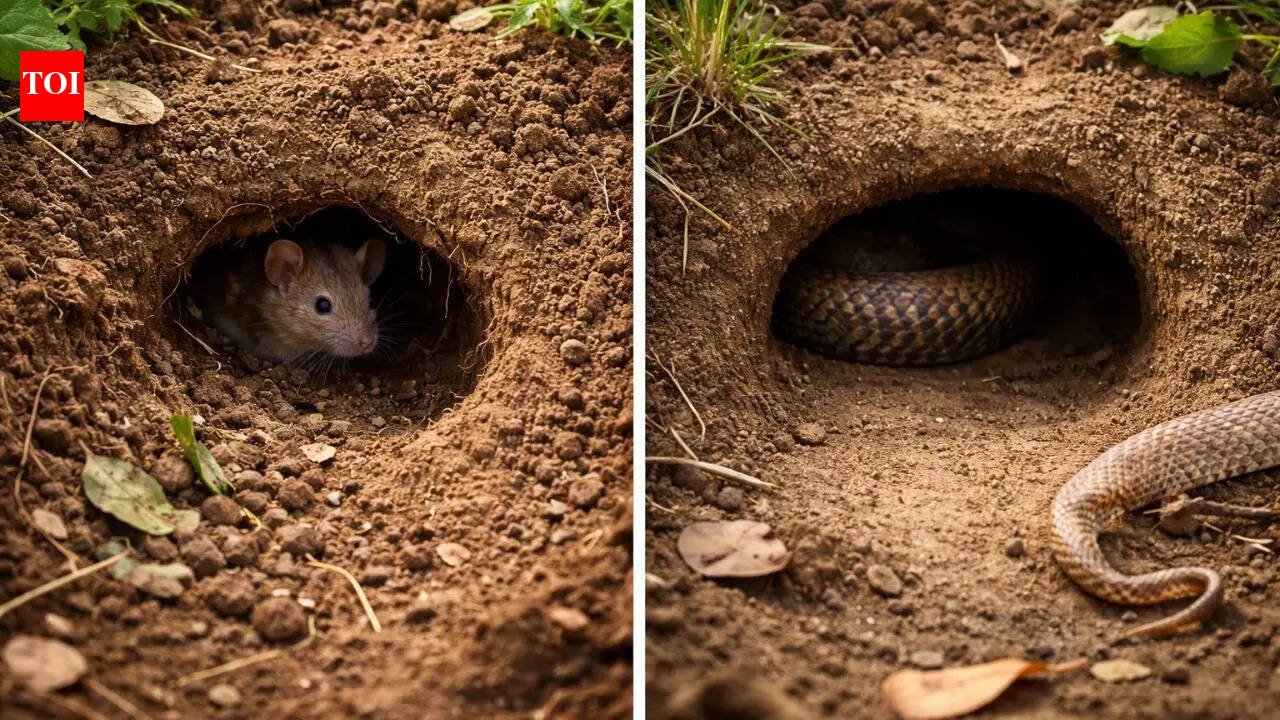
If you notice a hole in your garden, your mind may instantly think of what might be living in your backyard. Though it may seem like a trivial matter, knowing whether the hole in your garden belongs to a snake or a rodent can be vital information. At first glance, the holes made by snakes and rodents may look similar, but in reality, these two creatures dig their holes in totally different ways.There are also telltale signs that may point to what has made the hole in your garden. Instead of jumping to conclusions, knowing the differences between the two may prevent panic and guide you on what to do.
How snake holes and rodent holes are formed
The main difference lies in the creation of the holes. This is because rodents dig holes as part of a burrowing behaviour. This burrowing occurs through the use of their claws and teeth. This burrowing may be part of a larger tunnel network, which may be used for shelter, food, and movement.Snakes, on the other hand, do not dig holes. Instead, they use existing holes created by another animal. This implies that a “snake hole” may not be a hole created by a snake but one occupied by a snake.
Snake hole vs rodent hole: Size and appearance of the hole
PC: AI-Generated
Rodent holes tend to be wider compared to those of snakes. Rodent holes tend to be more irregular in shape. They tend to be two to three inches or more in diameter. The holes may appear rough around the edges. They may appear freshly dug.Snake holes tend to appear neater. Since snakes don’t dig, the holes appear undamaged. They tend to have neat holes with smooth edges.
Soil and surface clues around the hole
One of the simplest ways to identify the distinction between a rodent’s hole and a snake’s hole is to look at the surrounding area. Rodents tend to leave marks of digging. You may find loose soil, small hills of dirt, or dirt scattered around the rodent’s entry point. This indicates digging activity.On the other hand, a snake’s hole tends to have little to no loose soil. This is because a snake simply uses a pre-existing space.
Signs of activity nearby
Even if you cannot spot the creature, there are other signs which may reveal what creature uses the burrow. For example, if you are looking at a rodent burrow, you may be able to spot several holes, tunnels, or even a pathway in the ground. You may even spot damaged plants which have been chewed by a rodent. If you are looking at a snake burrow, you may spot shed skin, smooth tracks, or even droppings which have a dark colour with a white tip.
Why snakes use existing burrows
Snakes cannot dig complex burrows. Instead, they use existing burrows built by rodents or other animals. This gives them a haven from predators, a constant temperature, and a resting or hunting ground.It is therefore safe to say that holes occupied by snakes are always clean and unchanged. There is no digging, which makes them easily identifiable compared to rodent burrows.
When you should be cautious
It is not all the holes in your garden that may be a threat to your safety, but it is essential to be cautious. Some of the snakes that may be living in these holes may be venomous, depending on your geographical location.It is not recommended that you put your hand near or in the holes without first identifying the contents of the holes.
What these holes say about your garden
The existence of underground holes is often a sign that a small ecosystem is at work. Rodents are generally drawn to locations that are filled with food, soft earth, and shelter. They are then, in turn, likely to attract snakes, as they are their predators.This means that when you see one animal, you can account for the existence of another. Taking care of your garden environment is one way to control both rodent and snake activity.


