



Kolkata: There comes a moment, early in most IPL innings now, when the past feels very far away. It might come in the second over, when a length ball is nonchalantly muscled over extra cover. Or in the third, when a spinner is slog-swept. Usually, there would be nothing wrong with the delivery. Just that premeditative batting has taken on a completely new avatar. What used to be reconnaissance has become assault. What used to be patience is slowly slipping into the category of inefficiency.
For years, T20 batting’s most prized craft belonged to the anchor—that cog in the wheel who could absorb pressure, manage risk and bat deep. A 50 from 35 balls was once the gold standard of control. It held innings together, allowed attack to bloom at the end, and offered teams a sense of continuity in a format defined by volatility. That craft is not quite dead. In fact it has unmistakably evolved, albeit after being under siege for a while.
Since 2023, IPL has been rewired by a simple recalibration: the value of each ball has increased. Not in theory—T20 has always been about maximising deliveries—but in practice, in how teams are constructing innings and measuring success. Where top-order batters once operated comfortably in the 130–140 range, the modern baseline has moved closer to 160. The outliers have broken even further away. Abhishek Sharma started with strike rates of 200 and amazingly sustained that for nearly two years, breaking the myth that his sort of batting can’t thrive without a slice of luck.
Luck didn’t get him so far. There’s no denying that Abhishek, Ishan Kishan or Travis Head possess the skills and clarity of mind to sustain a tempo once reserved for cameos. It is tempting to see this as a generational shift, a matter of younger players being unencumbered by orthodoxy. But that would be too overarching to assume as long as batters like Shubman Gill keep faith in their ability to bat long and hard. The deeper change has been more structural, nudging the more veteran Indian batters to evolve.
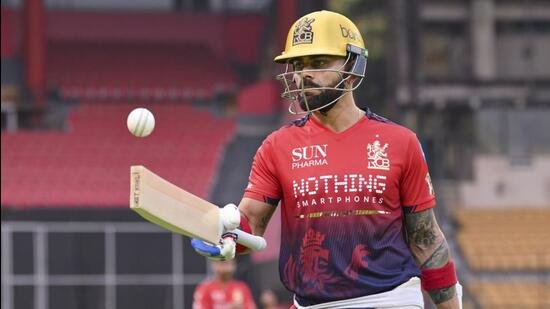
Consider the trajectory of Virat Kohli’s T20 batting. For much of his IPL career, Kohli was the classical anchor—technically immaculate, tactically patient, capable of pacing a chase with unnerving precision. His method was built on a steady sequence of tactical wins, minimising risk and expanding the range of shots once he was set. But the new way implored Kohli to adapt.
Which he did. His strike rate has climbed, his starts have become more aggressive. By any reasonable measure, Kohli still is among the league’s most productive batters. His scoring might still seem slow in absolute terms because the game around him has accelerated faster than his method could fully accommodate. The net change in Kohli’s acceleration is undeniable though. Between 2020 and 2022, his season strike rates were 121.35, 119.47 and 115.99. That suddenly surged to 139.82 in 2023, 154.70 in 2024 before settling on 144.71 last season.
Key here is the 2022 T20 World Cup, where a sobering 10-wicket defeat to England in the semi-final had challenged India’s top three—Kohli, Rohit Sharma and KL Rahul—to adapt or be left behind. The 2023 IPL, thus, emerged as a make-or-break season, especially for Kohli and Rohit.
If Kohli adapted, Rohit has, in many ways, moved farthest away from the anchor model. Where he once combined elegance with measured progression, Rohit has leaned decisively toward high-risk, high-reward shot selection from 2023. He attacks early and has embraced volatility. The results, therefore, have been uneven even though the strike rate has spiked from 120.18 in 2022 to 149.29 in 2025. There have been early dismissals that left the innings exposed, but also bursts of scoring that align perfectly with the modern game’s demands.
Between these two poles sits KL Rahul, perhaps the most contested figure in this debate. Rahul has long been one of the IPL’s most technically assured batters. His ability to anchor an innings once made him invaluable. But in the current environment, that same method has drawn scrutiny. Strike rates in the 120–130 range—once unremarkable—started to appear insufficient against the league’s escalating scoring benchmarks.
More stark is that strike rate of 113.22 in the 2023 IPL where everyone around him was throwing caution in the wind. But it was also probably because as designated No. 3 for that year’s ODI World Cup, Rahul opted to build rather than explode. His overall IPL strike rate nevertheless, rose to 149.72, signifying the shift in approach that even Rahul couldn’t ignore. Ultimately, the urge to preserve wickets for a late surge had been successfully replaced by the will to sustain a run rate above 10 for as long as possible. To that end, there was no way out but for the anchor to reshape his method.
Essentially, what is becoming obsolete is not the anchor itself, but a particular version of it: the accumulator who eschews risk, trades early restraint for late acceleration. By refusing to be pigeonholed, Kohli, Rohit and Rahul have stayed relevant by being markers of transition—players navigating a game that is changing quicker than any single method can comfortably contain.


