



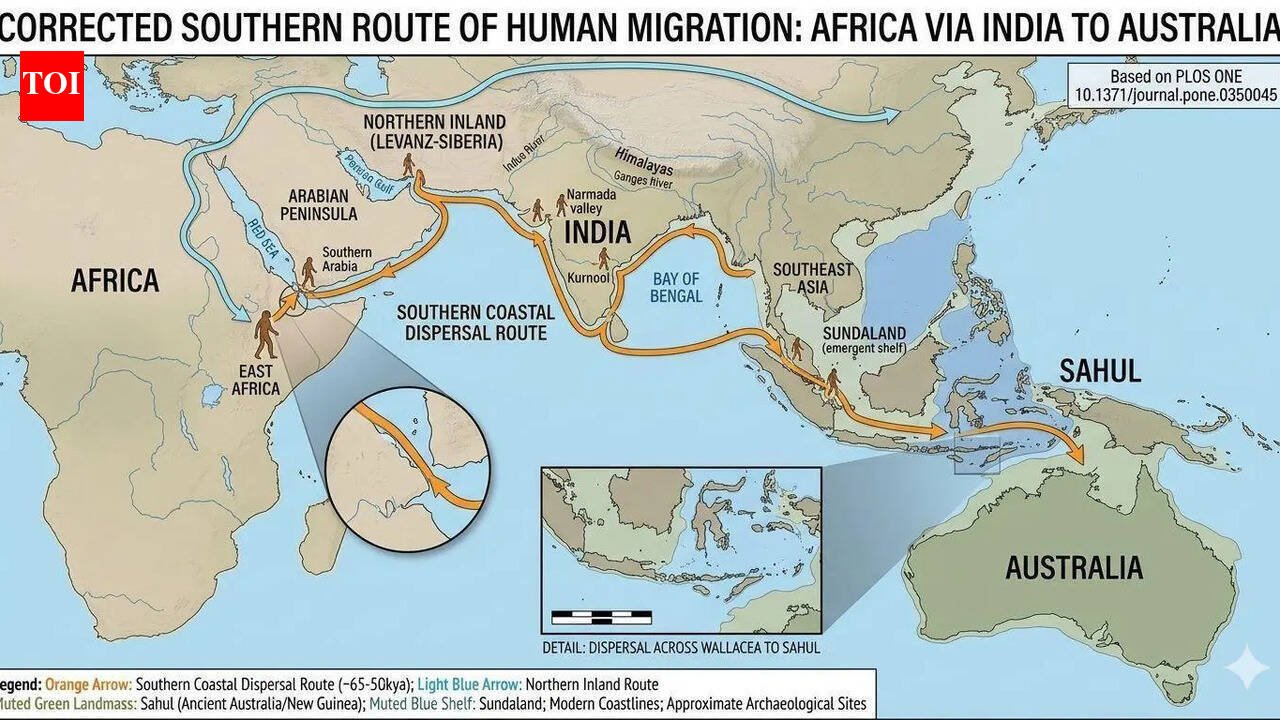
Prayagraj: Did modern humans use coastal routes to spread across the globe after migrating out of Africa? A new genetic study published in US journal PLOS ONE offers fresh evidence supporting this theory, identifying Sri Lanka as a crucial gateway in early human dispersal.This collaborative study conducted by 16 researchers from five global institutions, with prominent contributions from BHU (Banaras Hindu University), Birbal Sahni Institute of Palaeosciences, Lucknow, and the University of Colombo, involved an extensive DNA-based investigation into the ancestry of Sri Lanka’s three major communities: the Sinhalese, Sri Lankan Tamils and the Veddas, tracing their arrival in the country.For this, scientists utilised mitochondrial DNA that is transmitted exclusively from mother to child, allowing tracing of lineages spanning thousands of years.Lead author, Anjana Weikala from the Institute of Biochemistry, Molecular Biology and Biotechnology, University of Colombo, Sri Lanka, said 139 new genomes were sequenced and subsequently integrated with 247 datasets from around the world.Principal investigator and geneticist, Prof Gyaneshwer Chaubey of BHU, said scientists have long debated how humans, after migrating out of Africa, eventually reached Australia and Oceania. “Two potential pathways were hypothesised: an Inland Route (land path) and a Coastal Route (along the sea). The genetic data from Sri Lanka corroborates the Southern Coastal Route hypothesis. Approximately 57,000 years ago, a group of early humans migrating out of Africa travelled along the shores of the Indian Ocean to reach Sri Lanka. At that time, sea levels were significantly lower than they are today, resulting in the existence of a land bridge connecting India and Sri Lanka,” he said.He added that researchers have divided the history of human settlement in Sri Lanka into four major periods.The First Phase (57,000 years ago): This marks the time when modern humans first set foot on the South Asian subcontinent. Artifacts discovered in Sri Lanka’s Fa-Hien Lena and Batadomba Lena caves date back to this era.The Intermediate Phase: Following the Last Glacial Period, there was an influx of West Eurasian genes via India.The Historical Period (<7,000 years ago): During this time, the growth of agriculture and trade accelerated the exchange of populations between India and Sri Lanka.The Modern Era of Migration: The arrival of trading vessels and foreign invasions led to the emergence of new genetic admixtures.Senior author from Sri Lanka, Ruwandi Ranasinghe, said this research has also shed new light on Sri Lanka’s indigenous Vedda community.“The Vedda people are direct descendants of the Mesolithic hunter-gatherers who were the earliest inhabitants of Sri Lanka. Genetic data has revealed the presence of a founder effect within the Vedda community. Due to their isolation from the outside world for thousands of years, their DNA has preserved its ancient link. However, the size of their population has declined to a concerning level,” Ruwandi said.According to the study, the introduction of West Eurasian genes (such as Haplogroups U7 and H13) into Sri Lanka did not occur directly, but rather through India.The research has clarified that, despite their distinct languages and cultures, the Sinhala and Tamil populations share a largely identical genetic foundation.Both groups bear the profound genetic imprint of migrants who arrived from the Indian subcontinent. Deep genetic similarities have been observed between the DNA of both communities and that of South Indian populations.


