



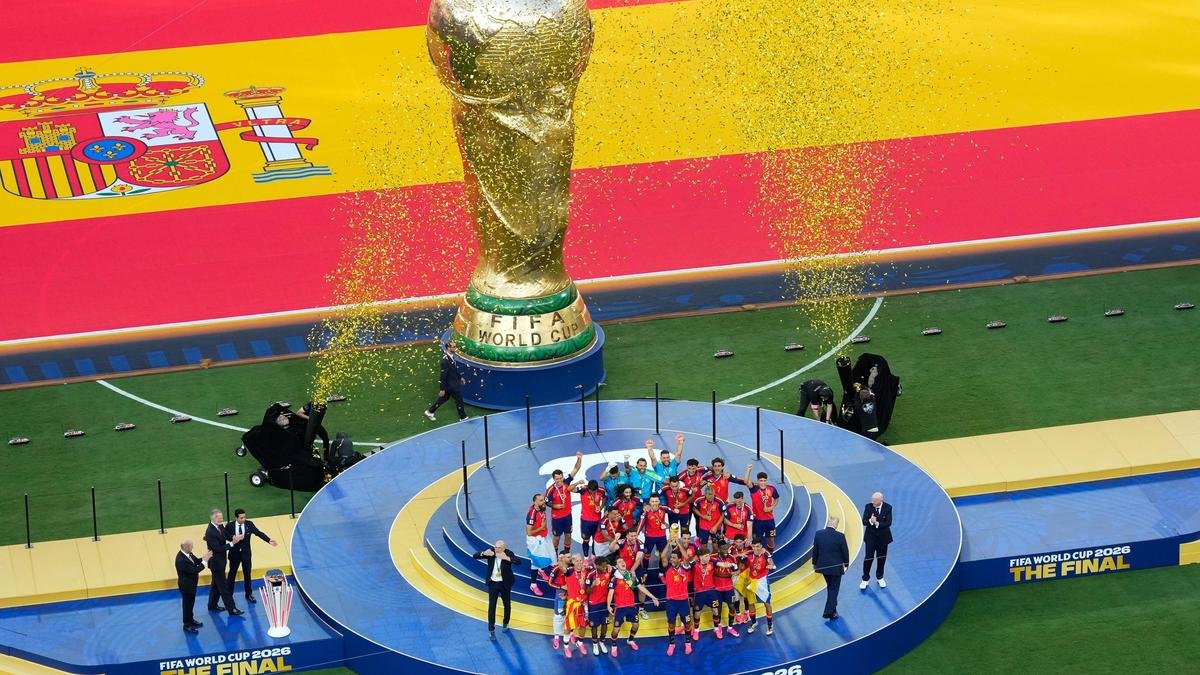
Spain players and coaches celebrate after the World Cup final soccer match between Spain and Argentina on July 19, 2026
| Photo Credit: YUKI IWAMURA
Spain’s win over Argentina in the 2026 FIFA World Cup final might have read a modest 1-0, but the scoreline hid what was in plain sight throughout. Spain smothered the Argentines, denying them the ball and disrupting any fluid move, so that the defending champions ended the full 120 minutes, including extra time with zero shots on target. How did it manage that against a team featuring Lionel Messi?
La Roja has prized possession as a mark of its identity ever since Luis Aragonés took charge in the mid-2000s followed by Vicente del Bosque building around midfielders such as Xavi, Iniesta and Xabi Alonso, and later Sergio Busquets. This style, termed “tiki-taka”, kept the ball as a way of denying it to the opposition and with it, the danger of any attack.
In 2026, Luis de la Fuente’s Spain built on that identity with a sharp second quality: counter-pressing — swarming the ball in compact packs the instant it is lost, to win it straight back. Spain was the tournament’s best at this, and the combination of slick passing and aggressive recovery let it concede just one goal in the whole competition.
In the final, Spain passed and pressed with gusto, denying the Albiceleste any meaningful sequence until deep into extra time. Two metrics capture that grip: possession share per period, and field tilt. Split into 15-minute phases, the game gave Argentina the majority of possession in only two (57% between half-time and the hour mark, and 52% in the second period of extra time). Spain controlled the other six.
Field tilt measures a team’s territorial dominance as its share of both teams’ possession in the final third — the third of the pitch nearest the opponent’s goal. It thus captures which side controlled the ball in the zones that most directly threaten the goal, rather than possession spread across the pitch.
By this measure Spain dominated every phase but one, and did so almost totally — 100% in three periods and above 90% in two more, with Argentina barely reaching the attacking third. The exception came in the second period of extra time, when Argentina, chasing an equaliser after Ferran Torres had put Spain ahead, posted a 95% field tilt.
But this was also after Enzo Fernández had been sent off in second-half stoppage time, leaving Argentina to play all of extra time a man down against a tiring Spain in late game. Spain’s stranglehold was marked throughout regulation as its 100% phases came in open, eleven-a-side play.
The charts show what Spain did. The question is how. Possession football rests on two things: technical command of the ball, evading tackles, passing precisely and positional awareness, with players drifting into space to offer passing lanes and wingers stretching the pitch alongside fullbacks and midfielders.
Spain has long selected for these qualities and drilled them over years, many of its players having come through de la Fuente’s youth sides.
Rodri, named the tournament’s best player with the Golden Ball, led the press with relentless running while distributing from deep. Pau Cubarsí, its Young Player winner, made line-breaking passes from defence and marshalled a high line that let Spain press through tight, compact spacing. At the other end there was little to do: where Emiliano Martínez made a final-record eleven saves for Argentina, Unai Simón’s role was reduced to sweeping behind a line that Argentina rarely breached.
For Messi, in what was surely his last World Cup, it made for a quiet farewell. His team was not merely beaten so much as suffocated.
Published – July 21, 2026 10:42 am IST


