


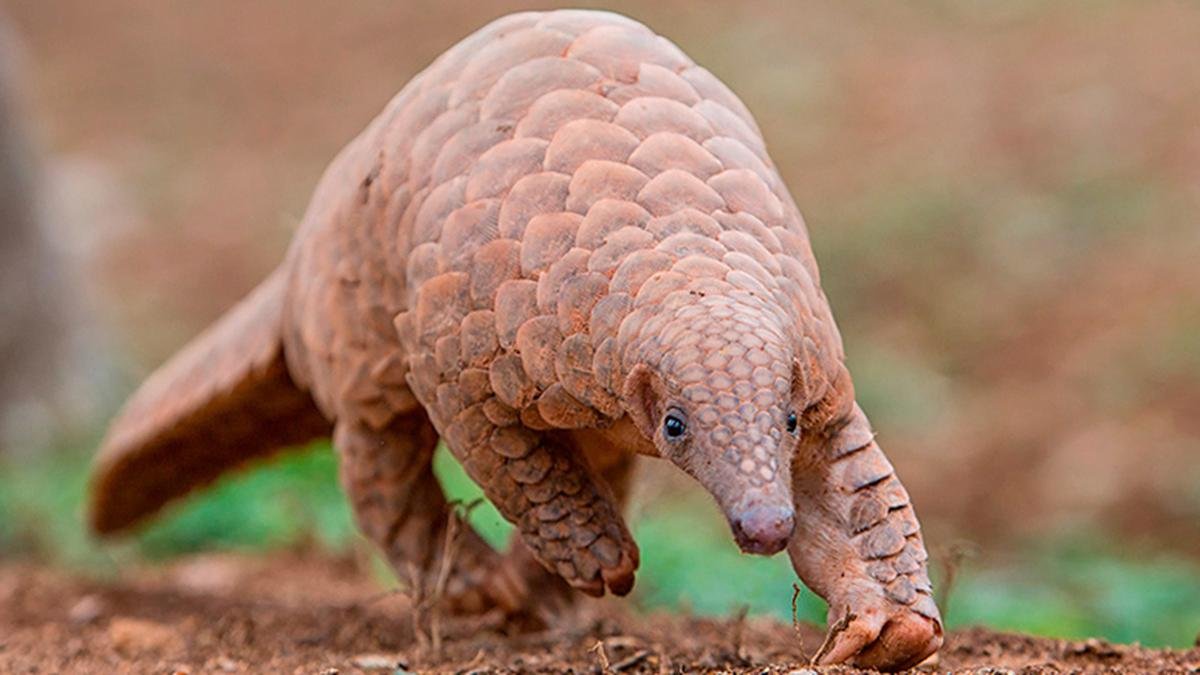
An endangered Indian pangolin at an unknown location in 2016.
| Photo Credit: Ajit Huilgol (CC BY)
Pangolins are one of the world’s most trafficked mammals even as their existence is threatened by shrinking habitats. So to protect them, conservationists are keen to know where they are being poached. The problem is that it is notoriously difficult to trace a bag of scales seized from a smuggler in an airport back to a specific location. The DNA in these materials is also often degraded and thus amenable for further analysis.
Now, a study published in PLoS Biology on May 7 by an international team of researchers has offered a breakthrough. The team was able to use advanced genetic sequencing to map the trafficking routes of the three most-traded pangolin species: the white-bellied, the Sunda, and the Chinese pangolins.
To overcome the low DNA quality in seized materials, the researchers used a new approach where they targeted just the 671 locations on the pangolin genome that differentiate between different populations. This way, they were able to use 122 museum specimens to plug large gaps in the geography of where wild pangolins are now too rare.
Then, together with hundreds of more recent samples, the researchers put together an unprecedented new database covering the major locations of all eight pangolin species. According to the team, this database is a “genetic map” that state agencies can use to pinpoint the origin of an individual trafficked pangolin with high accuracy.
Taking a step further, the researchers also revealed a complex relationship between local and international markets. Typically, experts have considered pangolin trafficking for local consumption and for ‘export’ to be independent problems — but the team’s data revealed otherwise. According to the paper, in domestic trade, pangolins are moved 454 km on average from the source. However, the places that ‘supply’ pangolins to local markets also often overlap with those ‘supplying’ international traffickers.
The team also identified three international trafficking hotspots: from southwestern Cameroon for white-bellied pangolins, from southwestern Borneo for Sunda pangolins, and around Myanmar for Chinese pangolins.
“To our knowledge, this is the first population genomics study jointly addressing the three most traded species of pangolins, whereas previous studies focused on the white-bellied pangolin, or partial ranges of Chinese and Sunda pangolins,” the team wrote in its paper. “Additionally, the geo-referenced DNA database presented in this study is unprecedented in sampling density and geographic scale, leading to detailed population genomic insights and informative domestic and international trade tracing estimates at a range-wide scale for each species.”
Per the data, traffickers also collect the scales of various nearby populations before shipping them worldwide, primarily to consumers in China and Vietnam.
“International seizures in China seem to have originated both from outside and within the country, with evidence of a network from northeastern India around Arunachal Pradesh and Assam (and possibly Bhutan) feeding Yunnan, while Yunnan was a potential source for Guangdong,” the researchers wrote.
The illegal wildlife trade is a multibillion-dollar transnational crime. But even though, just from 2015 to 2021, authorities around the world recorded more than 1.4 lakh seizures of various plant and animal species, they have lacked the evidence required to nip the trade at the source. The new “genetic map” may change that.
Published – May 19, 2026 07:45 am IST
