



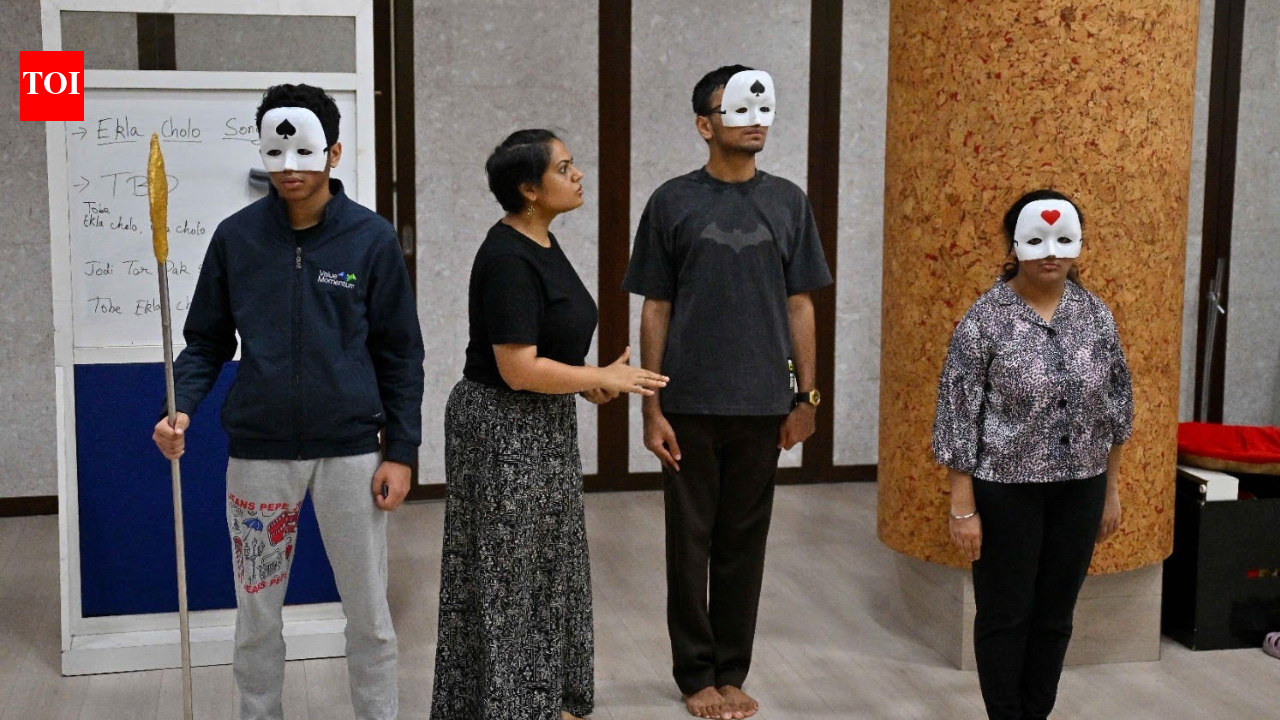
MUMBAI: On a Wednesday afternoon, 20 young people in a drama studio in Govandi are working on a performance unlike most the city has seen. Words come slow and deliberate—or in a sprint. Expressions resist easy reading. Lines find their own rhythm. And if the audience fails to read between the lines, the play’s theme says it plainly: diversity is dope. At the rehearsal of ‘The Land of Cards’ (Tasher Desh), the performers confess it’s also daunting.“I hope I pronounce the Bengali lyrics of Ekla Cholo Re correctly,” says Anvi Khandekar, 16, who plays the reformist prince in this Tagore classic. “Bengalis in the audience might be offended if I mispronounce the words. I worked hard with my drama teacher to get them right.”On July 5, the students of The Gateway Studio will stage their production of Tagore’s allegory on individuality and freedom at the children’s festival NMACC Bachpan, at the Nita Mukesh Ambani Cultural Centre — their first paid show at a major performing arts venue, and NMACC’s first production developed, produced and presented by young artistes with special needs.The Gateway Studio is part of The Gateway School of Mumbai, a special education school for children with disabilities. Seeded last October, the studio builds on the school’s own performing arts programme, which progresses from multisensory storytelling in lower school, to stage direction, script analysis, and physical theatre in middle school, and spatial awareness and teamwork in high school—with therapists working alongside performing arts teachers to help students develop coping strategies such as sensory and impulse control. For students with disabilities, theatre builds tools for navigating the world—communication, confidence, emotional regulation, the ability to read a room.For Farhan Dabhoiwala, it has been transformative. After graduating from Gateway, he earned a postgraduate diploma in acting and theatre-making from the Drama School Mumbai and now works as a paid intern at The Gateway Studio. “One needs to speak up and ask for work,” he says — which is precisely what the studio is designed to help its students do, by offering internships and building pathways into the industry. The larger goal, says vice-principal Abhishek Panchal, is to advocate for an inclusive theatre practice across the city. “We’re pushing for inclusion across the board from infrastructure and facilities to job opportunities on and off stage to building a market for inclusive theatre.”Inclusive theatre embraces diversity in its themes, formats, casts, crews and venues. It requires theatre-makers, managers and audiences to understand performers’ strengths and limitations—and adapt accordingly. It begins, says Aditi Dalal, with the script. “With Land of Cards, we adapted the script to a roughly 30-minute play, keeping lines short and language simple and used music and rhythm to help the actors memorise their lines,” says Dalal, Gateway’s high school drama teacher. At the rehearsal, she urges students not to shout but use their “big and heavy card voice”. Instructions are repeated, simplified and serialised. “Remove (your mask); (say your) Line; Throw (down your mask)” instructs Dalal, during a scene.Stage directions are reinforced with visual and auditory cues. “On a recce to NMACC last week, we measured the stage, entries and exits, and mapped the backstage area, then replicated the layout in our own studio to give performers a sense of familiarity,” says performing arts coordinator Darshana Patwa. Taped colour-coded Xs on the floor guide those who find it difficult to read spatial information, particularly individuals who experience challenges with spatial orientation, motor planning, or left-right discrimination. At the venue, a prompter will sit in the front row to support the performers on stage using hand gestures, facial expressions, and other visual cues. Lapel mics will support those who struggle to project. Butter paper will soften harsh stage lights. “An actor who found the lights too harsh wore sunglasses on stage,” says Panchal, to illustrate what adapting looks like.Theatre spaces themselves need to adapt, notes director Quasar Thakore-Padamsee. “They should extend the same infrastructural modifications backstage and on stage as some do for the audience.” Broader wings and larger greenrooms, not only to accommodate the cast and crew, but a support team of therapists and facilitators. Last year, co-directing Literature Live, he invited Gateway to stage Tagore’s Dakghar at the NCPA, only to find that neither the Experimental Theatre nor the Little Theatre had wings broad enough for the wheelchair-using members of the cast. “Eventually, we decided to use Godrej Dance Theatre,” he says.Infrastructure is only part of the challenge. Inclusive theatre can only thrive when audiences understand and demand it. “Kids may forget their lines; they may make funny actions. Support them by not laughing, we tell the audience,” says Panchal. At a school show, they took the message so thoroughly to heart that they remained stoic even during the funny bits.Inclusive theatre is making a tentative inroad into Mumbai’s performing arts scene, but Thakore-Padamsee is optimistic about where it leads. “A new form is emerging. We’re trying to get mixed-ability kids to make a regular piece. But soon some of those kids will say, ‘Hey, I want to do something different’ — and create stories for an audience that doesn’t see the world like everyone else.”


