



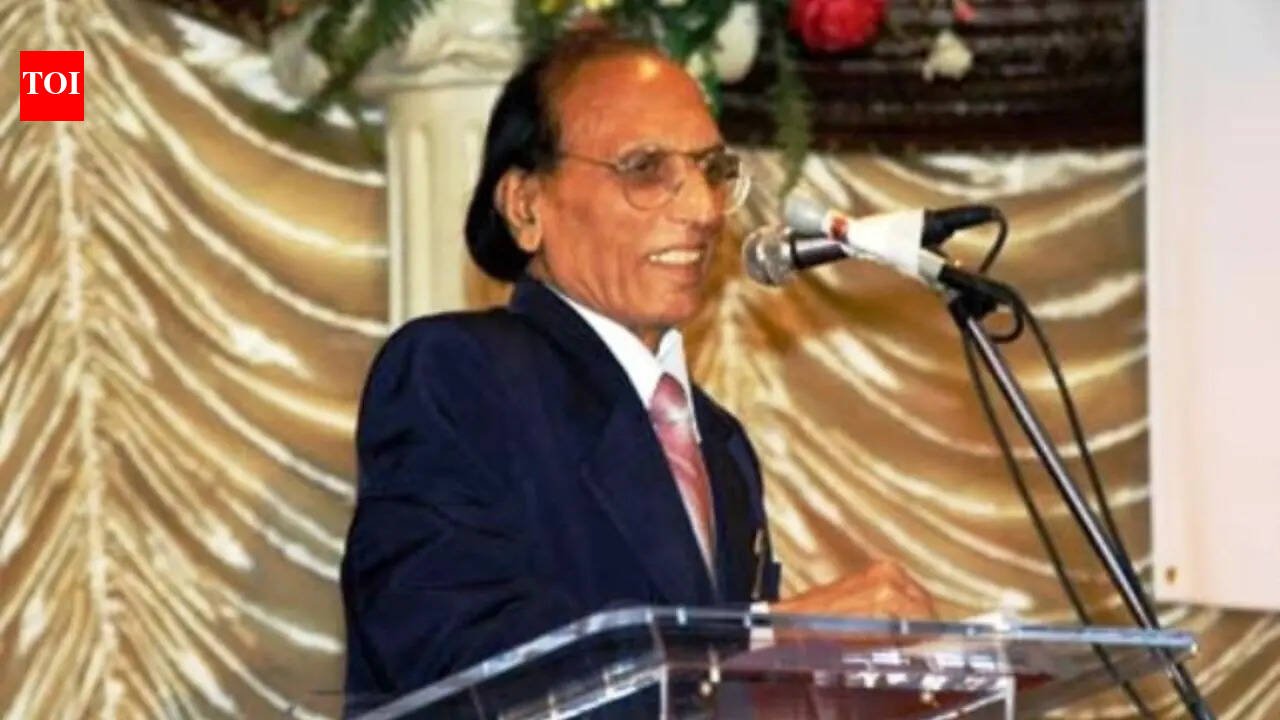
LUCKNOW: Long before his couplets became staples at mushairas across the country and earned admirers for him far beyond Urdu poetry circles, Lucknow became the unexpected launch pad for poet Bashir Badr who breathed his last in Bhopal on Thursday. That stroke of luck came from a chance invitation to a coveted radio mushaira organised by the All-India Radio station of Lucknow.Recalling the times, his contemporary Waseem Barelvi told TOI that Badr was a gifted poet with a body of published work in magazines but somehow, he could not make it to the stage.Committed to bring new talent to Mushairas, Barelvi recommended Badr to two programmes, first in Meerut and then in Bareilly, but they failed to create the desired ripples of triumph and success.Sometime in the 1970s, Barelvi was invited to the AIR Lucknow programme ‘Kalam-e-Shair ba-Zuban-e-Shair’, produced by Shahab Sarmadi. Around the same time, he learnt he had been selected for the broadcaster’s hugely popular radio mushaira, then considered the highest honour for an Urdu poet.“Nobel Prize ke barabar hua karta tha,” Barelvi said with a laugh. Excited but thinking of Badr, he urged the producer to invite one more poet. The request was accepted. That poet was Bashir Badr. The appearance transformed his fortunes. And there was no looking back for Badr thereafter.Interestingly one of Badr’s popular sher “Ujale Apni yadon ke hamare saath rahne do… na jaane kis gali mein zindagi ki shaam ho jaaye…” opens a popular programme even today.Mourning the demise of his friend of 40-odd years, Barelvi said: “he was a great soul immersed in love and light. But the simplicity of his craft was greater and helped in taking Urdu poetry to common walks of life.”Former chief secretary UP and poet Anis Ansari, who was Badr’s contemporary at Aligarh Muslim University in the 1960s, dittoed.“One of his poems was already a part of the MA Urdu syllabus when he joined the course,” he said adding, “a great body of Badr’s work forms the foundation of modern Urdu poetry that conveyed emotions without sounding like jargon (unlike the previously Arabic and Persian dominated works).”Pervez Malikzada, close family fin and son of noted poet Malikzada Manzoor Ahmad, said that death set him free. “Ten years ago, when my father died… I telephoned his wife who broke the news to him. But he could not remember his friend. At times, he didn’t even recognise his own family members. However, his contribution to contemporary urdu poetry and writing will remain etched in stone,” he said.Fromer head, Urdu, Khwaja Moinuddin Chishti Language University, Prof Fakhre Alam, remembered him for his simplicity. “I met him in several mushairas… but despite being so accomplished, he never had any airs. His demeanour was always warm and respectful,” he said adding, “but his talent was as high as the sky.. I remember when Zulfikar Ali Bhutto came to India … he quoted his sher dushmani jam kar karo lekin ye gunjaish rahe… jab kabhi ham dost ho jaayen to sharminda na hon.”Poet, Prof Nayyar Jalalpuri, who made his stage debut at a Mushaira in city chaired by Badr, recalled: “he read a couplet in response to my presentation… his fatherly embrace is my cherished memory… While many of his Ghazals are echoing at the back of my mind, I am numbed by the cruel irony of life that he went through…. A person full of emotions and words was eventually betrayed by his own brain (due to Dementia that grew into Alzheimer’s Disease).”Ajay Jain, another poet from the city, said that aspiring poets have a lot to learn from Badr. “Love, longing and loneliness are very deep emotions which were expressed with extreme simplicity by him… In fact, my biggest learning from his work is that one doesn’t need flowery language or heavy words to touch the heart,” he said.Admirers have their reasons for loving Badr. “His work is full of life lessons… Parakhna Mat… Parakhne se koi apna nahi rehta… is a talisman for strength of relationships,” said poet and IAS Hari Om.Culture enthusiast Jayant Krishna who once hosted Badr said: “he was simplicity personified… Unlike many achievers who have their protocols and expectations, he came in a public auto to my place and we all had an evening full of Lakhnavi food and his shayari.”Connoisseur of urdu poetry and faculty at King George’s Medical University Prof Kauser Usman said: “I will always remember him as a person who rose against the odds with sheer grit… Ham bhi dariya hain… hamein apne hunar maloom hai… jis taraf bhi chal padenge rasta mil jayega can compel any broken heart to gather oneself and start all over again.”Popular host and bookstore owner Manav Prakash vouched for Badr’s popularity among millennials if not Gen-Z. “He is one of our best-selling writers… but to me he will always remain a poet who saw the big picture of life,” he said quoting Badr’s sher, “musafir hain ham bhi; musafir ho tum bhi; kisi mod par phir mulaqat hogi.”


