



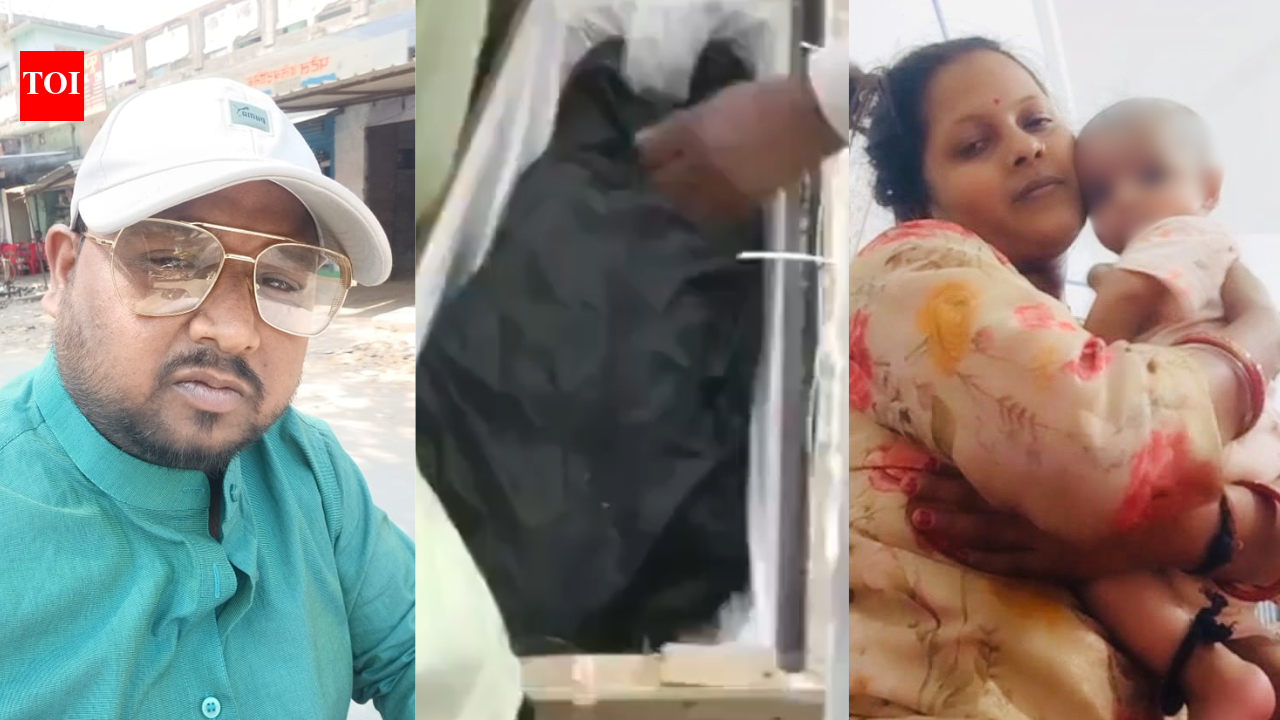
LUCKNOW: Tears, unanswered questions and the daunting responsibility of raising a six-month-old baby alone now define the life of Ranjana Chauhan, the widow of Indian seafarer Rakesh Chauhan. Sitting beside her husband’s framed photograph at her maternal home in Sadarpur village of Gorakhpur’s Chauri Chaura area, she says she has received neither concrete support from Xfinity, the company that recruited her husband for overseas deployment, nor any financial assistance after his death. Her only demand, she says, is justice.“I want justice. I want to know how my husband died and how his organs went missing from his body,” said Ranjana while speaking to TOI. “I have a six-month-old (Ritwik) child to care for. My husband was the sole breadwinner of our family. The shipping company has not provided any real help or financial aid.”Married to Rakesh in an arranged marriage four years ago, Ranjana recently completed her graduation. Following her husband’s death, she has begun searching for employment to support herself, her infant son and the family.The mysterious death of 33-year-old Rakesh Chauhan, a merchant navy seafarer from Deoria district, came to light on Tuesday when Forward Seamen’s Union of India (FSUI)—an organisation representing seafarers posted questions on X account, after a post mortem conducted in Deoria on June 5, found that almost all of Rakesh’s major internal organs were missing.Rakesh had been working in the shipping industry for the past six years. In November last year, he joined a vessel bound for Venezuela as a marine fitter, a skilled tradesperson responsible for assembling, installing, maintaining and repairing mechanical equipment onboard ships.“Rakesh was working as a marine fitter aboard a vessel in Venezuela and died in May this year under what the company described as an accident. However, they never shared any accident investigation report or the autopsy report conducted in the foreign country,” alleged Ramdev Chauhan, Rakesh’s father.According to the Federation of Seafarers’ Unions of India (FSUI), Rakesh’s body was repatriated to India without any autopsy report or a detailed explanation from Venezuelan authorities regarding the circumstances of his death. The family subsequently requested a second post mortem in Deoria.The postmortem report revealed that the brain, heart, both lungs, liver, kidneys, spleen, pancreas, stomach, intestines, thyroid, larynx and trachea were absent. Doctors also reportedly found extensive surgical stitching running from the neck to the pubic region and another incision extending from one ear to the other. With all major internal organs missing, the report stated that the exact cause of death could not be determined.“The shipping company had informed us on May 7 evening that Rakesh had suffered serious injuries after falling onboard the ship. We were told that his chances of survival were only five percent. Few hours later, we were informed about his death, with the company claiming that he had suffered a heart attack during treatment,” added Ramdev while speaking to TOI.Manoj Yadav, general secretary of the FSUI, described the case as deeply disturbing and demanded a comprehensive investigation into the circumstances surrounding Chauhan’s death.The union has urged Venezuelan authorities to conduct a transparent inquiry, establish accountability and release the complete autopsy records. It has also sought immediate intervention by the Indian Embassy in Venezuela and demanded adequate compensation for the bereaved family.Post mortem finds cause of death inconclusive due to missing vital organsThe post mortem examination (copy with TOI) found that Rakesh Chauhan’s body had already undergone extensive surgical dissection before the examination.Long stitched incisions extended from the neck to the pubic region and across the back of the head, suggesting a previous autopsy or organ retrieval procedure.The body showed bluish discoloration and had been preserved in a deep freezer.Doctors reported no visible ante mortem external injuries. However, the internal examination could not be completed because almost all major organs were absent. The report specifically revealed that the brain, heart, both lungs, liver, kidneys, spleen, pancreas, stomach, intestines, thyroid, larynx, trachea, and major blood vessels were missing.In addition, the skull, sternum, and several neck structures were absent. Owing to the absence of these vital organs, the examining doctors concluded that the cause of death could not be determined and were also unable to establish whether the death occurred due to ante mortem or postmortem events.


