



Conservation of water commons: The Nature School
For Seeratul Nisa, wetlands are more than just water bodies they are ecosystems worth protecting. A recent Environmental Science Graduate, Seerat hopes to pursue further studies with a focus on wetlands and migratory birds.
Her journey with conservation began through The Nature School, founded in 2019 by environmental lawyer Nadeem Qadri. Working with the Wildlife Conservation Fund (WCF), wildlife guards and communities living around Pampore’s wetlands, Seerat and other students have been actively involved in efforts to conserve Chatlam and Fashkoori wetlands.
“We go door-to-door and talk to people about why these wetlands are important, how they can be protected and why their conservation matters to all of us. Wetlands act like sponges and help control floods, but they also support our everyday lives. If the water remains clean, it can be used for kitchen gardens, paddy fields and even for domestic animals,” she says.
The Nature School is open to students, professionals, educators and anyone interested in nature and conservation. We keep it open on Sundays as a space for learning, interaction and sharing knowledge about nature. There is no fee; it is completely free and open to everyone.
Pampore’s wetlands also provide a safe winter refuge for migratory birds. From around October 15 until the end of March, more than one lakh migratory birds arrive in the wetlands, with over 60 species recorded every year,” Seerat said. “ During this period, poaching is banned and fishing is prohibited to ensure the birds remain undisturbed. For me, the most important thing is that these birds feel safe here. That safety has a lot to do with the awareness created among the communities,”
For Alima Hameed, a Class 8 student, learning about wetlands has changed the way she looks at the places around her.
“At the Nature School, we are taught why wetlands are important and how we can protect them. We also go on visits to the wetlands, where we learn what we should and should not do like not throwing garbage and taking care of the surroundings.
“We learn deeply about wetlands and why they matter. Then we share what we learn with our friends and families, and they also become aware of the need to protect these places. It becomes a chain of information one person tells another, and slowly, it creates a huge impact.”
“Hameeda” (name changed), 55, a mother of three daughters who lives close to the wetlands, says the waterbody is deeply woven into the lives of people in Pampore. “We love our wetlands; they are a part of who we are,” she said. “People here understand how important these wetlands are. We make sure not to throw waste into them, and we teach our children and remind our relatives to treat the wetlands with the same care and respect.”
She also credits The Nature School, for strengthening this sense of responsibility among the community. Through door-to-door awareness campaigns and field visits that bring students closer to the wetlands.
Catalyst of Conservation
“We are a volunteer-based organisation with around 5,000 volunteers and a core team of nearly 25 members across Jammu, Kashmir and Ladakh,”Nadeem Ahmed Dar , Executive Director, Jammu & Kashmir Eco-Watch said. “We train and empower volunteers to lead conservation efforts in their own communities. Our work focuses on clean-up drives, plantation and awareness programmes, particularly engaging youth and students on climate change and sustainability.”
“Recently, we have also removed significant amounts of legacy waste from these wetlands to help ensure that they continue to thrive, sustain themselves and support the wider ecosystem. While our core team has around 25 members, the super core team consists of nearly 10 members who work selflessly and tirelessly to conserve these critical ecological systems. We act as catalysts by sharing information and creating awareness about the importance of these critical ecological systems, and the diverse roles they play in our society and environment from supporting livelihoods and the local economy to regulating the microclimate. In the end, these ecosystems are directly connected to our everyday lives,” Nadeem said.
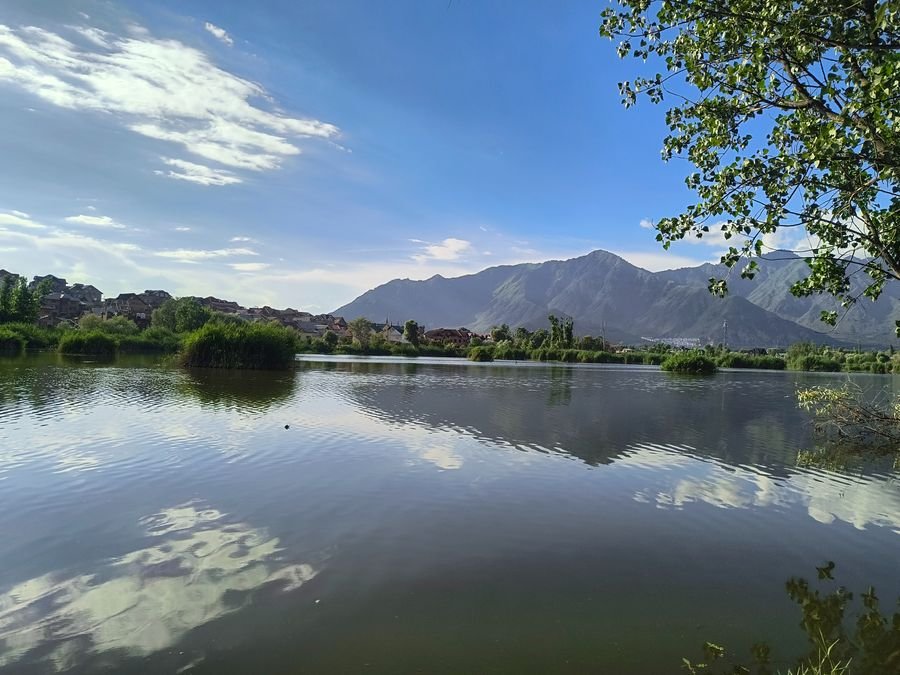
Kashmir Valley is known around the world for its serene wetlands. Among the hundreds of wetlands found across the valley, four are located in Pampore. These include Chatlam Wetland Reserve (CWR), Fashkoori Wetland Reserve (FWR), Manibugh Wetland Reserve (MWR), and Krenchoo Wetland Reserve (KWR). Located 16 kilometres South of Srinagar City, Chatlam Wetland Reserve is the largest of these wetlands. Also known as BODSAR or Lalpora Wetland, it has a basin area of 2.1 square kilometres. The wetland is rich in biodiversity and provides a habitat for hundreds of animal and plant species.
According to the study “Wetlands of Pampore, Kashmir Himalaya and Their Conservation,” published in the World Wetlands Day 2021 Proceedings, reveals Pampore’s wetlands are experiencing cultural eutrophication due to excess nitrogen and phosphorus. The study identifies untreated sewage, solid waste, agricultural fertilizers, silt deposition and climatic factors as major contributors to the deterioration of water quality.
Present Situation
“The wetlands of Pampore are currently in good condition, with no major encroachments or significant pollution. However, the challenges facing these wetlands are increasing with each passing year,”Nadeem Ahmed Dar said. “Pampore’s wetlands are distinct from other major wetlands in Kashmir. Unlike Hokersar, Shallabugh and Wular, which are hydrologically connected to and fed by the Jhelum, the Pampore wetlands form a separate wetland system and are not dependent on Jhelum waters. Instead, they contribute water to the Jhelum. Their relatively good water quality further adds to their ecological significance, making them a unique part of Kashmir’s wetland landscape.
The Transformation of Fashkhoori Wetland
Fashkoori is a small wetland of around 300 kanals, supporting different kinds of aquatic life. Different species of birds used to come and breed here, and every year Pampore alone receives more than one lakh migratory birds during the winter season. This is what makes Fashkoori and the other wetlands different. Their water levels are now optimum and the water quality is good.
“Basically, we have four wetlands in Pampore, and among them, Fashkoori was in a very shabby and notorious condition. The water levels were very unsatisfactory, the water quality was poor, and there was maximum pollution, with grey water entering the wetland and affecting its ecosystem and aquatic life,” Nadeem added.
“Fashkoori Wetland was earlier managed by the Department of Fisheries . In 2013, there was a handover and takeover, after which it came under the Department of Wildlife Protection, J&K,” Nadeem said. “But without the support of local partners, such as NGOs and NPOs, conservation would not have been possible. One such organisation is the Wildlife Conservation Fund, which, since the early 2000s, has been working to conserve these wetlands”.
“The organisation is led by Environmental lawyer Nadeem Qadri, who has tried every possible good practice to involve communities in the conservation of the wetland. He first started interacting with local communities and tried to make them aware of why this wetland could be a game changer for the identity of Pampore,” he added.
Pampore Wetlands : A Second Home For Migratory Birds
“Living in Pampore, I have watched these birds from my own window; the arrival of migratory birds, their movement across the wetlands and their return year after year. Over the years, I have recorded over 143 bird species in the Pampore Wetlands and prepared a checklist with their English, Kashmiri and scientific names,” Parvaiz Yousuf, Phd Student at James Cook University Australia, also served as Director for Wetland Research Centre said. “Migratory birds are particularly important. Species such as the Ruddy shelduck, Pheasant – tailed jacana, Greylag Goose, Greater White-fronted Goose and Bar-headed Goose have been observed here. The Bar-headed Goose, which is very common in Jammu but rare in Kashmir, was recorded for the first time in Kashmir at Chatlam Wetland Reserve on December 5, 2019.”
“All the birds found in Hokersar Wetlands are also found in Pampore Wetlands, and the majority of wetland birds documented in my book “Birds of Jammu and Kashmir including Ladakh,” are also present here. Birds are very important for the ecosystem and ecological balance, particularly in nutrient cycling. They are also important for ecotourism, as many people come to Kashmir to see and observe birds,” he added.
Parvaiz further said that , “The biggest threat to wetlands is habitat destruction. If wetlands are encroached upon and there is no habitat, there will be no birds. Land encroachment may have occurred more in the past when there was less attention towards wetland conservation, but I do not think it is at the same level now because there is greater protection and awareness among the commons.
Government’s Support
“Our main focus is habitat management. This includes removing unwanted weeds and vegetation and creating water pools in areas where vegetation and grass are excessive. These pools provide adequate water for migratory birds that arrive during the winter season, John Mohammad Mir, Block Officer, Pampore Wetlands,” said. “Wherever necessary, we also carry out desilting work to improve the condition of the wetlands. The embankments and bunds are repaired every year to regulate the inflow and outflow of water.
“We collect water samples from all four wetlands every month through the Pollution Control Board and monitor their condition regularly. Keeping a close watch on water quality is very important for maintaining the health of these wetlands.“Protection is another major responsibility. Our field staff patrol the wetlands around the clock to prevent illegal activities such as poaching of migratory birds and encroachment. Whenever we detect a violation, we report and take action under the relevant provisions of the Wildlife Act.” He added.
“At Fashkoori Wetland, we regularly conduct solid-waste clean-up drives in collaboration with local schools, GDC Pampore and WCF. However, a major challenge remains the inflow of sewage and grey water through drainage channels. We have taken up the issue with the Municipal Committee Pampore, and an STP is proposed to address the problem in the near future.” Mir said.
(The author is a recipient of the Promise of Commons Fellowship 2026, on the significance of Commons and its community stewardship)


