



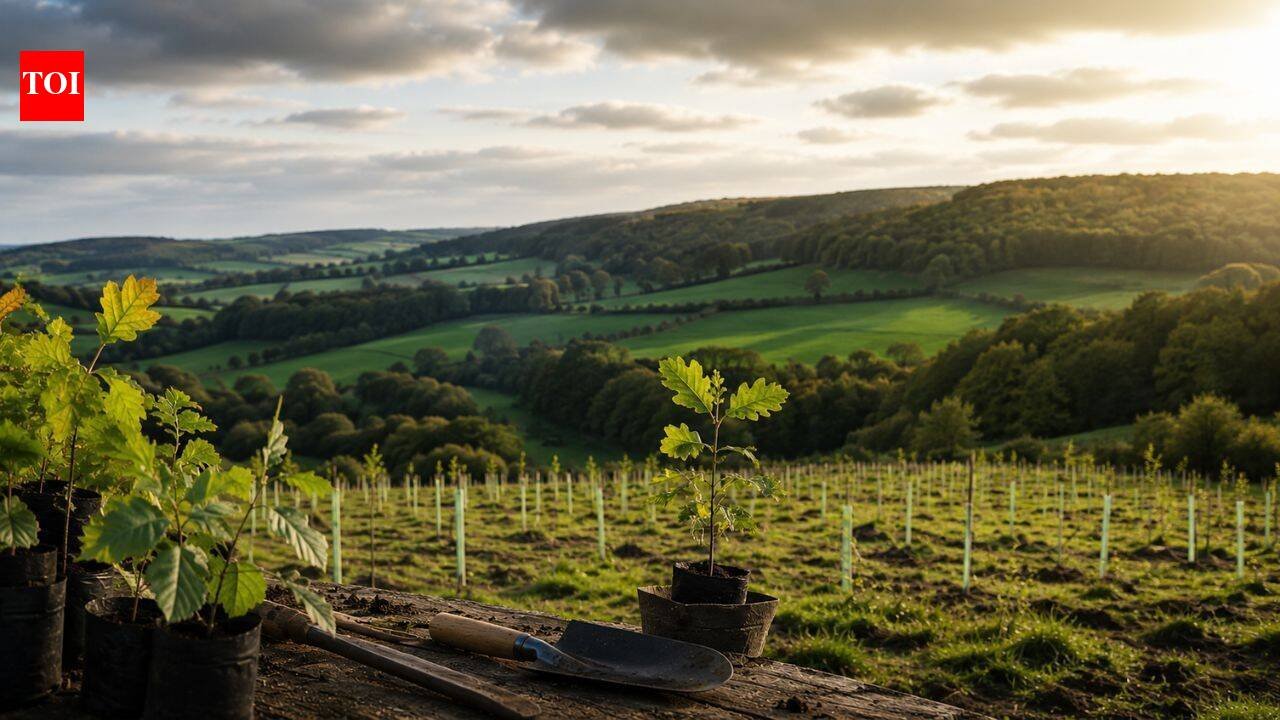
In 1996, British publisher Felix Dennis planted a small wood near his home in Dorsington, Warwickshire, without any idea that it would grow into one of the largest privately planted forests in England. What started as a personal project soon turned into something far bigger. Dennis wanted to bring native broadleaf trees back to a landscape that had lost most of its woodland cover, and that first patch of ground became the seed of the Heart of England Forest.By 2003, the ambition had outgrown a single landowner’s efforts, and the Heart of England Forest charity was formally established to carry the project forward. The plan was simple in principle but vast in scale: buy up land across South Warwickshire, stretching from the old borders of the Forest of Arden down to the Vale of Evesham, and plant it with native trees such as oak, ash and birch.
How the Heart of England Forest is growing through land purchases and woodland restoration
Dennis told The Guardian he was hoping that long after his death, the charity would one day possess “25,000 acres of woodland planted with 10 million native broadleafed trees, completely open to the public.” That bequest has helped the charity continue purchasing and planting land even after its founder’s death, including the acquisition of existing woodland such as Coughton Park Wood, where conifer plantations are gradually being converted to native broadleaf woodland.The forest today reflects the layered ambition Dennis described back in 2013: not just a timber plantation, but a public space intended for walking, wildlife watching and woodland crafts, built one sapling at a time from a single wood he planted near his own home nearly three decades ago. The charity continues to track its progress each year, with land purchases and planting rates reported as part of its ongoing impact updates.
The 2013 milestone that transformed the Heart of England Forest
The project reached a significant milestone in September 2013, when its millionth tree, an oak sapling, was planted at a ceremony attended by hundreds of residents, council members and forestry officials. By that point, the charity had purchased 2,500 acres of land and was planting at a rate of roughly 300 acres a year, a pace that had already made it the world’s largest privately planted forest.Dennis, who had been diagnosed with throat cancer the previous year, spoke about the scale of his ambition for the project. He said he hoped that long after his death, the charity he founded would eventually possess 25,000 acres of woodland planted with 10 million native broadleaf trees, entirely open to the public. At the ceremony, Dennis read from one of his own poems, reflecting on how planting a tree can be a way of leaving something behind after death.
Why Felix Dennis believed England needed more native woodlands
Dennis was blunt about why he believed the work was necessary. He pointed out that Britain had fallen far behind its European neighbours when it came to native tree cover, noting that France, Germany and Italy had roughly a quarter of their land under native high forest, while parts of England struggled to reach even 1.5%. In his words, Britain was so far down the league table that it was barely visible on the chart.That sense of urgency shaped how the forest was designed. Rather than planting a single block of woodland, the charity aimed to create a connected network of woods across South Warwickshire, offering wildlife corridors as well as space for people to walk and enjoy the countryside. Species planted included English oak, ash, sessile oak, small-leaved lime, field maple, cherry, hornbeam, aspen, sweet chestnut, rowan, whitebeam and willow, reflecting the charity’s focus on native broadleaf variety rather than fast-growing conifers.
How the Heart of England Forest continued to grow after Felix Dennis’ death
Dennis passed away in 2014, but the forest he had set in motion continued to expand well beyond the million-tree milestone he lived to see. According to the Heart of England Forest charity, the site now covers a mosaic of habitats across 9,000 acres, including 4,900 acres of new woodland alongside more than 600 acres of mature and ancient woodland that predates the project entirely.Nearly 2.3 million trees have been planted since the charity began, a figure that shows just how much the project has grown in the years since Dennis’s death. The charity’s original vision, of a joined-up native forest offering both wildlife habitat and public access, remains the guiding principle behind ongoing planting and land purchases.


