



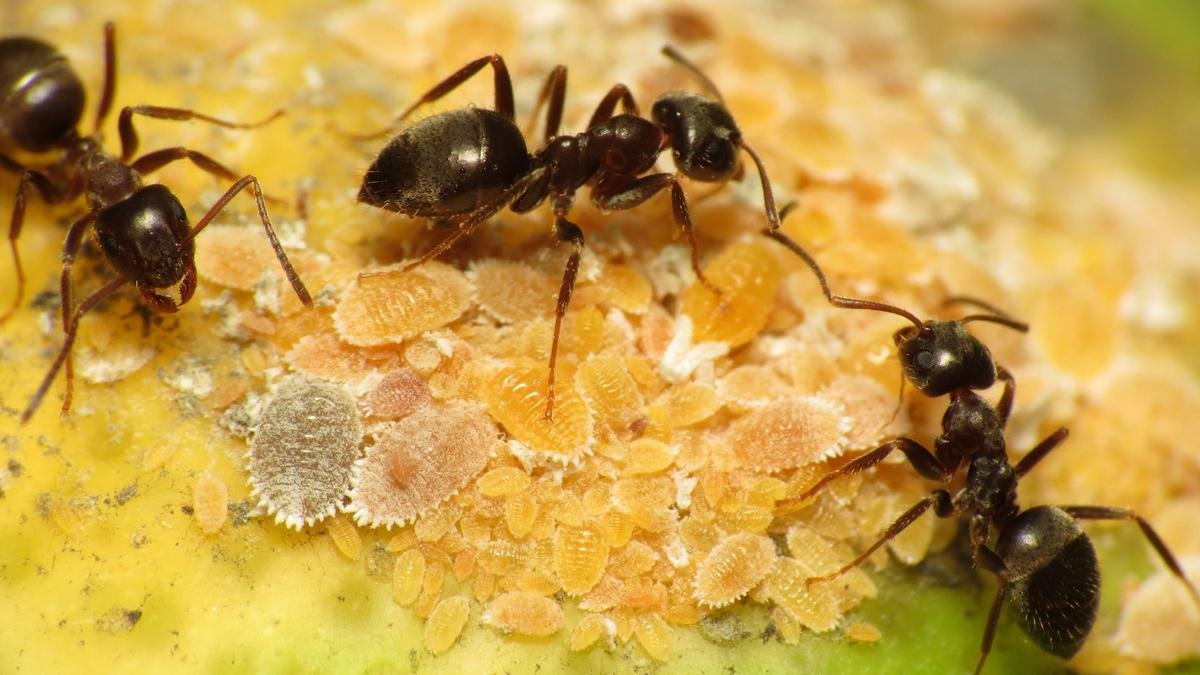
Black garden ants tend to mealybugs.
| Photo Credit: Katja Schulz (CC BY)
Ants are associated with a range of very positive qualities — including a self-motivated work ethic, preparedness and long-term thinking, and a preference for collective effort. Many ant species are also social, and living in social groups offers many advantages. However, there are downsides too.
Among humans, the occurrence of seasonal outbreaks of infections such as influenza and other diseases is the result of the nature of the social structures humans live in. That is how we have learnt the basic rules of limiting these outbreaks’ effects. If you notice a general build-up of symptoms, you take leave from your workplace and isolate yourself for a few days. Altering one’s social contact networks reduces the spread of pathogens. This process requires collective discipline — just the kind of qualities that ants are famous for.
So how do ants living in their colonies cope with pathogens? In some ant species, individuals spread antimicrobial secretions from the metapleural gland on themselves, on larvae, and on their fellow nest dwellers. This gives rise to a ‘social immunity’: every individual in the colony has some protection against infections.
Other, more dramatic measures have been observed. Researchers at the University of Lausanne in Switzerland introduced a worker black ant whose leg had been experimentally injured back among its companions. It was seen that the fellow ants quickly amputated this leg by repeated bites at the joint linking the leg to the body (Current Biology, 34, 2024). A wounded limb would have attracted disease-caused microbes and endangered other ants in the colony.
A more recent study looked at how ant colonies respond to an epidemic (Science, 390, 266, 2025). The ant studied was the black garden ant, which is related to the Indian black ants that we see in and around our homes. The black garden ants build complex underground nests that have one main entrance, a central portion housing the queen, eggs, and larvae, and several satellite chambers used by other ants in the colony and to store food and collect waste. Tunnels connect various parts of the nest. There is clear division of labour, with some worker ants acting as nurse caretakers and others acting as foragers.
In the experiments, a single queen around 200 worker ants began to build a nest. All ants have miniature QR codes stuck on them and video cameras follow their movements. The scientists monitored the nest structures using micro-CT scans. One day later, 20 worker ants that had been exposed to a pathogenic fungus were introduced to the colony.
Over the next few days, the infected ants exited the nest more often, and spent more time outside than their nestmates. This was self-isolating behavior. The architecture of the nest had also adapted: the entrances were spaced further apart than normal. The pace of work became frantic and focused on digging longer tunnels. There were also fewer connections between chambers.
Together, these changes led to more segregation and restricted interactions between the segregated groups. High-value ants like the queen and the nurses had significantly lower exposure to the forager ants and remained healthy.
Sounds familiar? Humans maintain quarantines, wear masks when interacting with others, and wash hands often when faced with an epidemic in our communities. Ants seem to have evolved their own, very effective social distancing measures.
The article was written in collaboration with Sushil Chandani, who works in molecular modelling.
dbala@lvpei.orgsushilchandani@gmail.com
Published – June 12, 2026 08:00 am IST


