



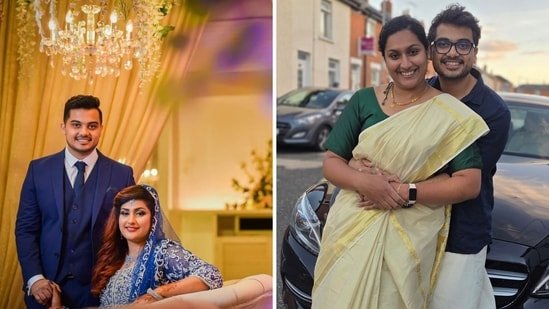
For Tuaha Sultan, a Pakistani man, life “changed in every way possible” after tying the knot with Mavin Alphonse, an Indian Christian woman from Kerala. Building a life together has been a rewarding transformation for him, marked by navigating different languages, blending distinct food cultures, and finding harmony in an interfaith marriage. By centring their relationship on mutual respect, they have successfully created a peaceful sanctuary where both of their cultural identities are honoured and celebrated under one roof. Yet, stepping into the public eye has forced them to confront a harsh digital reality on their joint social media handle, where critics frequently weaponise their backgrounds to hurl toxic accusations and question their patriotism. In a candid conversation with Hindustantimes.com, Sultan opened up about the profound shifts in his daily routine, the beautiful blend of their traditions, and the emotional tightrope of navigating cross-border love.


When did their journey begin?
Tuaha Sultan from Karachi, Pakistan and Mavin Alphonse from Kottayam, India, first met in 2015, and before they knew it, they became “best friends”. However, that’s not all they were destined to be, and soon the couple fell deeply in love with each other.
Recalling the moment, Sultan shared, “I just came back in December 2015 after my semester abroad in the USA. So, I returned to finish the remainder of my bachelors in the UK where I started it. The university in the UK was organising an event called ‘Global festival’ where the students can represent their culture. I was doing a dance performance with some of my friends there and the organiser told me that there is a society which is ‘The Bollywood Society’ which is looking for dancers so I should meet them,” adding, “When I went there, that is where I met Mavin for the first time. She was one of those who started the society. As soon as we met, we clicked and became best friends in no time.”
He continued, “We did a few dance performances in a group together and used to hangout a lot. Slowly, I fell in love with her and I asked her out. Once she said yes, things started getting serious/official very quickly. Her mum flew from a different city as soon as she heard that she was dating not just a non-Malayalee or not an Indian, but a Muslim Pakistani. But once she met me, she loved me from the very first day, which made things smoother for us.”
How did their families react?
Sultan told Hindustantimes.com, “We faced a lot of challenges with making families understand that this will work. Unfortunately, some people in our family stopped talking to us and it has been years since we spoke to them. We tried our best but if we are not even given a chance, there is not much that we can do. But if some family went away due to this, so much of our family got expanded from both sides who show us so much love.”
When did they get married?
“We got married in 2018 but there were multiple events. We had a Church wedding and the Nikkah ceremony in the UK. We had a Valima ceremony in Pakistan,” Sultan shared, adding, “UK was our easiest option to get married in as that is where we met. So, I came back to the UK after I finished my bachelors and then got married as we were already dating during my bachelors degree time.”
However, not everything was smooth,, as the Pakistani man recalled how hard it was to find a church for their wedding.
“Finding a church for our wedding was also a struggle. As no priest was willing to be a part of it. After many months of struggle, we found one who did it for us. The issue there was of us being a Muslim and a Christian couple.”
How did their lives change after marriage?
Expressing feelings for both, Sultan said, “Life changed in every way possible. We are from different religions, we speak different languages and we eat different food. We communicate with each other in English as I speak Urdu and she speaks Malayalam. She is a Christian and I am a Muslim. She loves her idli sambar while I love my paya and nehari.”
Blending two entirely different worlds required a lot of patience, understanding, and a healthy dose of humour as they navigated their daily routines. Instead of letting these deep cultural divides create a distance between them, the couple embraced their differences as an opportunity to learn and grow closer together.
“The beautiful thing about this relationship is that now we get to celebrate more festivals and enjoy more food. We even have made our own versions of food which is a Malabar and Sindhi Biryani combo. So it has cashews on top but it has potatoes too. We both love to celebrate not just our own festivals but every celebration that we can be part of. So our household celebrates Eid, Onam and Christmas. But whenever we get the chance, we join others who are celebrating their own religious or cultural events.”
Did they ever visit each other’s countries?
While Alphonse has been to Pakistan, Sultan has yet to visit India. “Mavin has been to Pakistan twice and I was scared at first but whenever anyone was told that she is an Indian, she received so much love. She visited once when I finished my bachelors in the UK and went back to Pakistan. She then visited after we were married for our Valima ceremony.”
Explaining why he is yet to visit India, Sultan told Hindustantimes.com, “I am still in the process of going to India as my application has been on hold for over 13 months due to the Pahalgam incident. I was supposed to be in Delhi, Mumbai, Agra and some parts of Kerala in August 2026 to attend a family function. My visa is still under processing as they have been on hold by the Indian government since April 2025. Whenever the visas resume, we will be visiting India.”
Hate and love on social media:
To document and celebrate their beautiful cross-border journey, the couple launched a joint Instagram page, opening up a window into their daily lives. Through candid snippets, they wanted to show the world that love easily transcends regional and religious boundaries.
However, building an online presence quickly proved to be a challenging emotional tightrope. While their vulnerability has attracted an abundance of love from supportive followers, it has also made them the target of extreme, unprovoked hate from internet trolls.
“Either we receive so much love and support or total hatred. For those who support us, they share their stories or the connection they have on the other side of the border which really motivates us to keep doing what we are doing. People share about their family or even ask us how we told our families about us so they can share their stories to their family,” said Sultan.
He added, “These are not only Pakistani Indian relationships but if they are from different regions in India, same religion but different type, or even if they love someone who is not what their household expects. People just need to see someone’s story to get inspired so they can pursue their own story.”
Talking about the negativity the couple receives online, Sultan told Hindustantimes.com, “As for the hate we get, as soon as someone realises that we are either Indian or Pakistani, the hate comments start. If you go through our Instagram, which is called WhereWeBelongTM, you will witness how much people fight and argue.”
He continued, “They automatically start making assumptions about our religion, how one might have been forced with things, about how we are anti national and how we are making a mistake. With some of the people who hated us but seemed educated, we did reply asking why the hatred is there to which they simply said they can’t support someone from the other side.”
It became painfully clear that logic and education were no match for deep-seated geopolitical biases. Instead of finding open minds, the couple discovered that internet users actively sought new angles to fuel their prejudice, turning even local identities into weapons of division.
“The hatred goes to an extent that our own people will hate us too. So a Pakistani will try to understand which part of Pakistan I am from, so they can hate that part. Same for India, once they realise that Mavin is from Kerala, then all the hatred goes towards Kerala. They don’t give us a chance to show our story and how things are respected and celebrated.”


