


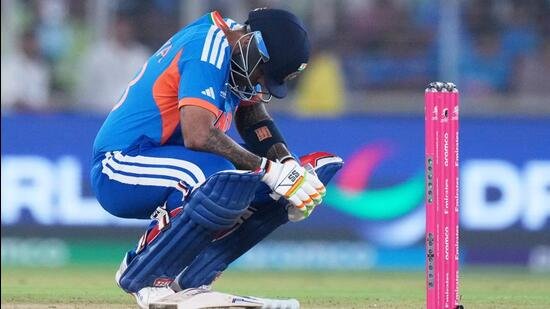
Ahmedabad: For months leading up to the home World Cup, India committed to doubling down on the intent from their last T20 title. They played a brand of cricket that would bulldoze opponents with belligerence, whoever did not meet the high-tempo template was discarded from the squad. A thumping defeat against South Africa in the Super 8s revealed the flip side of this strategy.
From questioning if they are even beatable to wondering if the defending champions will survive, their aura has taken a beating. India might think they just had a completely off day against the Proteas in Ahmedabad, which was true; but deeper issues in the squad makeup have been exposed, traces of which were visible during the league stages.
There are no quick fix solutions in sight as India prepares for Zimbabwe in Chennai next, followed by West Indies in Kolkata. Not only are they in a must-win situation, but India may also need other results to go their way in their draw, given their poor run rate.
The premise behind a top order with very high intent—Abhishek Sharma, Sanju Samson and Ishan Kishan—was to make a statement of a no-holds barred mentality. However, South Africa showed on Sunday, with their savvy planning that it wasn’t all that difficult to pull the chain.
One of the classic T20 bowling theories to restrict six-hitting openers is to offer them no pace to work with. You could do it with spin or task fast bowlers to bowl slow as a mix-up. South Africa did both. They used Aiden Markram to rip the ball early away from India’s left-handers. Lungi Ngidi and Marco Jansen ran in from far but bowled ever so slowly to disturb batters’ rhythm.
For the off-spinners to be a menace, they don’t have to have a high pedigree in T20, even the ball holding its line as Netherlands’ Aryan Dutt and Pakistan’s Salman Agha showed can trouble the inside edge of the left-hander.
A big reason we didn’t see much of this in India’s bilateral matches leading up to the World Cup was the batting friendly pitches they played on. There, a part-time off-spinner could be taken down, and pace-off balls sat up to be hit. The choice of slower pitches in the World Cup has been part of the Indian plan. Their batters have been unable to match that ploy.
“I think the biggest challenge for us is finding a way to play on wickets that are not typical to what we’re playing on,” Ryan ten Doeshchate, Indian assistant coach said. “There was obviously a bit of hold in the wicket and when you lose Ishan in the first over and you’ve got three quality seamers like they (South Africa) do, it needs a little bit of assessment and application. It’s a fine line between putting the reins and stopping guys from playing the way they play, but I think it’s come to the point now where the intervention of saying ‘guys, there’s different ways to go about a chase, even setting a score’.”
Conversely, what Dewald Brevis and David Miller were able to counter-punch after losing early wickets and they attacked India’s No 1 spin weapon Varun Chakravarthy.
One of the reasons they could attack is their left-right batting combination, which made the Indian bowlers’ task more difficult.
India’s plethora of left-handers in the playing 11 forced their hand. They had to send in Washington Sundar and Shivam Dube ahead of Hardik Pandya to partner Surya, not wanting to use up their only two right handers together.
Going ahead, changes, if any, will be in the top order. “We’ve now had four teams open with part-time off spin and it’s got a wicket. So to start every innings 0/1 is obviously putting pressure,” Ten Doeschate said. “Do you stick with the guys who we feel have performed really well over the last 18 months and who are maybe shy of a few runs now? Or do we twist and bring Sanju, who’s also a fantastic player and obviously helps tactically with having a right hander at the top? I’m sure that’ll be a talking point over the next few days.”
Samson himself has been woefully out of form, and despite some fluent strokes against minnows Namibia, he eventually got out to the same mode of dismissal that’s been his recent undoing – caught in front of square on the leg side. Samson may have to come in for Tilak Varma, with Kishan dropping down to No 3. But the Kerala opener’s best chance to score, like the rest of the line up, is when the ball comes on to the bat.
Dropping Axar
Although it wasn’t the decisive reason why India lost to South Africa, the move to drop deputy Axar Patel for Washington Sundar did not serve the purpose. India’ initial strategy was to use two of Washington’s overs in the Powerplay and protect Varun Chakravarthy and Jasprit Bumrah’s extra over in the middle.
Early South African wickets gave them a welcome start, but this made the Washy over Axar move meaningless, with the latter’s batting prowess missed during the run chase.


