



It’s a stadium steeped in tradition, but it hasn’t shied away from sprucing itself up without disassociating itself from the past. The Wankhede Stadium has changed character in the 51 years of its existence, but it hasn’t lost any of its character.
Almost immediately after entering the premises through the Vinoo Mankad Gate, one is greeted by a statue of the original don of Indian batting, Sunil Gavaskar, his bat raised, captured mid-stride, a tribute to how the great man brought up his 10,000th Test run, against Pakistan in Ahmedabad in March 1987, with a dab past short third-man off off-spinner Ijaz Fakih.
The long walk from the gate to the press box takes one through a plethora of stalls in the process of being set up and which will be bustling with greater activity on match evening. To the right of the press box, just past the stand named after him, is a towering statue of Sachin Tendulkar essaying an aerial straight drive. Tendulkar was Gavaskar’s successor in every sense of the term; to have the statues of two of the greatest batters of all time is credit to the authorities here, who have also honoured other stalwarts by naming gates and stands after them.
One of the newer additions to the sprawling premises is the MCA Sharad Pawar Cricket Museum, curated by Devendra Prabhudesai and named after the former union minister who served as the president of the Mumbai Cricket Association and the Board of Control for Cricket in India, as well as headed the International Cricket Council. The museum is a veritable celebration of the rich history of Mumbai cricket, of its contribution to Indian cricket, and of its pre-eminent position as the leader of the pack when it comes to the sport in the country. There is a spectacular collection of memorabilia dating back to more than 80 years. The stirring deeds while representing the country of the greats of the game, men and women, are documented as meticulously as domestic giants who have played significant parts in Bombay/Mumbai winning the Ranji Trophy a staggering 42 times.
It’s impossible not to feel the tug of cricket anywhere around the Wankhede, which has a unique touch to it. It’s here that India created history on 2 April 2011 by becoming the first home side to go all the way in the ODI World Cup; it’s also here that their challenge fell flat in the semifinal of the 2016 T20 World Cup, when they were well beaten by eventually champions West Indies.
Familiar opponent
The Wankhede offers India the unique opportunity of becoming the first side to replicate its 50-over heroics by lifting the T20 World Cup. Thursday isn’t a final per se, but it could so easily be the final before the final. Standing between them and a Sunday date in Ahmedabad are Harry Brook’s England, India’s semifinal opponents for the third edition on the trot.
The teams have split their two previous last-four clashes, both remarkably one-sided affairs. Then skipper Jos Buttler and Alex Hales consigned India to a crushing ten-wicket hammering in Adelaide in November 2022 with a massive unbroken 170-run alliance, while India paid them back in the same coin in Providence in June 2024 when Rohit Sharma masterminded a 68-run rout with a sparkling 57.
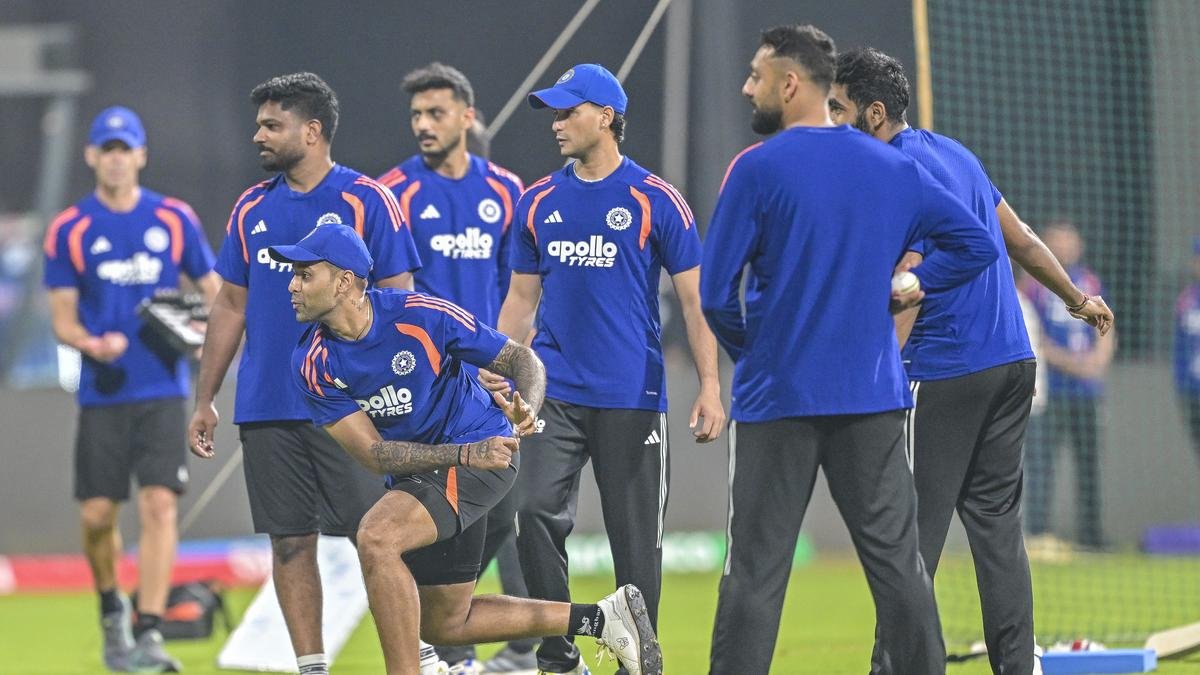
So much has changed in the 21 months since India backed up that victory with a seven-run heist against South Africa in the final. Alongside Virat Kohli and Ravindra Jadeja, Rohit rode into the T02I sunset within hours of holding aloft the trophy in Bridgetown; India have a new captain in Suryakumar Yadav, a somewhat left-field choice given that Hardik Pandya was Rohit’s deputy during the American adventure. They also boast several survivors from their victorious previous campaign, but there is a string of exciting newbies, among them Abhishek Sharma and Ishan Kishan, the tyros that occupy two of the top three positions in the batting order, and wrist-spinner Varun Chakaravarthy, currently the No. 1 T20I bowler in the universe.
Kishan has had his moments in this tournament, most notably against Namibia and Pakistan in the league phase, but has gone off the boil somewhat from the time he was dismissed in the first over in Ahmedabad by South African captain Aiden Markram in India’s first Super Eight encounter. Even three months back, Kishan wasn’t a serious threat to figure in the World Cup 15 but a change in mindset which ushered Shubman Gill out of the running coupled with the little Jharkhandi’s spectacular form in domestic cricket compelled a rethink that took him ahead of Sanju Samson in the wicketkeeper-batter pecking order. Like most others in the Indian set-up, Kishan knows the Wankhede like the back of his hand, having plied his wares for Mumbai Indians in the IPL for several years before moving to Sunrisers Hyderabad for IPL 2025. Familiarity with a venue where one has had success previously certainly helps, and that’s what Abhishek too will be hoping, because it was here that, in January last year, he blasted the living daylights out of England.
In a magnificent display of ball-bashing, the left-hander pulverised the bowling with seven fours and 13 gigantic sixes on his way to a 54-ball 135. England were lifted by the second-over dismissal of Sanju Samson with only 21 on the board, but ended up leaking 247, thanks mainly to Abhishek’s effervescence. Jofra Archer, who has had a good tournament, went for 55 in his four overs and Adil Rashid 41 in three. Abhishek could do with some inspiration. He has had a poor tournament by anyone’s standards, and hasn’t looked like the No. 1 T20I batter that the rankings attest he is. Having taken four innings to make his first World Cup runs, his only contribution of note was 55 against Zimbabwe in Chennai. Maybe a return to the scene where he played his most bruising international innings is just the tonic he needs.
India were forced to split their left-left opening combine of Abhishek and Kishan after three straight first-over dismissals to off-spin. Kishan’s wicketkeeping-opening slot has gone to Samson, who mainly came into the mix because his right-handedness offered a marked point of difference, but he proved that there is more to him than just that with a match-turning unbeaten 97 against West Indies in the virtual quarterfinal in Kolkata in Sunday.
Samson has flattered to deceive in the past but the general feeling that he could have turned the corner after the Eden epic is strong. One of Samson’s biggest enemies hitherto was self-doubt, which threatened to consume him. Now that he knows what he can do at the international level – and we say this with all respect, even though he has three T20I tons to go with an ODI century in his last appearance for the country, in December 2023 – he will perhaps divorce himself from the gremlins that have eaten away at him for so many years now and become the sustained destroyer that he has shown himself to be with Rajasthan Royals in the IPL.
One of the keys to India making it to the semifinals without really approaching their best is numerous different players coming to the party. There hasn’t been one standout performer, but India have been able to eke out contributions from different personnel at key moments, be it a half-century here, a two-wicket over there, or even two fours in four deliveries, like Shivam Dube conjured in the penultimate over of the tense chase against the Caribbeans. Maybe there is nothing like the perfect game – though India did have the near-perfect batting display in Chennai against Zimbabwe when each of their six batters weighed in handsomely in an intimidating total of 256 for four. But if there is, India still haven’t produced it. Maybe that’s something to look forward to, because what this side is capable of when it hits top gear is little short of awe-inspiring.
Buttler’s struggles
England have had a grand campaign after an early loss to West Indies. Their spin attack manned by Rashid, Liam Dawson and Will Jacks has relished the assistance pitches in Pallekele and Colombo offered them during the Super Eights, when they had the measure of New Zealand, Sri Lanka and Pakistan. The shift back from slightly tricky tracks to a potentially excellent one for batting isn’t the most demanding – certainly not half as much as going in the other direction – and it is on this that England will bank for Buttler to get back among the runs.
An acknowledged destroyer of the best bowling attacks, Buttler has been well off pace in a tournament where he has made a mere 62 runs in seven innings, with a highest of 26. If England haven’t so much as contemplated leaving him out, it is because of his proven class. India will be hoping the sleeping giant doesn’t wake up on Thursday, because if Buttler gets going, he will be well nigh impossible to stop.
Like India, England have won the World Cup twice, under Paul Collingwood in the Caribbean in 2010 and when Buttler masterminded their campaign in Australia a dozen years later. Brook has run a tight ship, maintaining his composure and showing none of the off-field indiscretions that marked the beginning of his captaincy career. England came into the World Cup under a cloud following their 1-4 hammering in the Ashes, which cast a shadow over the coaching career of Brendon McCullum. They have earned themselves plenty of breathing room and if they are able to put it past the hosts and move into the title round, it will mark a tremendous revival, no matter how the final pans out.
Having taken the scenic route to the semis, India are within two wins of rewriting history by becoming the first three-time champions of the shortest World Cup. They will have the luxury of an entire nation rooting for them, but unless they execute their skills to perfection, all that support and backing will have little impact. For that, it is imperative that they pull up their catching and fielding socks, which have been in tatters for a while. Maybe, they will derive inspiration from the stunning Tendulkar statue that is impossible to miss, and from the rich history of a ground where the great man made his final international appearance in November 2013.


