



Chandigarh was envisioned not merely as a city, but as a disciplined expression of modern India—a place where architecture, space and governance spoke louder than individual identities. A key feature of this vision was restraint: public institutions would not be named after individuals, and statues would not dominate public spaces.


It was a deliberate design philosophy that kept the city free from personality-driven symbolism and focused instead on a collective, egalitarian identity. It was also one of the dream projects of Jawaharlal Nehru, who envisioned Chandigarh as a marker of a new, forward-looking nation.
Alongside him, the then chief minister of undivided Punjab, Partap Singh Kairon, played a decisive role in shaping and executing this vision. Yet, what is striking is not just how Chandigarh was built—but how it chose to remember, or rather, not remember.
Even after the reorganisation of Punjab in 1966, when Chandigarh became a Union Territory, the city continued to evolve without visibly commemorating these very leaders who were instrumental in its creation.
This absence reflects what can be described as Chandigarh’s “silent code”: a deeply embedded principle of urban identity that resists political naming and statuary. The idea was simple yet profound: a city should belong equally to all its citizens. Rare exceptions—such as the Zakir Hussain Rose Garden, Tagore Theatre and select institutional naming within PGIMER and Panjab University—remain restrained acknowledgements, never the basis of a naming culture.
The vision of Le Corbusier, who designed Chandigarh as an egalitarian, forward-looking city, emphasised functional architecture over symbolism, and clean, uncluttered public spaces. The Edict of Chandigarh, as prescribed by him, also states that no personal statues shall be erected in the city or parks of Chandigarh. The city is planned to breathe the new sublimated spirit of art.
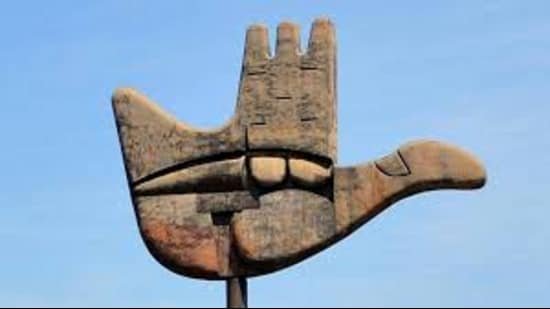
Landmarks such as the Capitol Complex and the Open Hand Monument reflect this philosophy. They symbolize ideas—governance, peace, and openness—rather than individuals.
The discipline on statues
In most cities, statues become focal points of identity—and often, contestation. Chandigarh consciously avoided this trajectory. During my tenure as deputy commissioner (1986–1991), a community group sought to install a statue in a prominent public space. The issue was never about the individual being honoured—it was about precedent.
As deputy commissioner, I received numerous such requests for naming roundabouts or installing statues. These were handled with a combination of diplomacy and firm refusal to preserve the city’s “silent code”.
Over the decades, the Chandigarh Administration has largely upheld this restraint through a cautious, case-by-case approach. A few statues—such as those of national figures like Mahatma Gandhi—do exist, but they are limited and carefully located.
Decisions are guided by urban design norms, heritage considerations—especially after the Capitol Complex received UNESCO recognition—and the foundational planning ethos of the city.
Why this restraint matters today
In an era where “legacy politics” increasingly shapes urban landscapes, Chandigarh’s restraint offers an important lesson. Neutral spaces reduce the risk of identity-based contestation. Institutions known by their function are judged by performance, not by the aura of a name. Most importantly, no citizen feels like an outsider in a city that does not privilege one narrative over another.
The question before Chandigarh today is not about a specific statue or a name—it is about the city’s soul. Will it remain a city defined by its vision, or will it become a canvas for competing symbols? The answer will determine whether Chandigarh continues to stand apart—or gradually fades into the “horizontal noise” of the modern urban landscape.
krishnamohan718@gmail.com
(The writer, a retired IAS officer, served as home secretary & deputy commissioner of UT)


