



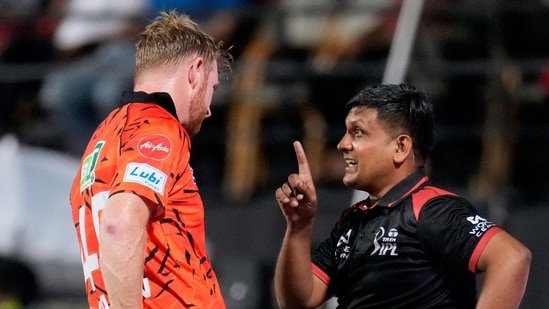
Heinrich Klaasen’s dismissal against Royal Challengers Bengaluru was not just an important wicket for the defending champions. It became one of the first genuine flashpoints of IPL 2026, with the Sunrisers Hyderabad batter clearly not convinced by the decision that ended his stay.
The moment came on the first ball of the 14th over of SRH’s innings, with the side at 135 for 4 and building through a crucial phase. Romario Shepherd, reintroduced into the attack by Rajat Patidar, dug in a back-of-a-length delivery around off. Klaasen, who had made 31 off 22 balls, attempted to pull but failed to get the desired connection. The ball ballooned towards deep midwicket, where Phil Salt completed the catch right on the edge of the boundary. What followed, however, was immediate uncertainty. With Salt’s back foot appearing extremely close to the cushions, the on-field umpires referred the decision upstairs.
Klaasen waits, questions, and walks off unconvinced
Klaasen did not immediately walk off. Instead, he paused near the boundary, watching the replays unfold. During that brief but tense wait, he was seen in conversation with the fourth umpire, an indication that he believed there was enough doubt around the catch. It was not an aggressive protest, but it was clear he was not entirely comfortable with how the moment was unfolding.
Boundary catches often exist in that grey area where perception and evidence collide. From the batter’s angle, Salt’s positioning would have looked dangerously close, possibly suggesting contact with the rope or cushions. In real time, those margins can feel decisive. Klaasen’s reaction reflected that instinct, the sense that he might have survived.
The final decision, though, was based strictly on available evidence. The TV umpire checked for any visible contact or movement of the boundary cushions and, finding none, ruled the catch clean. The dismissal stood, handing RCB a crucial breakthrough at a point where SRH had begun to regain control.
What followed was telling without being dramatic. Upon seeing the OUT signal, Heinrich Klaasen did not appear convinced. There was a brief exchange before he turned and walked back, his body language reflecting quiet frustration rather than overt dissent. It was a small moment, but one that captured the tension between what a player feels in the middle and what technology ultimately confirms.
In a game increasingly defined by fine margins and forensic checks, Klaasen’s dismissal served as a reminder of how thin that line can be, and how, sometimes, acceptance lags just a little behind the decision.


