



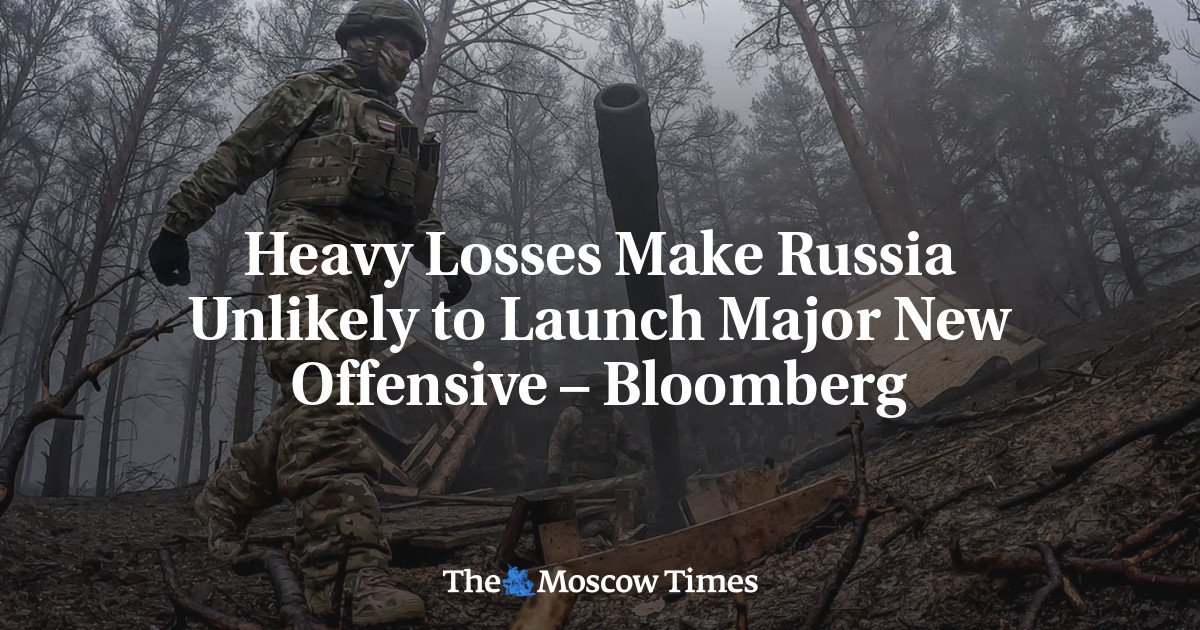
Heavy battlefield losses are likely to prevent Russia from launching a major new offensive in Ukraine in the coming months, Western officials and military analysts told Bloomberg as the war entered its fifth year.
Russia’s battlefield losses have exceeded its monthly recruitment of 30,000 to 35,000 new contract soldiers for three consecutive months, Western officials told Bloomberg on condition of anonymity, raising the possibility of the country’s first mobilization since fall 2022.
That trend is likely to undermine Moscow’s capacity to launch a major new offensive in the coming months, the officials said.
“We’ve seen a casualty uptick which is disproportionate in scale and some of the economic situation in Russia is starting to become quite precarious, especially as we move into summer,” Bloomberg quoted British Armed Forces Minister Al Carns as saying.
He said the Kremlin may be forced to step up recruitment efforts in major cities after largely focusing on poorer rural regions in the first four years of the war, something he warned would “start to undermine and fracture some of the political support that sits within those high density areas.”
Moscow remains the federal subject with the lowest confirmed death rate at five fatalities per 10,000 men, according to calculations by the BBC’s Russian service and the exiled outlet Mediazona based on open-source data.
In economically disadvantaged regions such as the republics of Buryatia and Tuva, the rate is 27 and 33 times higher, respectively.
The ethnic and geographic disparities also exist in raw numbers, with analysis showing 2,437 of the confirmed war dead come from Moscow compared to Bashkortostan (9,331), Tatarstan (7,585) and Sverdlovsk Oblast (6,700).
Overall, the number of confirmed Russian military deaths has surpassed 200,000, according to the same data.
Britain’s Defense Secretary John Healey previously told Bloomberg that Moscow has increasingly turned to foreign nationals to replenish its ranks.
He estimated that around 17,000 North Korean troops had been deployed to support Russian operations and said Russia was recruiting thousands of people from India, Pakistan, Nepal, Nigeria, Senegal and Cuba.
Recruitment drives abroad have sparked protests from some foreign governments, who say their citizens were misled into signing military contracts.
According to officials, some recruits from poorer countries were promised high-paying civilian jobs in Russia but upon arrival were pressured into signing contracts with the Russian Defense Ministry that they did not understand before being sent to the front lines.
South Africa has negotiated the return of some of its citizens who ended up fighting in Ukraine, President Cyril Ramaphosa said Tuesday.
He said some cases were linked to the activities of a daughter of former President Jacob Zuma.
Protests from foreign governments have forced Russia to scale back some overseas recruitment efforts, officials said.
Henry Boyd, senior fellow at the International Institute for Strategic Studies, told Bloomberg that Moscow’s heavy losses “put pressure on their current operational posture.”
“They do have the option of scaling back on some of their offensive activity to counterbalance that,” he noted.
At the same time, Carns told Bloomberg that Russia remains a significant threat in Ukraine and beyond, while Ukraine’s top general Oleksandr Syrskyi said this month that the situation on the front lines remains “difficult.”
The replenishment issues come as the Russian military grapples with the loss of Starlink and the state crackdown on Telegram, a key battlefield communications tool, and as U.S.-led efforts to negotiate a peace deal to end the war have stalled.
Read this story in Russian at The Moscow Times’ Russian service.


