



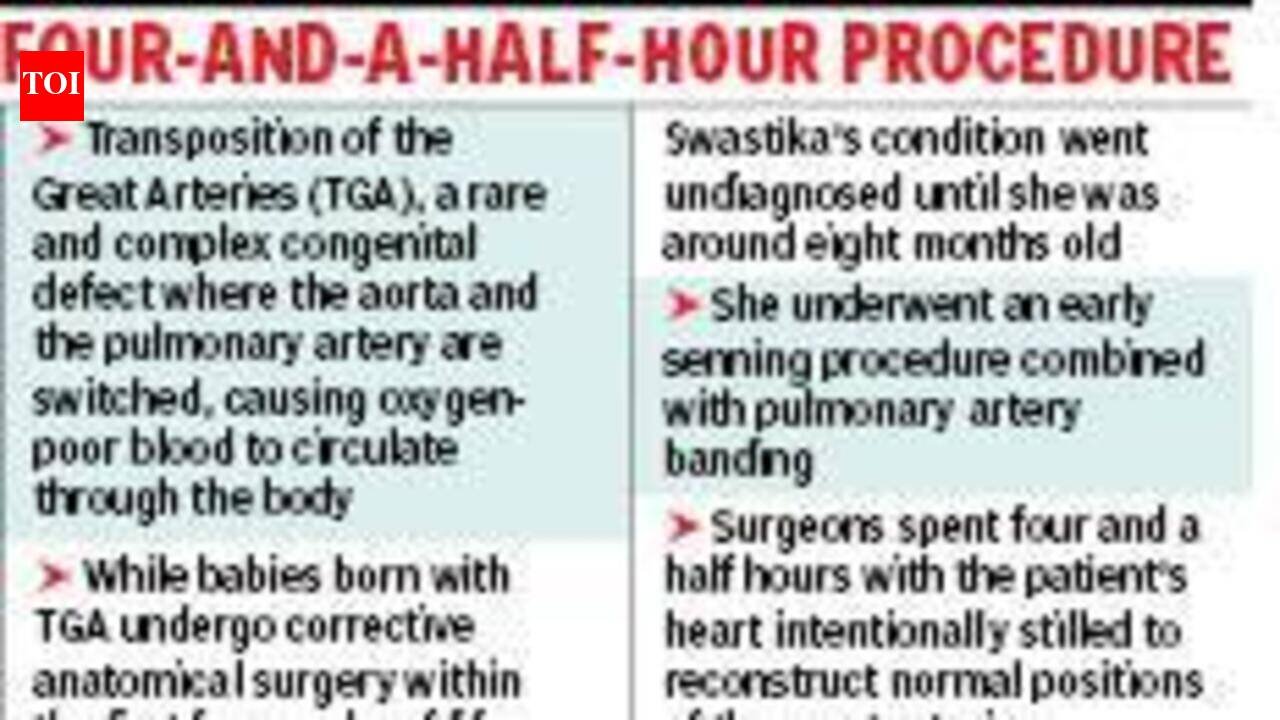
Kolkata: In a medical achievement that challenges conventional timelines for congenital heart interventions, a multidisciplinary team at a pvt hospital in Kolkata has successfully performed a complex, definitive corrective surgery on a seven-year-old girl born with reversed major blood vessels. The milestone procedure effectively concludes a multi-year, multi-stage medical journey for the young patient, Swastika, who spent her early childhood facing severe oxygen deprivation.Swastika was born with transposition of the great arteries (TGA), a rare and complex congenital defect where the aorta and the pulmonary artery are switched, causing oxygen-poor blood to circulate through the body rather than nourishing it. While babies born with TGA typically undergo corrective anatomical surgery within the first few weeks of life, Swastika’s condition went undiagnosed until she was approximately eight months old. Having missed the ideal initial window for definitive repair, she underwent an early senning (atrial switch) procedure combined with pulmonary artery banding to prepare her left ventricle for future interventions.When her family arrived at BM Birla Heart Hospital nearly two years ago seeking permanent answers, extensive evaluations led by paediatric cardiac surgeon Kuntal Roy Chowdhury and paediatric ardiologist Shyamajit Samaddar revealed that her left ventricle lacked the immediate strength required to support the final corrective operation. To mitigate the high risk of sudden failure, the medical team devised an innovative, long-term staging strategy. They surgically created an arteriovenous (AV) fistula in her left elbow—a technique standardly used to facilitate dialysis access. In this instance, the fistula served to deliberately increase the volume of blood returning to the heart, effectively training and strengthening the weakened ventricle over the course of a year.“It helped to strengthen her left ventricle which was forced to pump at a greater intensity due to the obstruction. It had the desired result and made it easier to do the switch procedure though it was late and hence risky. Ideally, the surgery should have been done within three to six weeks of her birth, but Swastika was diagnosed when she was already six years old,” said Roy Chowdhury.Following consecutive evaluations that confirmed the ventricle had gained sufficient strength, a highly specialized surgical team took Swastika to the operating theatre. Led by Roy Chowdhury alongside Samaddar, head of cardiac anaesthesia Prabir Kumar Das, and a perfusion team directed by Sudhakar Rao, the surgeons spent nearly four and a half hours with the patient’s heart intentionally stilled to meticulously reconstruct and restore the normal anatomical positions of the great arteries.Her post-operative recovery was upervised specialized around-the-clock monitoring provided by pediatric cardiologist Satarupa Mukherjee and the Paediatric Cardiac Intensive Care Unit (PCICU) team. Swastika was successfully weaned off ventilator support within 48 hours of the operation and was discharged from the hospital just ten days later. Hospital officials confirm she has transitioned seamlessly back to everyday childhood activities, including attending school and playing with friends, free from the limitations that marked her first seven years.Medical experts note that Swastika’s case highlights the shifting boundaries of pediatric cardiac intervention. Roy Chowdhury emphasized that innovative staged strategies can successfully prepare late-presenting hearts for complex repairs, even when early corrective windows are missed. Dr. Samaddar added that while early diagnosis remains the primary cornerstone for treating congenital heart diseases, this outcome proves that multidisciplinary collaboration and persistent, structured planning can yield excellent results in delayed presentations.


