



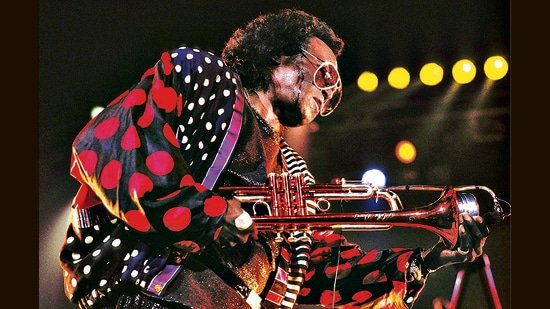
In post-war Europe, he was celebrated as a symbol of Black American genius; in Paris, he rubbed shoulders with Picasso and Jean-Paul Sartre. In parts of Africa and Latin America, he became proof that jazz could absorb non-Western rhythms, and exist as local idioms — no compromise; no imitation.


“Miles Davis is still the global brand ambassador of jazz,” says music critic Sunil Sampat. And nowhere did he seem to inspire as much devotion as in Japan.
In his autobiography, Miles (co-written with the poet and editor Quincy Troupe), the legend recalls his first trip to that country, in 1964. He had taken sleeping pills, among other things, to help with the long flight and, finally alighting, vomited before a throng of fans.
“They didn’t miss a beat,” he writes. “They got me some medicine and got me straight and treated me like a king. Man, I had a ball, and I have respected and loved the Japanese people ever since.”
That love was reciprocated in full. In 1975, Davis arrived in Osaka with a battered body and a sound that had split the jazz world in two.
American critics had spent the previous few years recoiling from his electric turn, and from albums such as Bitches Brew (1970) and On the Corner (1972). But in Japan, even his loudest, “strangest”, most psychedelic incarnations were met, from the start, with the admiration they would eventually earn around the world.
The concerts recorded at Osaka Festival Hall would become the live albums Agharta and Pangaea, documents of electric Miles at his densest and most confrontational. To Japanese listeners, these were not controversial works. They were canonical texts.
FLAVOURS OF NIPPON
Davis’s incredible popularity here had something to do with how Japan listened, says Masaaki Hara, Tokyo-based music critic, producer with the label Rings, and author of Jazz Thing: This Thing Called Jazz (2018).
By the late-1940s, the country had developed one of the most dedicated jazz cultures in the world, thanks to the phenomenon of jazz kissa, small cafés where customers gathered to listen, in silence, to expensive imported records played on high-end sound systems.
The historian E Taylor Atkins, in Blue Nippon: Authenticating Jazz in Japan (2001), describes how this evolved into a culture around jazz that was tied to ideas of refinement, cosmopolitanism and modernity. “Appreciation of this intensity must be learned and cultivated like the mental discipline of Zen,” he writes, recasting the cafés as “temples” of a sort of ritualised deep-listening practice.
Davis, perhaps more than any other jazz musician, rewarded such ritual.
His music rarely gives itself away all at once, thriving instead on space, atmosphere and attention. It is in deep listening that one notices and comes to appreciate the withheld phrase, unexpected silence, rhythmic shift.
There was something Confucian about him as a band leader. He famously told musicians “[don’t] play what’s there, play what’s not there.”
Japanese listeners responded to this use of space, silence and sonic texture, particularly in the electric period that purists elsewhere found so off-putting. His music would go on to influence Japanese artists across the spectrum, from trumpeter Terumasa Hino and his son, the bassist Kenji Hino, to saxophonist Yasuaki Shimizu and pianist and composer Masabumi Kikuchi.
“Miles exerted influence through his charisma and fashion as well,” Hara adds. “He appeared in Japanese TV commercials (most notably for a shochu beverage in the 1980s), and so his legend was known even to those who had never heard his music.”
GLOBAL SOUND, LOCAL BREW
Elsewhere in Asia, the legend functioned as something subtler but also immensely powerful: permission.
Musicologist Ryan S McNulty points out that Davis spent much of his career “imagining” Africa, not just through rhythm but through instruments such as the conga and water drum that he invited into ensembles in the 1970s. His musical philosophy did more.
Particularly during the ’60s and ’70s, Davis in effect drew from the sounds of Africa, the African diaspora, Spain and India to create something resembling a sound of the Global South: a world of music connected by groove, improvisation and a history of cultural exchange.
In doing so, he offered musicians in newly post-colonial societies something rare: a model of modernity that did not demand imitation of the West.
In South Africa, trumpeter Hugh Masekela, one of the continent’s defining jazz voices, spoke of Davis as a crucial influence because of the way he legitimised sounds that drew from local cultures. Masekela has said Davis explicitly urged him to stop reproducing American jazz, and told him he should build from South African traditions instead. “He said to me, in his gravelly voice, ‘Hugh… you should just do your own thing,’” Masekela told the Guardian in 2004.
JAZZ BEYOND BOUNDARIES
In India, the connection was more indirect.
Though Davis experimented with the sounds of the sitar and tabla in the 1970s, on records such as On the Corner and Get Up with It, and mentored and played with Indo-jazz fusion pioneer John McLaughlin, he didn’t lean as strongly into Indian music as contemporaries like John Coltrane and Yusef Lateef did.
But, Sampat argues, he helped pave the way for Indo-jazz fusion.
“One of the spin-offs from Davis would be the emergence of Shakti,” Sampat says, referring to the band created in 1973, by McLaughlin and the Indian artists L Shankar (violin), Zakir Hussain (tabla) and TH Vinayakram (ghatam). “I don’t think fusion would have taken off when it did, had it not been for Bitches Brew and In a Silent Way (1969),” Sampat says.
Meanwhile, across Latin America, particularly in Brazil, his fusion period served as validation. Brazilian music had long thrived on collision: samba merging with jazz and Afrodiasporic rhythms smashing into psychedelia and folk.
American jazz often carried anxieties around purity, but Davis didn’t. He refused to acknowledge any musical boundaries, and the success of that approach legitimised what Brazilian artists were already doing, opening the door for percussionists such as Airto Moreira and Paulinho da Costa.
Different countries, then, encountered, and adopted, different Davises. Perhaps this is what makes him such a singular global figure.
He changed so completely, so many times, that there was always a Miles for where you were, what you needed, and whichever decade you happened to be born into.
Most artists leave behind a body of work. He left behind something more like a wardrobe: vast, varied, unexpected; full of things that shouldn’t go together but somehow really do.
Thirty-five years after his death, people are still rummaging through it and picking things that feel like they were made just for them.
It’s not a legacy he left us then, but an inheritance. And an invitation. To create, start over, break things down and make them new. Be unafraid, uncompromising and non-conforming.
What a way to change the world.


