






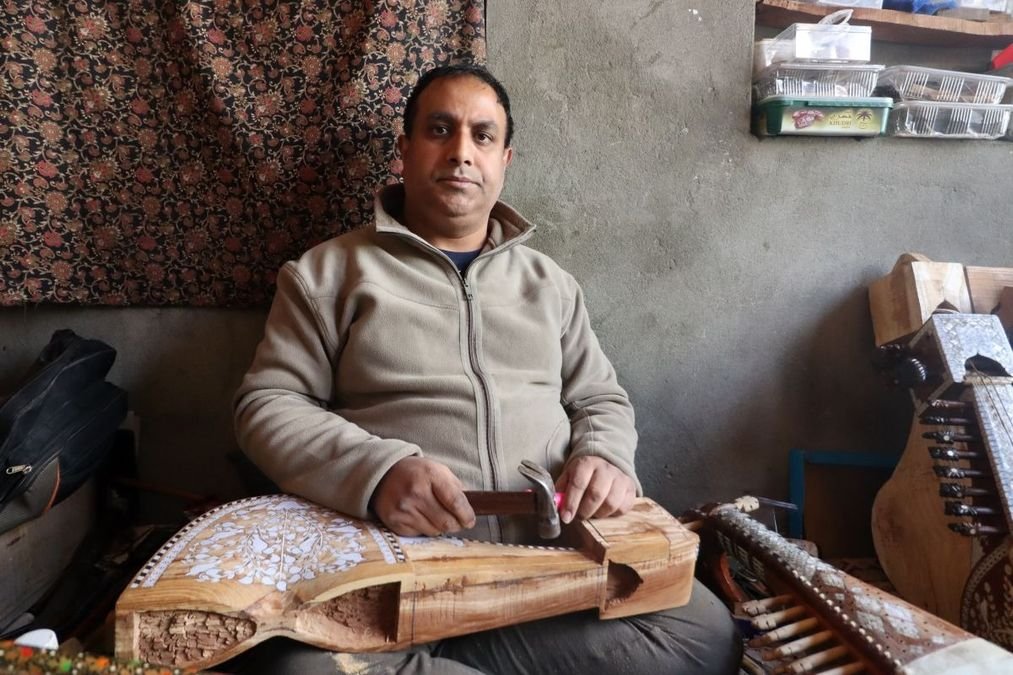
Srinagar: At an age when most children are busy with schoolbooks and playgrounds, Mohammad Altaf Sheikh found himself drawn to a different world, one filled with the scent of mulberry wood, the sound of traditional instruments and the quiet rhythm of craftsmanship.
Today, in Srinagar’s Safakadal, Altaf is carrying forward a legacy left behind by his late father, Ustad Ghulam Nabi Sheikh, a renowned Kashmiri instrument maker remembered for his contribution to the traditional art of crafting the Kashmiri sarangi and rabab.
For him, the craft is more than a profession. It is an inheritance shaped by childhood memories, years of practice and a deep connection to Kashmir’s musical and spiritual heritage.
“I am the son of the legendary Ustad Ghulam Nabi Sheikh,” Altaf says with pride, remembering his father as an artist who earned great respect for his skill and craftsmanship.
His journey began during a difficult period in Kashmir’s history. In the 1990s, when the political situation had deeply affected everyday life, Altaf’s father stopped sending him to school. However, he never directly instructed his young son to take up instrument-making as a profession.
Instead, Altaf would sit quietly in front of his father, watching him work, observing how a piece of wood gradually transformed into an instrument capable of producing soulful melodies.
Curiosity eventually turned into passion.
“One day, my father caught me trying to make an instrument behind his back. That was when he began teaching me how to make it properly and perfectly,” Altaf recalls.
What began as childhood fascination soon became a lifelong pursuit. Under his father’s guidance, he learnt the techniques, patience and precision required to create traditional Kashmiri musical instruments by hand.
After his father’s death, Altaf took on the responsibility of preserving the family’s craft, determined to ensure that the knowledge passed down to him would not disappear with the passing of its master.
Wood becomes music
Inside his workspace in Noorbagh, the process begins with mulberry wood, which is left to dry naturally in the sun before being shaped and carved.
The transformation is slow and demanding. Every curve, cut and detail requires a steady hand and years of experience. From shaping the instrument’s wooden body to carving its intricate patterns, the work depends on traditional skills rather than machine-made precision.
A single Kashmiri sarangi can take one to two months to complete.
For Altaf, every instrument carries a part of its maker.
“I invest my time and soul to make one sarangi,” he says, describing the dedication that goes into creating an instrument capable of preserving the distinctive character of Kashmir’s traditional music.
His work is closely connected to Sufiana Mausiqi, Kashmir’s classical musical tradition, in which the sound of traditional instruments has long accompanied spiritual expression and contemplation.
Altaf describes this music as something that reaches beyond entertainment.
“This is spiritual music. It is precious for those who love it. It brings joy to the heart, and when the rabab is played, it brings peace and rest to the soul,” he says.
For him, the instruments he creates are not merely objects of craftsmanship. They are vessels of melody, memory and devotion — connecting musicians and listeners to a cultural heritage that has endured across generations.
The secrets behind the craft
Altaf believes that while others may attempt to reproduce his family’s designs and craftsmanship, there are elements that cannot easily be replicated.
He says three closely guarded aspects of the family’s rabab-making tradition distinguish his instruments from imitations. He does not disclose the details, but maintains that these techniques, developed and refined through generations of practice, contribute to the instrument’s distinctive character.
The knowledge, he believes, comes not simply from copying a design but from understanding the craft at a deeper level — something acquired through years of working with wood, learning from experience and listening to the instrument’s voice.
“Our father started this work and built this legacy in Kashmir,” he says, underscoring the family’s place in a tradition he hopes will continue long after him.
An inheritance for the next generation
Today, Altaf sees himself as both a craftsman and a custodian of his father’s memory.
Every instrument he completes is a reminder of the man who first introduced him to the craft, the lessons learnt by watching him work and the techniques passed down through patient instruction.
His ambition is to see the tradition continue through his children, ensuring that the family’s knowledge reaches another generation.
For Altaf, preserving the craft means safeguarding more than a livelihood. It means protecting a part of Kashmir’s cultural identity, its spiritual music and the handmade artistry that gives traditional instruments their character.
In an age increasingly shaped by machines and mass production, his work remains rooted in the intimacy of handcraft — a piece of mulberry wood, a craftsman’s tools and the accumulated wisdom of years.
He began by watching his father.
Now, years after his father’s passing, he continues to carve the instruments that keep that legacy alive, hoping that one day his children will do the same.
For Mohammad Altaf Sheikh, the music may begin in the hands of a craftsman, but the legacy belongs to generations yet to come.


