






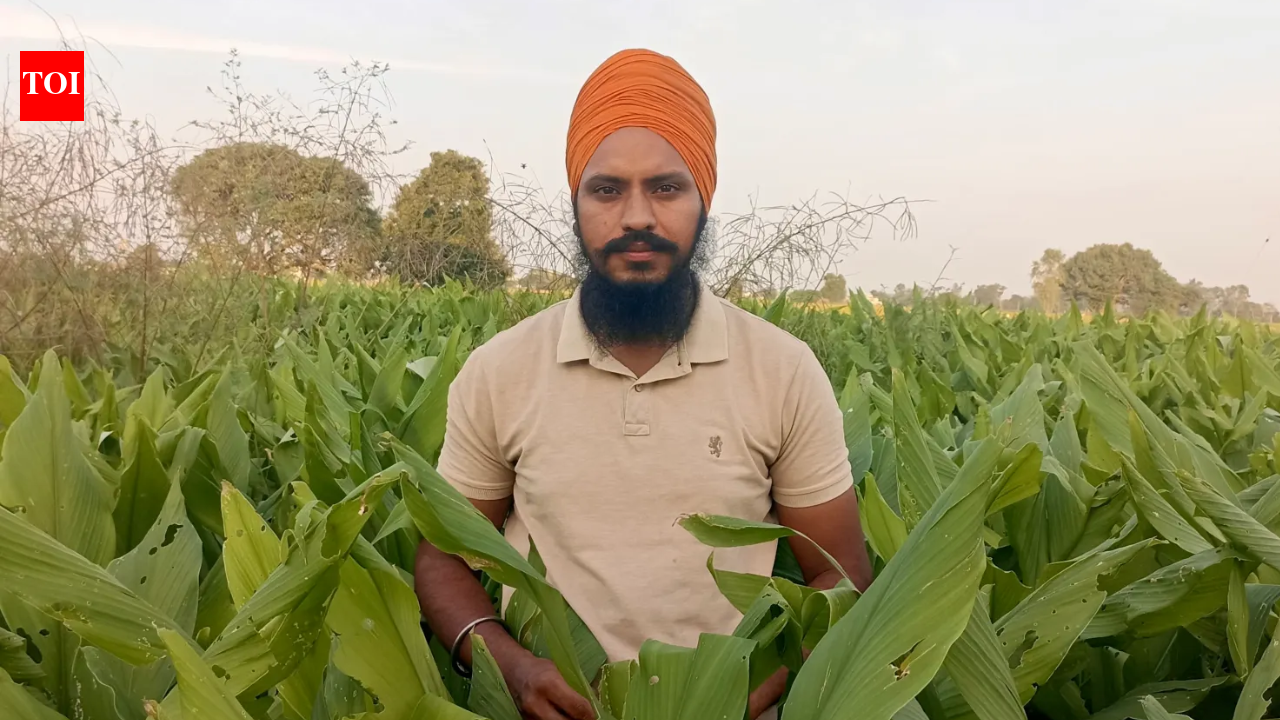
When Jobandeep Singh completed his mechanical engineering degree, he could have followed a familiar path: find a job, build a career and perhaps move abroad, as many of his classmates did. Instead, the 32-year-old made a decision that took him back to his village in Punjab. In 2015, after working for just four months, he quit his job and returned to his family’s land in Mala Khedi village in Amritsar district.His ambition was not simply to become a farmer. He wanted to build a business around agriculture, one that would allow him to grow a variety of crops, find his own customers and make farming economically viable on a relatively small landholding.More than a decade later, Singh cultivates organic crops on four acres of his five-acre holding, keeps livestock, practises poultry farming and beekeeping, and sells his produce directly to around 50 regular customers. His farm, marketed under the brand Asees Natural Farm, is also Punjab Agro-certified. His efforts have earned him the Surjit Singh Dhillon Outstanding Small Farmer Award from Punjab Agricultural University (PAU), Ludhiana.In a state where agriculture is heavily associated with the wheat-paddy cycle, Singh’s approach is to grow a wider range of crops and connect production with the people who buy his food.
From a small beginning to a diversified farm
Singh did not begin by cultivating all five acres. His family had owned 12 acres before the land was divided, leaving him with five acres. Much of the land had been leased out, and he gradually brought it back under cultivation after completing his studies.In 2017, he began growing turmeric on two kanals, equivalent to a quarter of an acre. He also cultivated traditional basmati rice on one acre during the kharif season and wheat during the rabi season. The response to his produce encouraged him to expand.By 2019, he had introduced vegetables, millets such as ragi and kangni, fodder crops and more turmeric. Over time, the farm developed into a more diversified operation, with different crops grown in smaller plots rather than concentrating on the conventional wheat-paddy combination.“Today, four of my five acres are under organic cultivation. Instead of concentrating on the wheat-paddy cycle that dominates Punjab agriculture, I have divided my fields into small plots, growing a range of crops, including fennel, flaxseed, black gram, white chickpeas, lentils, mustard, peas, vegetables and basmati,” Singh told The Indian Express.The choice of crops changes with the agricultural season. During rabi, he grows crops such as organic wheat, mustard, lentils, black gram, white chickpeas, peas and fodder. During kharif, his farm produces basmati varieties 1121 and 1509, among other crops.For Singh, diversification is not merely about having more varieties of produce available. It is central to how he wants to run his farm. “I always wanted to do business and started directly with organic farming instead of sowing MSP crops,” he said.He estimates that his model can generate a net profit of up to Rs 3 lakh per acre, provided the farm is managed well and weather conditions remain favourable. This is his estimate of the model’s potential, not a guaranteed return for every farmer. The remaining acre of his holding accommodates his house, cattle shed and fodder for the animals.He also says the farm meets more than 90% of his household’s daily needs, leaving the family to purchase only a few essentials from the market.
The business is not just about growing crop
A farm may produce good-quality food, but finding people willing to buy it regularly is another challenge. Singh’s early experience outside farming helped him address that problem.After graduating, he spent a few months working at his brother-in-law’s dairy, helping deliver milk to households in Amritsar. The work gave him an opportunity to build relationships with customers even before he had developed his own farming enterprise.“When I started growing crops, several of those households began buying my products. That encouraged me because I already had customers before developing my farming model,” Singh said. That initial network gave him a starting point for direct sales. Today, he sells produce at the Sunday market in Company Bagh, Amritsar, and markets his products under the Asees Natural Farm brand. He has around 50 regular customers, including people from lower-income households.Instead of relying entirely on an intermediary to sell what he grows, Singh has made customer relationships part of his agricultural business. Buyers know where their food comes from, while he has a more direct route to the market.But the arrangement also demands more of his time. “Unlike conventional wheat-paddy farming, my model requires daily involvement, from tending crops and managing livestock to processing and selling produce,” he said.
Singh sells his farm produce directly to around 50 regular customers. (Photo courtesy: The Indian Express)
Dairy, poultry and beekeeping complete the picture
Crop cultivation is only one part of Singh’s farm. His dairy unit has five animals, including indigenous and crossbred cows and Murrah buffaloes. The milk supports his household and his brothers’ families, who use it to prepare curd, lassi, paneer and desi ghee. Any surplus is sold.The animals also provide manure for the fields, linking livestock management with crop cultivation. Rather than treating the different activities as separate businesses, Singh uses them to support one another.He relies on farmyard manure and prepares jeevamrit, a mixture made from cow dung, cow urine, jaggery, besan and water. The mixture is left to ferment before being applied to the fields through spraying or irrigation. Depending on the season, fermentation takes four to five days in summer and up to 15 days in winter.He also grows green manure, uses crop residues sourced from neighbouring fields for mulching and relies on manual weeding instead of chemical weedicides. These practices, he says, help him avoid expenditure on chemical fertilisers and pesticides.His approach has developed through practical experience as well as training. He has attended programmes associated with Punjab Agricultural University, Krishi Vigyan Kendra and Punjab Agro.
The economics of organic farming
For Singh, the case for organic farming is also a business question. He believes that a diversified farm can offer an alternative to dependence on crops whose procurement prices are determined through the minimum support price (MSP) system. However, he is clear that growing organically does not automatically translate into higher profits.Organic crops may produce lower yields than conventionally cultivated crops. Singh argues that the higher prices such produce can command may compensate for the difference, provided farmers manage their operations well and find buyers willing to pay for the produce.His model also creates seasonal employment. Despite cultivating a relatively small area, he employs at least five people regularly for around six months each year.He wants consumers to look beyond the price of individual products and understand the work involved in producing them. In his view, greater demand for genuine organic produce can strengthen the market and eventually make such food more accessible at competitive prices.At the same time, the economics remain important for the future of farming. In an interview with The Tribune published in May 2026, Singh spoke about the need for farmers to earn enough to sustain their livelihoods. “For passion, a person may continue farming throughout life. But if income is insufficient, the next generation will leave the profession,” he said.It is a concern that goes beyond his own farm: a farming model can be environmentally conscious, but it must also provide a viable livelihood if younger people are to consider agriculture a long-term career.
A different idea of success
Singh’s journey has not been about expanding into a large landholding or abandoning agriculture for a more conventional career. He has instead focused on making the land available to him work in different ways – through crop diversity, livestock, natural inputs and direct relationships with customers.His work was recognised by PAU with the Surjit Singh Dhillon Outstanding Small Farmer Award, which honours his adoption of organic farming practices and eco-friendly agricultural technologies. The award was also mentioned in The Times of India‘s September report on farmers selected for recognition at the joint Kisan Mela and Pashu Palan Mela organised by PAU and Guru Angad Dev Veterinary and Animal Sciences University.Singh’s experience does not suggest that every farmer can replicate his model or earn the same returns. Crop choices, weather, labour, local demand and access to customers all influence whether a diversified organic farm succeeds.What it does demonstrate is that farming can be approached as more than the cultivation of a single crop for sale. By starting on a small patch, expanding gradually and building a customer base alongside production, Singh has created an agricultural enterprise around the resources available to him.For someone who left an engineering job after four months, the return to his village was not a retreat from business. It was a decision to pursue it on his own terms – with the farm, its produce and the people who buy it at the centre of the enterprise.


