






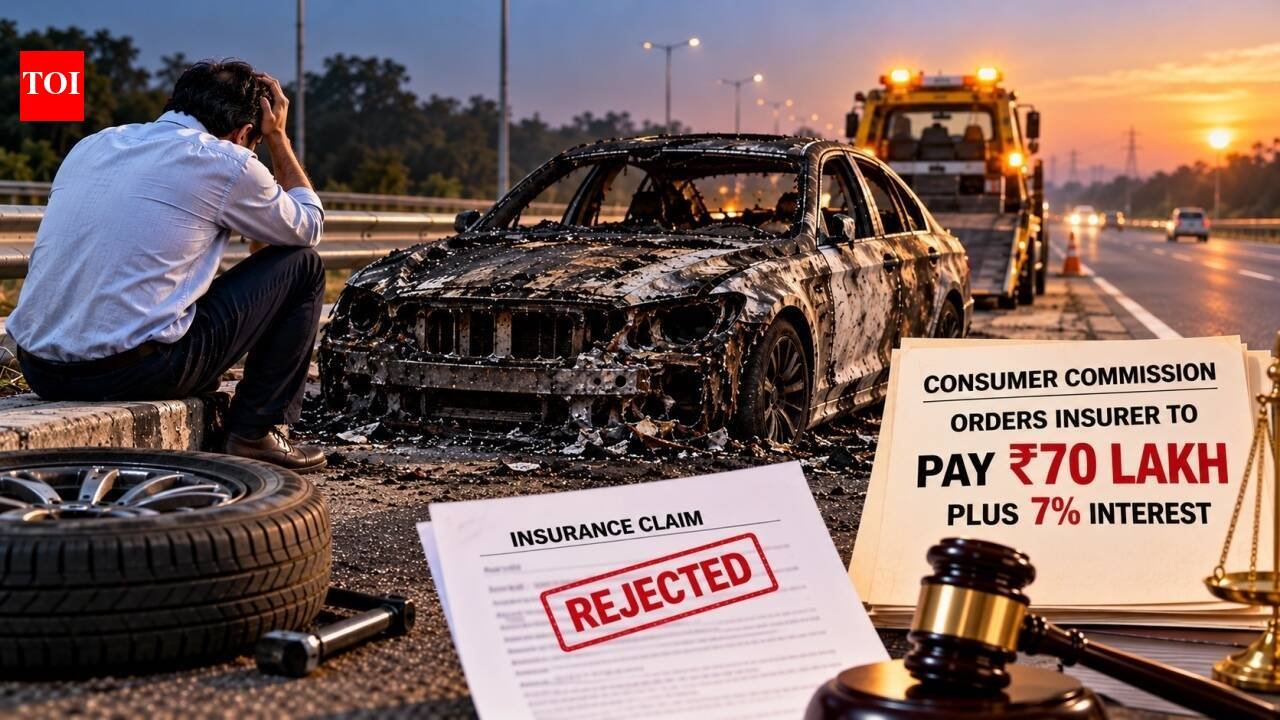
You leave your punctured car on the roadside and in the morning it is found burnt. Should the insurer give a payout? In one such case a man’s BMW developed a tyre puncture on the highway late at night. Since it was already quite late, he and his driver locked the vehicle and parked it on the roadside before travelling back in another vehicle.The following morning it was found to be completely gutted by fire. Since the vehicle was insured, the man expected the insurance policy to cover the loss. But it didn’t.
What the case is about
According to the complaint filed by the man, he left the BMW on the highway overnight after it suffered a puncture. However, the next morning the vehicle was found to be completely burnt. The incident was subsequently recorded by the local police and fire department.The BMW carried an Insured Declared Value (IDV) of Rs 70,00,000, while the had paid an insurance premium of Rs 1,65,996 for the policy.He informed the insurance company that it was not possible to prepare a repair estimate because the authorised dealer had declared the vehicle to be completely damaged.After receiving this information, the insurer registered the matter as a major “Total Loss” claim and told the man that the settlement decision would have to be taken by its MD in Chennai.The car owner later sent a follow-up letter to the MD, but the insurer rejected the claim.The matter turned into a prolonged legal dispute. The motor insurance company refused to pay the claim based on the vehicle’s Insured Declared Value (IDV), citing the fact that it had been left unattended. The car owner subsequently approached the Consumer Commission seeking payment under the insurance policy.The Maharashtra State Consumer Disputes Redressal Commission has now ruled in the car owner’s favour and ordered the motor insurer to pay the IDV along with interest. The decision brings an end to a legal battle that continued for more than a decade for the Solapur resident.
Why did the insurer reject the IDV claim?
The insurer alleged that the man had violated several conditions of the policy. It specifically claimed that he had failed to promptly inform both the police and the insurance company in writing. The insurer also said he had “breached Condition No. 4 by leaving the vehicle unattended on the road without taking proper precautions to prevent further loss.”The company argued that the incident involved only a minor breakdown, namely a tyre puncture, and was not an accident. According to the insurer, the car owner or his driver should have remained with the BMW or shifted it to a safer location nearby, such as a village or Dhaba, instead of leaving the vehicle unattended.The insurer also referred to the BMW’s earlier insurance policies and the gap during which the vehicle did not have insurance cover. On that basis, and after accounting for depreciation, it assessed the vehicle’s value at no more than Rs 59 lakh, according to an ET report.
Why did the consumer commission rule in favour of car owner?
The commission found that the man had not violated ‘Condition No. 4 of the Insurance Policy’. The condition requires that when an insured vehicle breaks down, it must not be left unattended “without proper precautions being taken to prevent further damage or loss.”In its order, the state commission clarified that the policy does not impose an absolute ban on leaving a vehicle that has broken down. Instead, the condition requires the insured to take appropriate precautions to prevent any further damage or loss before leaving the vehicle unattended.The commission noted that, given the late hour, there were no tyre repair facilities or mechanics available. The man was therefore faced with an unexpected situation. It further observed that the fact that the BMW had been locked and left by the roadside was not the proximate cause of the fire. The commission also did not agree with the insurer’s contention that the vehicle had been deliberately set on fire.The commission further dismissed the insurer’s assessment that the BMW was worth Rs 56 lakh. It held that the insurance company could not independently reduce the vehicle’s value through depreciation when settling the claim.The commission directed the insurance company to pay Rs 70 lakh, which is the BMW’s Insured Declared Value (IDV), along with interest at 7% per annum. The interest is to be calculated from the date on which the claim was repudiated, November 23, 2012, until the amount is actually realised.Apart from the IDV and interest, the insurer has been ordered to pay Rs 50,000 as compensation for mental agony and harassment. It must also pay Rs 25,000 towards the expenses incurred in the litigation.According to Sarthak Prashar, Director, Global People Solutions at Grant Thornton Bharat, the Consumer Commission ruled in favour of the car owner as it found the insurer’s repudiation of the claim unjustified.“The relevant policy condition did not impose an absolute prohibition on leaving a disabled vehicle unattended; it required the insured to take reasonable precautions to prevent further loss or damage. In this case, after the vehicle suffered a tyre puncture late at night on a highway, it was parked safely near a known landmark, with the windows rolled up and the vehicle securely locked,” explains Prashar.“The Commission considered these precautions reasonable in the circumstances and held that the policy could not be interpreted to require the driver to compromise personal safety by remaining with the vehicle overnight,” he tells TOI.“Importantly, the insurer could not establish any causal nexus between the vehicle being left unattended and the subsequent fire. There was no evidence of wilful breach, gross negligence or mala fide conduct by the insured. Accordingly, the repudiation was held to constitute deficiency in service, and the insurer was directed to honour the claim,” he adds.
Lessons when taking car insurance
Sarthak Prashar says that the key takeaway is that motor insurance should not be treated merely as a price-driven purchase.“Policyholders should understand the scope of coverage, exclusions, policy conditions and the Insured Declared Value (IDV), particularly since these can directly affect claim settlement. The judgment also reinforces the importance of taking reasonable precautions when a vehicle breaks down or an unforeseen event occurs. What constitutes a reasonable precaution will depend on the facts and practical circumstances of each case; the policyholder is not expected to take steps that could compromise personal safety,” he says.From a claims perspective, incidents should be reported promptly, relevant records and evidence should be preserved, and the insured should cooperate with the insurer’s claim process.“At the same time, repudiation for breach of a policy condition should have a direct nexus with the loss suffered. Technical non-compliance, particularly where it did not cause or contribute to the loss, should not by itself defeat an otherwise genuine claim,” he adds.


