





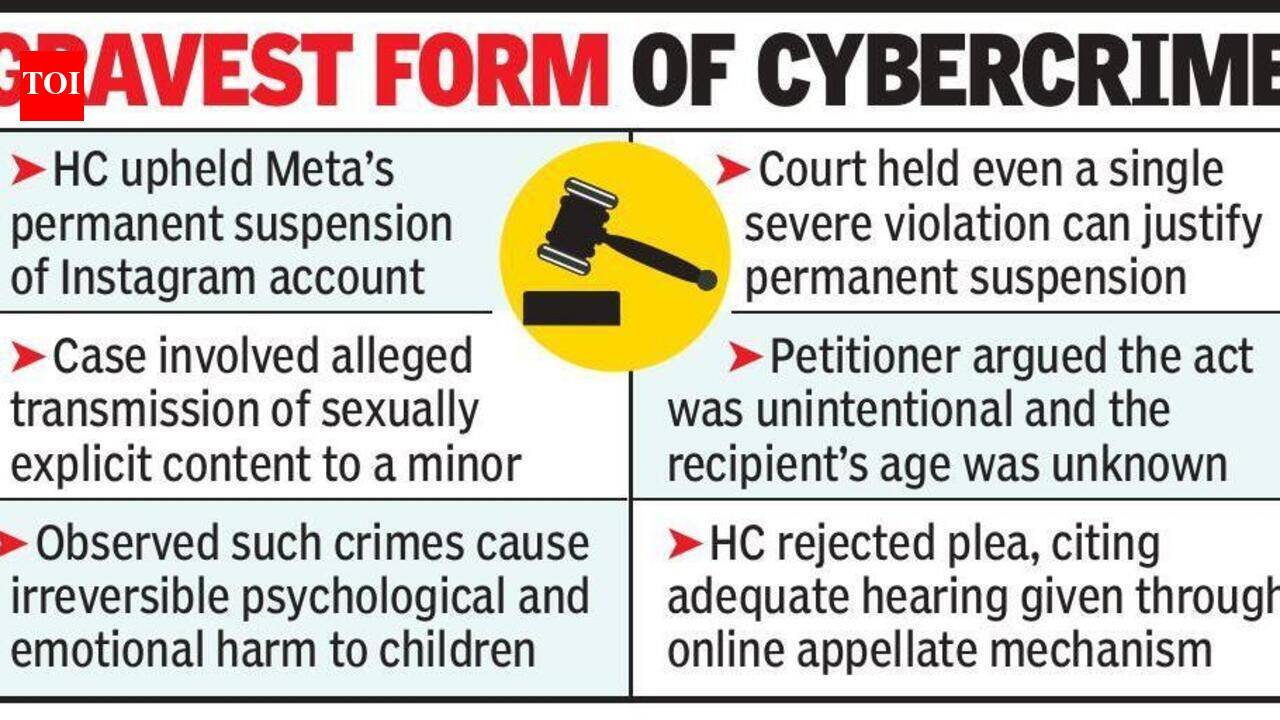
Nagpur: The Nagpur bench of Bombay High Court recently upheld Meta’s decision to permanently suspend an Instagram account of a city-based influencer accused of sharing sexually explicit content with a minor, observing online child sexual exploitation was emerging as “one of the most serious forms of cyber-enabled crime”.A division bench comprising Justices Anil Kilor and Raj Wakode dismissed a writ filed by an influencer, who challenged the permanent suspension of his Instagram account after failing to obtain relief from the Grievance Appellate Committee constituted under Information Technology (Intermediary Guidelines and Digital Media Ethics Code) Rules, 2021.In a strongly worded order, the court underscored the growing dangers posed by online child exploitation and endorsed Meta’s strict enforcement policy against explicit content.“Online child sexual exploitation has emerged as one of the most serious forms of cyber-enabled crime, causing irreversible physical, psychological and emotional harm to children,” the bench observed.As per court record, Meta found “multiple violations” of its community standards on child sexual exploitation, abuse and nudity while reviewing the petitioner’s account. The company subsequently suspended the account permanently.The petitioner, represented by advocate Priti Badwaik Pendke, appointed through the legal aid cell, argued the alleged transmission was “entirely unintentional” and claimed he was unaware the recipient was a minor. She argued that Meta ought to have granted him an opportunity to correct the mistake before imposing the harsh penalty.However, deputy solicitor general of India Karthik Shukul, appearing for the Union govt, argued that even a single instance involving child sexual exploitation was sufficient to justify immediate action under applicable rules and platform policies.The bench accepted the contention, noting that Meta’s policy permits permanent suspension “if the violation is severe enough” even after a single occurrence.“Meta’s zero-tolerance policy cannot be faulted as being arbitrary or disproportionate. Rather, it constitutes a necessary and proportionate response to one of the most heinous forms of online abuse,” the court said.The judges further observed that social media intermediaries had a corresponding responsibility to ensure their platforms were not misused for facilitating or promoting child exploitation.Referring to Rule 3 of the Information Technology Rules, 2021, the bench said intermediaries were empowered to terminate user access immediately in cases involving obscene, paedophilic or exploitative material.


