






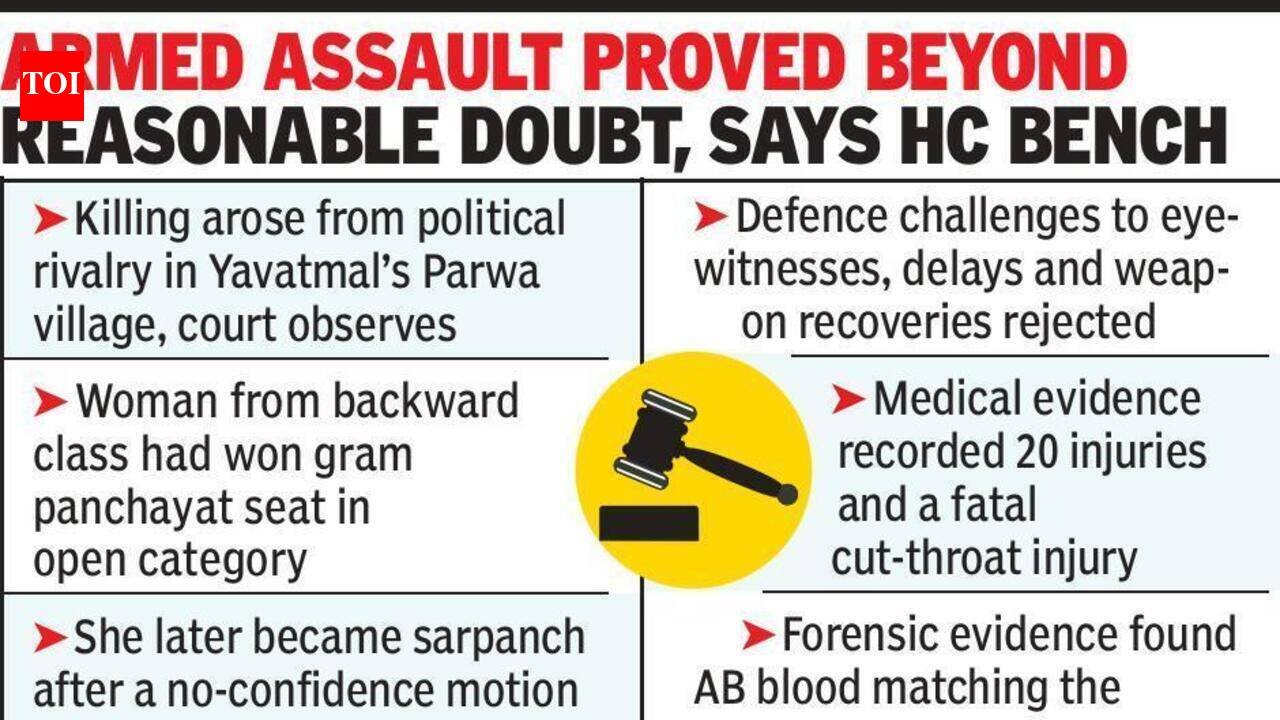
Nagpur: A woman from a backward community winning a gram panchayat seat in the open category and subsequently becoming sarpanch sparked a political rivalry that eventually led to the murder of her husband in Yavatmal’s Parwa village in 2018, the Nagpur bench of the Bombay high court observed while affirming life terms awarded to 10 accused.A division bench of Justices Urmila Joshi-Phalke and Nivedita Mehta dismissed five connected appeals challenging the January 20, 2020 judgement of the additional sessions judge, Yavatmal, in a special (atrocity) case.The case traces its origins to local political developments in Parwa village. A woman from a backward community won a gram panchayat seat in the open category in 2015 and later became sarpanch in January 2016 after a no-confidence motion unseated the incumbent. According to the prosecution, her elevation was opposed by members of a rival political faction in the village.The prosecution alleged that tensions steadily escalated over issues including caste-based abuse, allocation of a water hand pump and election of Tanta Mukti Samiti. On January 27, 2018, the woman was allegedly threatened that her husband would be killed. The following day, her house was reportedly attacked and household articles damaged.The violence culminated on March 27, 2018, when her husband was allegedly assaulted near an anganwadi centre by a group armed with swords, knives, guptis, sickles, satturs and iron rods.To establish its case, the prosecution examined the complainant, her son and other relatives as eyewitnesses. The defence questioned their credibility, citing their relationship with the deceased and political affiliations. It also raised concerns over the complainant’s conduct after the incident, delays in registration of FIR and recording of statements, and recoveries of weapons from allegedly open places.Rejecting these contentions, the high court held that the delays had been satisfactorily explained by the investigating officer of Awdhootwadi police station. The court noted that police received information about the assault at about 2.05 pm, immediately rushed to the spot, shifted the body and completed preliminary entries before registration of the FIR.The bench found substantial corroboration from medical evidence. Doctors recorded as many as 20 injuries on the victim and opined that death occurred due to “shock and hemorrhage following multiple stab injuries with evidence of cut-throat injury.”The prosecution relied on the testimony of 18 witnesses, along with spot and inquest panchnamas, memorandum statements, weapon recoveries, forensic evidence and chemical analyser reports. The court noted that blood of group AB, matching that of the deceased, was detected on several seized articles, including soil samples, clothing and weapons.Dismissing defence argument that inconsistencies in eyewitness accounts rendered them unreliable, the bench observed that evidence must be “weighed and not counted”. It further held that witnesses to a sudden group assault could not be expected to provide a “photographic account” of the incident, and that minor omissions or improvements did not undermine otherwise trustworthy testimony.Upholding the convictions, the court also affirmed the finding regarding the common object of the unlawful assembly under Section 149 of the IPC, observing that members of such an assembly can be held liable if they were aware that the offence was likely to be committed in pursuit of the group’s common object.


