



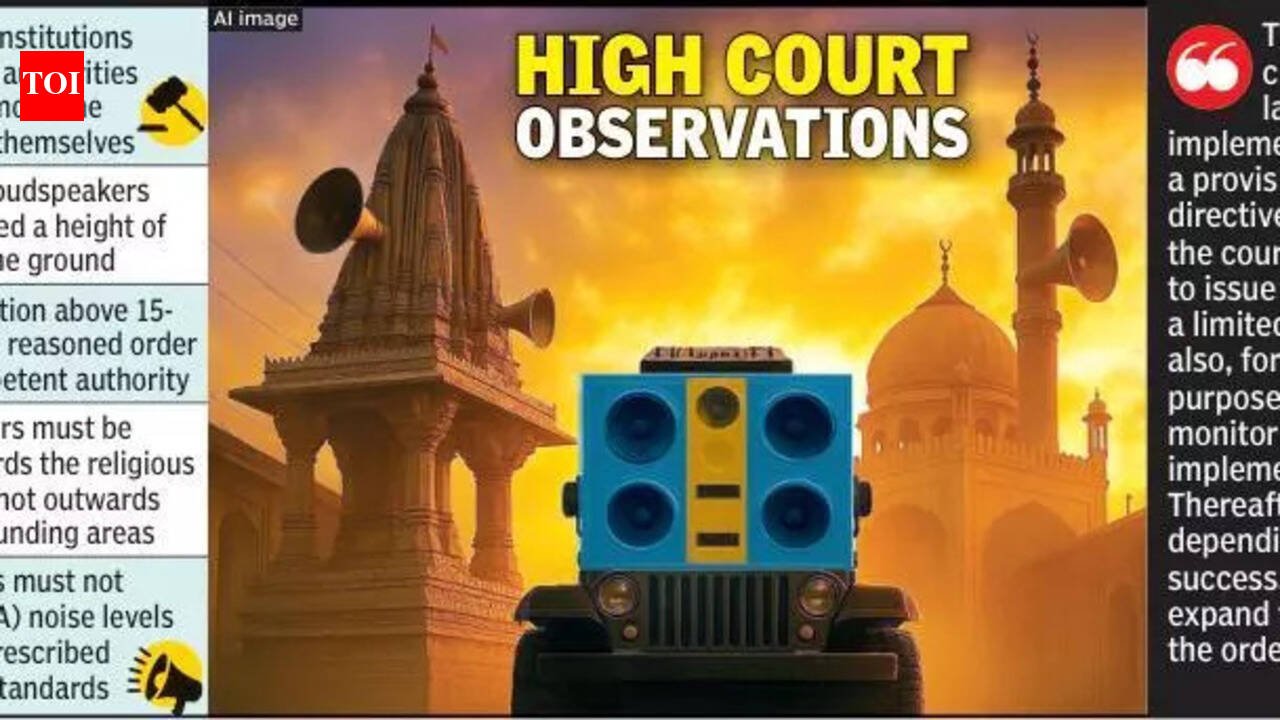
Nagpur: The Nagpur bench of the Bombay high court on Thursday ordered authorities to remove loudspeakers installed without permission at religious places in Nagpur within 7 days, initiating a monitored enforcement drive to curb noise pollution in the city.Taking note of repeated violations, division bench comprising Justices Anil Pansare and Nivedita Mehta observed that “there is complete lack of implementation, be it a provision of law or directives issued by the courts.” The directives were issued while hearing a bunch of PILs (No 8 and 90 of 2025 and suo motu PIL 16/2025).“We intend to issue directives for a limited area, and also, for a limited purpose, and to monitor its implementation. Thereafter, depending on success, we will expand the scope of the order,” the bench stated. Referring to the Noise Pollution (Regulation and Control) Rules, 2000, the court reiterated that loudspeakers or public address systems cannot be used without written permission from the designated authority, which includes the district magistrate and police commissioner. The court directed the collector and police commissioner to publish a public notice in widely circulated newspapers asking all religious institutions to remove loudspeakers installed without permission within seven days of the notice. In case of non-compliance, the authorities were instructed to remove the equipment themselves. For loudspeakers installed with prior permission, the bench mandated that their height must not exceed 15 feet from the ground. If this limit exceeds, the authority must issue a reasoned order explaining the necessity. The judges also directed that the loudspeakers must be oriented towards the religious structure rather than outwards. Any deviation requires a separate reasoned order from the authority. The court noted that “the arrangement will achieve balance between right to speech and right to listen or decline to listen,” adding that the freedom of speech under Article 19 also includes “freedom not to listen and/or to remain silent”. The court also addressed other major sources of noise and air pollution. It directed the Chief Controller of Explosives to ensure that the maximum sound output of firecrackers does not exceed 75 dB(A) or the limit prescribed under Indian standards, whichever is lower, and to prevent the manufacture of firecrackers harmful to air quality. Authorities including the district magistrate, police commissioner and municipal commissioner were instructed to verify whether event lawns and marriage halls in Nagpur possess the required permissions. They must ensure that DJs, sound systems and firecrackers are not used during ceremonies without prior approval from the competent authority. The bench said issues related to noise pollution from vehicles and construction activities will be examined in subsequent hearings. Parties were asked to submit suggestions regarding implementation of the rules and directives issued by courts. The judges directed all authorities to submit a compliance report before the next hearing scheduled for March 12. Advocate BK Wasnik appeared in one of the petitions. Advocate Ashutosh Dharmadhikari represented petitioner Awantika Chitnavis in another case. Mugdha Chandurkar, instructed by deputy solicitor general Kartik Shukul, appeared for the Union govt. Abdul Subhan was amicus curiae, while NS Rao represented the state govt.


