






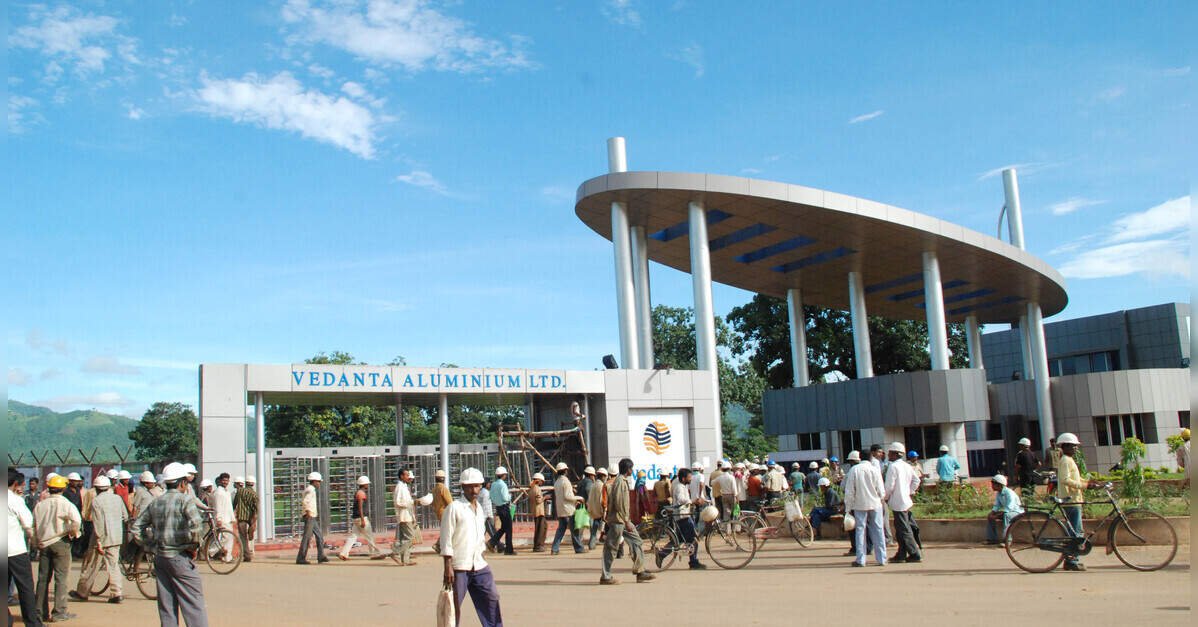
Bhubaneswar: The Orissa High Court on Thursday dismissed a petition filed by Vedanta Ltd seeking supply of 150 million tonnes of bauxite at rates envisaged under a 2004 agreement with Odisha Mining Corporation (OMC), holding that the company could not invoke rights under agreements that had been terminated and rendered unworkable by subsequent statutory changes.
A division bench of Chief Justice Harish Tandon and Justice Murahari Sri Raman held that Vedanta’s claim was founded on assurances contained in MoUs and agreements executed between 2003 and 2009, under which 150 million tonnes of bauxite were proposed to be supplied for its alumina refinery at Lanjigarh. Vedanta argued that it had invested heavily in Odisha on the strength of these assurances and was therefore entitled to insist on supply of bauxite at the agreed pricing formula.
The court, however, noted that the original joint venture arrangement between OMC and Vedanta was terminated in September 2015 after amendments to Mines and Minerals (Development and Regulation) Act changed the legal framework governing mining operations and govt-company joint ventures. The termination was never challenged by Vedanta and had attained finality, the bench observed.
The judgment recorded that after termination of the joint venture, Vedanta participated in the state’s Long-Term Linkage (LTL) mechanism, applied under the 2018 policy and entered into LTL sale agreements with OMC. The company subsequently executed another LTL agreement in 2023 and continued to receive supplies under the revised policy framework.
The bench held that by participating in the new regime and accepting its benefits, Vedanta had acquiesced to the changed framework and could not seek to resurrect rights flowing from the terminated agreements. “By participating in the later process as laid down under the amended provisions, it has acquiesced by its own conduct,” the court said.
Examining the doctrine of promissory estoppel in detail, which Vedanta sought to invoke, the court referred to several Supreme Court judgments and reiterated that while the doctrine can be invoked against govt in appropriate cases, it cannot be used to compel the state to act contrary to statutory provisions or in matters involving natural resources governed by law. Promissory estoppel is a legal doctrine that prevents a govt or party from reneging on a promise that induced another party to make investments or alter its position, unless enforcing the promise would conflict with law or overriding public interest.
The bench further held that under Section 17A of MMDR Act and Rule 45 of the Minerals (Other than Atomic and Hydro Carbons Energy Minerals) Concession Rules, 2016, the authorities were justified in determining the pricing mechanism and raising demands accordingly. Finding no merit in the petition, the court dismissed the case, vacated interim orders and allowed the authorities to take follow-up action in accordance with law.
Vedanta had argued that Odisha and OMC assured it of long-term availability of 150 million tonnes of bauxite under the 2003-2007 MoUs and 2004 agreement. Relying on those assurances, it invested heavily, more than Rs 1 lakh crore in two decades, in setting up its alumina refinery at Lanjigarh and downstream aluminium facilities. Therefore, the state should be held to its promise and continue supplying bauxite on the originally agreed pricing formula.
Advocate general Pitamabar Acharya had argued that the original 2003 MoU was superseded by the 2007 MoU, which itself was valid only for two years and was never extended. Therefore, Vedanta could not seek enforcement of the MoUs after more than 16 years.
Vedanta enjoyed interim protection for more than three and a half years in the present writ petition, from March 29, 2023 until the judgment on Oct 1, 2026, enabling it to lift bauxite at the interim price of Rs 1,000 per tonne, against a market price of Rs 2,000 to Rs 4,500, while the dispute over the final pricing mechanism remained pending.


