






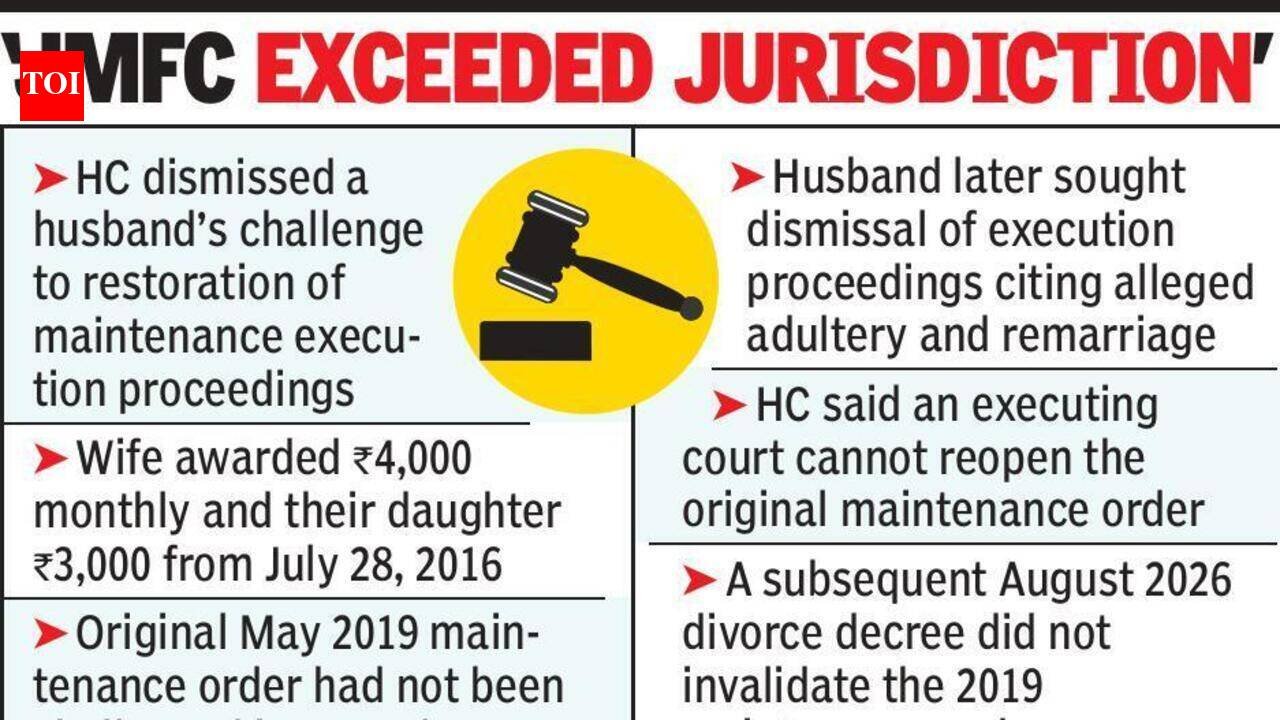
Nagpur: The Nagpur bench of Bombay High Court recently held that a maintenance order cannot be indirectly challenged in execution proceedings by raising a subsequent allegation that the wife was living in adultery. It ruled that such a disputed issue must be pursued through appropriate legal proceedings.Justice Mehroz Pathan dismissed a petition filed by a Gadchiroli teacher, challenging the restoration of maintenance execution proceedings initiated by his wife.The court held that the executing court had exceeded its jurisdiction by examining the allegation that the wife had remarried and was living in adultery while considering the husband’s application to terminate the execution proceedings.The dispute arose from a maintenance order passed by Chamorshi JMFC on May 6, 2019, in proceedings under the Domestic Violence (DV) Act. It directed the husband to pay ₹4,000 a month to the wife and ₹3,000 a month to the daughter, from July 28, 2016. The husband did not challenge that order.After execution proceedings were initiated for enforcement of the maintenance order, the petitioner filed an application in 2023 seeking their dismissal. He relied on subsequent developments, including the wife’s alleged second marriage and her alleged relationship with another man.The JMFC court accepted his application on May 30, 2024, holding that there had been a change in circumstances warranting dismissal of the execution proceedings.The wife and daughter challenged the order before Gadchiroli Sessions Court. The revisional court, on April 11, 2025, set aside the magistrate’s order and restored the execution proceedings, holding that the original maintenance order continued to remain in force. The husband then approached HC.On August 12, 2026, Civil Judge, Senior Division, Gadchiroli, granted divorce to the husband on the ground that the wife was living in adultery.The husband relied on the divorce decree before HC, arguing that it established his allegation and that the wife was consequently barred from claiming maintenance under CrPC’s Section 125(4).Justice Pathan, however, held that the subsequent divorce decree could not affect the validity of the 2019 maintenance order or the execution proceedings.The court emphasised that the husband had allowed the original maintenance order to remain unchallenged. “If he wanted to contest the wife’s entitlement to maintenance on the grounds of adultery, the appropriate course was to challenge the original order under the DV Act or pursue a separate proceeding under CrPC,” it said.HC also noted that the wife had specifically denied the allegations of a second marriage and adultery. “The scope of the execution proceedings was limited to examining whether the JMFC’s order of maintenance was being duly complied with. The executing court could not sit in appeal over the original maintenance order or examine the correctness of findings,” the judge said.The court further observed that a mere allegation that a wife was living in adultery was not sufficient. “Such an allegation must be established through cogent and reliable evidence, and the party raising the plea must prima facie establish. It could not be used as a basis for denying or withholding maintenance already awarded, particularly in execution proceedings,” Justice Pathan said.


