



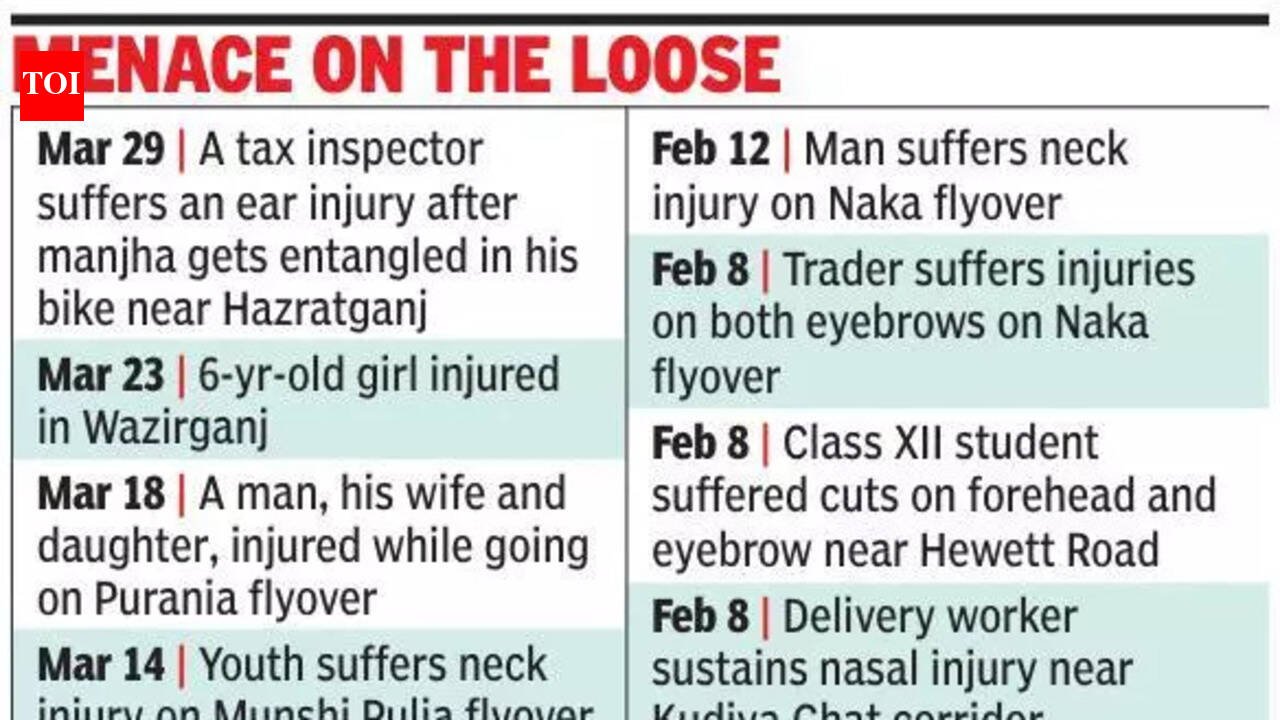
Lucknow: Flyovers across Lucknow have emerged as major danger zones due to the increasing menace of hazardous kite string, or “manjha”, with one person killed and at least 21 injured—many seriously—over the past one-and-a-half months. Data compiled from recent incidents shows that more than half of the accidents occurred on key flyovers, particularly at Naka, Chowk, Hussainganj, and Nakkhas. At least seven accidents have been reported on flyovers in the last 45 days alone, including five on the busy Naka flyover. Other major incidents were recorded at KGMU, Haiderganj, and Purnia flyovers. The most tragic case occurred on Feb 4 at the Haiderganj flyover, where Mohammad Shoaib, a medical representative, died after his throat was slit by the sharp string while commuting. A road safety expert, Vinod Acharya, said that flyovers have emerged as hotspots for manjha-related injuries due to a combination of speed and exposure. “On flyovers, two-wheeler riders travel at higher speeds and are more exposed, unlike congested inner roads. The thin, nearly invisible manjha gets stretched across open spaces and, at high velocity, acts like a sharp blade—often hitting the neck or face before the rider even notices,” said the expert. He added that the lack of trees, poles, and obstructions on flyovers allows the kite string to remain suspended at dangerous heights, increasing the risk of severe injuries. Despite the seriousness of the incidents, enforcement remains weak. At least six FIRs, including charges of culpable homicide not amounting to murder, have been registered at police stations such as Bazar Khala, Hussainganj, and Chowk. However, not a single arrest has been made so far, and in several cases, the accused remain unidentified. The repeated accidents have sparked demands for stricter enforcement, targeted action against sellers, and preventive measures such as regular checks on flyovers to avert further tragedies. “Bareilly glass-coated manjha is an extremely hazardous variety of kite string prepared by coating synthetic or nylon threads with a paste made of finely crushed glass and strong chemical adhesives,” a senior police officer explained. He said that the majority of injuries caused in Lucknow cases were from manjha from Bareilly district. “This process gives the thread a razor-sharp edge and significantly increases its tensile strength, making it far more dangerous than traditional cotton manjha.” The officer said that unlike conventional kite strings, which tend to snap under pressure, glass-coated manjha remains intact and can stretch across roads, especially on open stretches. He further noted that this variety is commonly manufactured and supplied from Bareilly and nearby regions, and despite bans, it continues to be sold illegally due to its popularity in competitive kite flying.


