



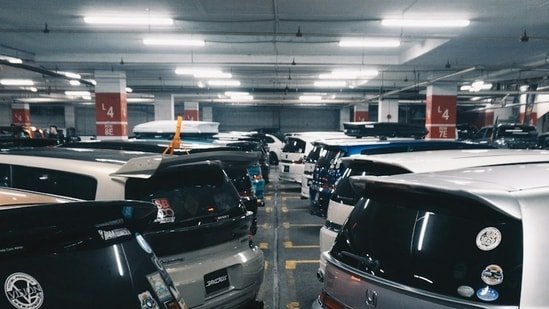
To address persistent parking issues in affordable housing societies, the Haryana government has made it mandatory for real estate developers to provide one car-parking space for each flat under the revised policy.
Industry observers said the changes are likely to enhance liveability in affordable housing projects. Still, the higher costs may marginally raise the entry barrier for homebuyers, particularly in cities such as Gurugram.


The move comes alongside the revised price cap of ₹5,575 per square foot (PSF) in Gurugram. While the increase slightly improves developer margins, the added cost of providing parking, estimated at around 10% of the flat price, could push up overall prices, making units less affordable for buyers, said real estate experts.
All about the one-car parking norm
As per the new norms, each dwelling unit must be allotted one Equivalent Car Space (ECS), with the parking cost set at 10% of the flat price. Developers are also required to clearly mark parking slots at the time of building plan approval to ensure greater transparency for buyers.
Any additional parking space, if available, can be designated for visitor parking or two-wheelers, offering some flexibility in layout planning while maintaining minimum standards.
Haryana has amended its 2013 Affordable Housing Policy, mandating one car-parking space per flat . The amendment, signed by Additional Chief Secretary (DTCP) Anurag Agarwal on April 6, formalises the requirement, stating that all parking slots must be clearly identified during plan sanctions. Earlier, the provision of parking in such projects was left to developers’ discretion, the Hindustan Times newspaper reported.
What happens to affordable housing projects that have already received the license?
For projects that have already received a license and approved building plans, the builder must get consent of at least two-thirds of allottees to implement the rule. However, projects that have already obtained an Occupation Certificate (OC) are exempt, the policy said.
Allotment rates for affordable housing set at ₹5575 sq ft
It should be noted that the Haryana government has revised the maximum allotment rates across cities based on carpet area. In Gurugram, the cap has been increased to ₹5,575 per square foot (PSF), along with an additional charge of ₹1,300 per sq ft for balcony space, capped at ₹1.3 lakh per flat.
Earlier, affordable housing rates in the city were capped at ₹5,000 per sq ft (carpet area) and ₹1,200 per sq ft for balcony areas.
Will the cost of affordable housing units go up?
As a result of these revisions, the cost of an affordable 600 sq ft apartment in Gurugram is now estimated at around ₹35–36 lakh. Additionally, the cost of parking, fixed at about 10% of the flat price, would add roughly ₹3.5–3.6 lakh, raising the overall cost for homebuyers.
“The Haryana amendment’s new PSF cap of 5,575 in Gurugram slightly increases developer margins, but the required parking, which costs 10% of the flat rate, will make things more expensive for buyers, making units even less affordable,” said Santhosh Kumar, vice chairman, ANAROCK Group.
As ANAROCK has repeatedly affirmed, to make affordable housing more attractive to developers, the segment needs focused, high-impact measures such as tax breaks for developers, so they shift their focus more to this vital segment rather than to the current premium and luxury segments, and for buyers, to improve affordability.
Bringing back the Credit-Linked Subsidy Scheme (CLSS) under PMAY for EWS/LIG buyers would give affordable housing buyers interest subsidies of up to ₹1.8 lakh, boosting demand. The government can also incentivise developers to build more affordable housing by reintroducing the 100% tax holiday benefit they previously enjoyed under section 80-IBA in the Finance Act, 2016. This section provides major tax relief on the profits earned from developing and building affordable housing projects, said Kumar.
A report by Anarock had earlier shown that there are limited affordable housing options in the primary market, as new supply in this category has declined substantially over the last few years.
A recent report by Knight Frank India showed that housing sales below ₹50 lakhs witnessed the steepest decline in the large base-volume category. Among the categories with the lowest base volume, this affordable housing price segment witnessed the steepest YoY decline of 23%, with residential sales of 16,273 units in Q1 2026, it noted.


