









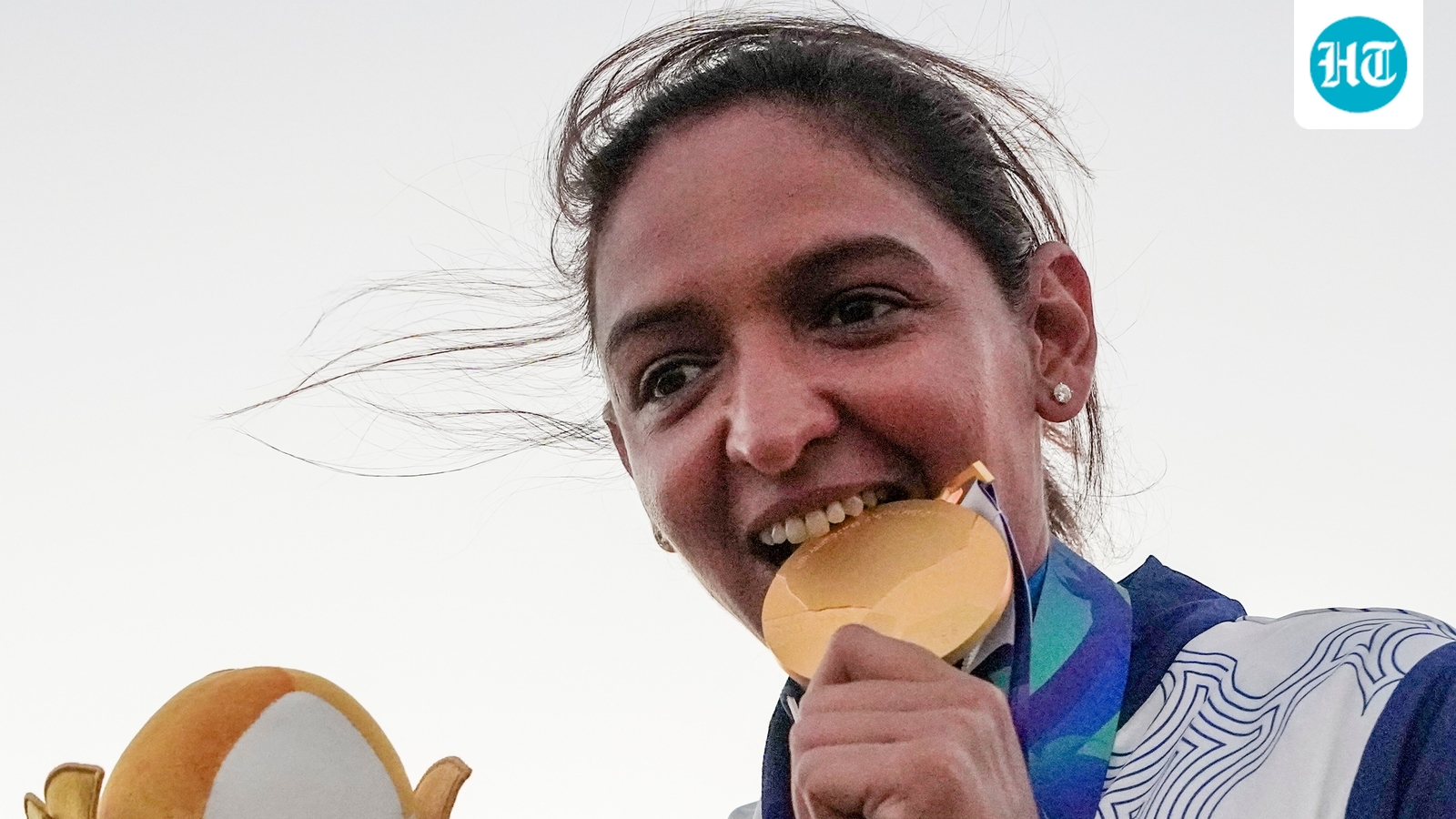
Harmanpreet Kaur stood at the end of another Indian triumph in Nagoya, an Asian Games gold medal around her neck and another trophy added to a period in which victory has begun to look less like an event and more like an expectation. India had overwhelmed Sri Lanka by 147 runs in the final, successfully defending the title they won at Hangzhou three years earlier.
Nearly half a century separates India’s first officially recognised women’s international in 1976 from Harmanpreet’s latest medal, and the clearest measure is how radically the country’s relationship with the team has changed. India once celebrated participation, then competitiveness, then appearances in major finals. Harmanpreet now captains a side for whom anything short of winning can feel insufficient.
That is why Nagoya matters beyond the medal table. It arrives after India’s maiden ODI World Cup triumph in 2025 and another Women’s Asia Cup title this month, placing Harmanpreet at the centre of perhaps the most decorated stretch Indian women’s cricket has experienced.
From survival to expectation
The Women’s Cricket Association of India was formed in 1973, when women’s cricket existed largely outside the country’s sporting mainstream. India played their first officially recognised international against West Indies in Bengaluru in October 1976, with Shantha Rangaswamy as captain.
Those women were not playing in an age of franchise contracts or prime-time broadcasts. Their struggle was more fundamental: to establish that women representing India deserved fixtures, infrastructure and permanence. India hosted the Women’s World Cup in 1978 and had to wait until 1997 to reach their first World Cup semi-final.
A later generation made India increasingly difficult to ignore. Anjum Chopra became a foremost batter and captain, while Mithali Raj and Jhulan Goswami gave Indian women’s cricket international stature. By the time India reached their maiden World Cup final in 2005, the team had moved beyond merely proving that it belonged.
Mithali and Jhulan then became the constants of the modern era. Mithali carried India’s batting expectations across generations, while Jhulan developed into one of the finest fast bowlers in the women’s game. Women’s cricket came under the BCCI umbrella after the WCAI merger in 2006, central contracts followed, and institutional support expanded.
Then came 2017.
India’s run to the World Cup final in England became the cultural breakthrough decades of progress had been building towards. Mithali was captain, but Harmanpreet’s unbeaten 171 against Australia in the semi-final became one of the defining innings in Indian women’s cricket. India lost the final to England at Lord’s, yet the tournament transformed the team’s public profile.
Harmanpreet’s subsequent captaincy was not an uninterrupted procession towards silverware. India reached the 2018 T20 World Cup semi-final and the 2020 final, where Australia overwhelmed them. Two years later came another near-miss against Australia in the Commonwealth Games final.
When Mithali retired in 2022 and Harmanpreet inherited the ODI captaincy, India had become a major force but remained without the defining global breakthrough. The ecosystem around her changed rapidly. Equal international match fees arrived in 2022, while the Women’s Premier League began in 2023. Harmanpreet did not create those structural changes, but she became the national team’s defining leader as Indian women’s cricket acquired unprecedented visibility and expectation.
The first Asian Games gold at Hangzhou in 2023 was another landmark, but the result that transformed Harmanpreet’s place in history came two years later. At home in 2025, India defeated South Africa in the ODI World Cup final to become world champions for the first time. Harmanpreet later spoke about wanting India to “make winning a habit”. The phrase now feels like a mission statement. India were eliminated in the group stage of the 2026 T20 World Cup, but responded by winning the Asia Cup unbeaten and then retaining their Asian Games crown.
Nagoya also showed how much the team around Harmanpreet has matured. She did not need to produce a heroic captain’s innings in the final. Smriti Mandhana made 79, Shafali Verma struck 48 and Richa Ghosh finished unbeaten on 49 as India piled up 216 for three before dismissing Sri Lanka for 69. That is the strongest measure of Harmanpreet’s mature captaincy. The player whose 171 once seemed capable of carrying Indian women’s cricket into a new age now leads a side deep enough to create historic moments without depending on her alone.
Shantha Rangaswamy’s generation fought to establish an Indian team. Anjum Chopra’s generation made it competitive. Mithali Raj and Jhulan Goswami gave it stature and permanence. Harmanpreet inherited that history and became the captain under whom India’s greatest ambitions began turning into trophies. Nearly 50 years after India’s women first walked onto an international cricket field, they no longer need to convince the country that they belong. They now have to cope with a country expecting them to win.


