



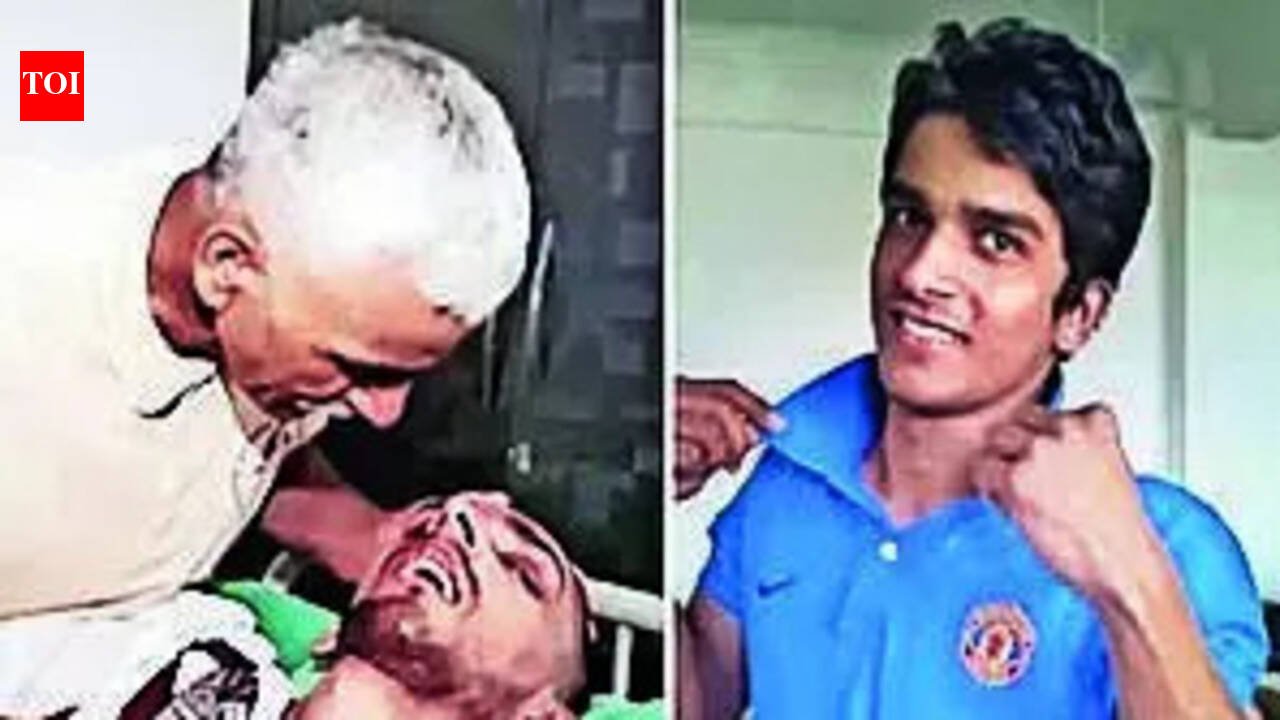
Supreme Court’s landmark judgment allowing withdrawal of life support to Harish Rana will help families in a similar situation because of the guidelines laid down by it, even as it asked the Centre to legislate, Manish Jain, counsel for Rana’s family, says. Injured after a fall when he was a civil engineering student in Chandigarh in 2013, Rana was in a vegetative state for 13 years, and his family fought a long legal battle. After 10 days of withdrawal of life support at AIIMS, under the watch of specialists, Rana died. Jain spoke to TOI about the dilemma before the court, application of ‘right to die with dignity’, the widened definition of life support it accepted, and more. Excerpts:
Manish Jain, counsel for Rana’s family
Why do you think it was so difficult for the legal system to allow passive euthanasia or withdrawing life support from a person who is beyond recovery? Right to die with dignity was recognised in Common Cause back in 2018.Under our laws, if a person has committed a crime, they can be charged under appropriate sections and awarded the death penalty. But when it comes to a person who has not committed any crime, how do you take their life away? If one cannot give life, how can they simply take life? This dilemma has no solution. Because of this dilemma, Article 21, which talks about ‘right to die with dignity’, came into the picture. If someone kills you, that’s an offence. Therefore, a case where a court has to decide on taking someone’s life is always difficult.
You were a part of the legal team when Harish Rana’s petition was rejected by Delhi HC in 2024 and Supreme Court upheld that. When you moved SC again, what changed about your approach?In a case of passive euthanasia, what is acceptable is withdrawal of life support. But Harish Rana did not fall in the ambit of traditional life support because he was not connected to a ventilator or any other such equipment. He was surviving on a PEG (percutaneous endoscopic gastrostomy) tube, which was medical equipment. The first time we went to HC, we said he is surviving through medical support but not traditional life support. Since this was not traditional life support, the judge refused the plea. Against that order, we went to Supreme Court, which ordered medical assistance to Harish Rana. During medical assistance, the family faced many issues. The PEG tube that was used to feed Harish had to be inserted only by a specialist and there are only two doctors in all of NCR who could do it because it needs to be inserted in the stomach. If someone else did it, Harish would catch an infection. At times, even the hospital gave the wrong tube. Because of all these troubles, we approached the court again after six months. We changed our approach simply on the part of definition of life support. We argued that the support system keeping the person alive also needs to be considered as life support. The court considered the PEG tube as life support equipment and eventually allowed withdrawal of that.How, in your opinion, has the judgment reshaped end-of-life jurisprudence in India?
Rana was the first recipient of passive euthanasia in India. The 31-year-old was in a coma for over 13 years.
Jurisprudence normally talks about ‘right to life’ and whatever we need for life to flourish like air, water, economics, environment. The same jurisprudence talks about a life of dignity and when that life itself is one that of suffering and there is no support system, it finds a way to address the issue – end of life. This means that when the medical support system affirms that there is no chance of recovery and IPC and BNS also say that it does not fall in their ambit, jurisprudence says that instead of prolonging the pain, it’s better to remove all medical equipment and give salvation.Which paragraph in the ruling do you think will be cited most often in courts in future?I think this one: ‘Our decision today does not neatly fit within logic and reason alone. It sits in a space between love, loss, medicine and mercy. This decision is not about choosing death but is rather one of not artificially prolonging life. It is the decision to withdraw life-sustaining treatment when that treatment no longer heals, restores, or meaningfully improves life. It is allowing nature to take its course when medicine can only delay the inevitable because survival is not always the same as living’.There have been cases before Harish Rana when such pleas have been struck down. In Aruna Shanbaug’s case, too, withdrawal of life support was rejected.The basic difference between Aruna Shanbaug’s case and Harish Rana’s case was that Aruna was on a ventilator as a life support system, Harish was not. Aruna would still react to certain tastes like bitter, sweet, but Harish would not. If someone clapped in front of Aruna’s eyes, she would blink. Harish would not. Aruna reacted with her eyes… this meant that she still had some life left in her. That was not the case with Harish. Besides, Harish’s case was filed by his parents, Aruna’s was filed by journalist Pinki Virani, to which the staff of King Edward Memorial College and Hospital raised an objection. The hospital staff did not want Aruna to die because she was family for them and they cared for her deeply. In Harish’s case, there was clear medical evidence supported by the family’s statement that they wanted his suffering to end.Is the judgment also a reflection of how society itself has changed?Dying is still not very popular, and nobody will agree to let a person die. But yes, with this case, the scope of ‘right to die with dignity’ has definitely expanded.How do you see the approach of courts changing in pleas for the right to die with dignity after this?Supreme Court, while ruling in this case, has laid down guidelines that when a person is in a state where recovery is out of question, two separate medical boards can certify withdrawal of life support. SC has said the treating doctor can inform a hospital and a primary medical board can be formed to study the patient’s medical reports. If the board, after taking consent of family or next of kin or close friends, certifies in favour of withdrawing life support, a second medical board should be constituted to do another check of all medical records. Only if there is conflict between the decisions of the two boards should the matter go to a high court.What do you think this means for families in a similar state where someone is in a permanent vegetative state and they want to let them go with dignity?Families will not have to knock on the doors of courts for this. A certificate from the medical board will do. These guidelines will hopefully ease the pain of many people in similar situations.


