



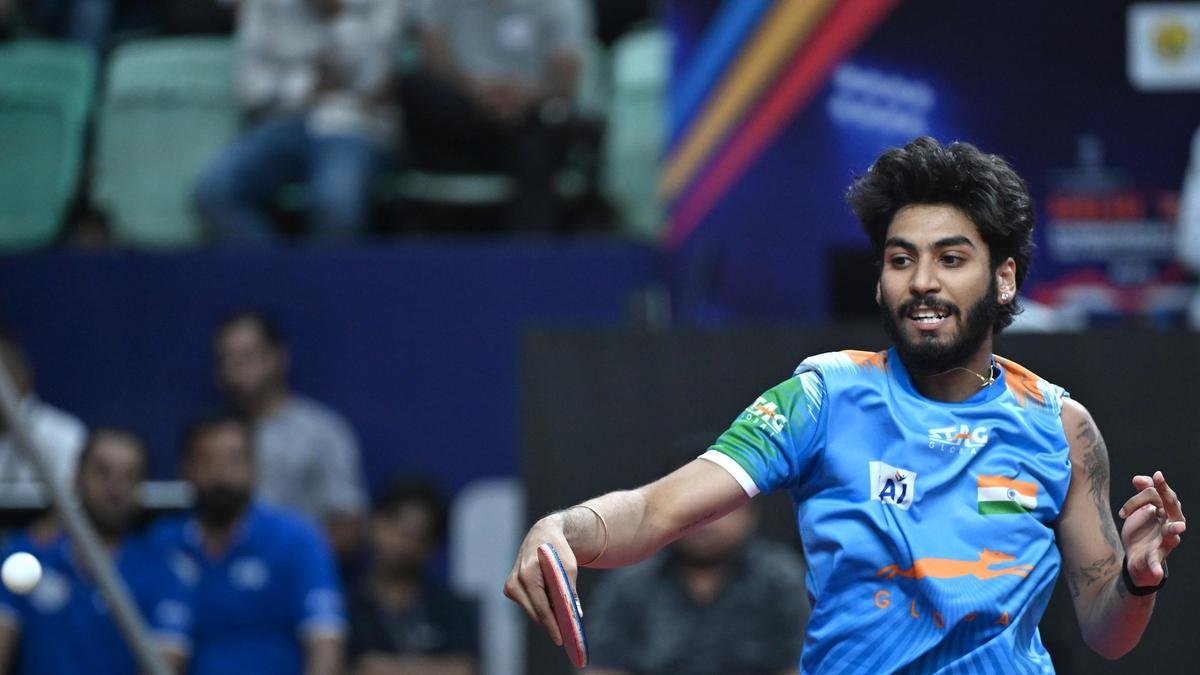
The moment he blocked one of Payas Jain’s signature forehand topspins from the backhand corner deep into the forehand corner and watched his doubles partner fail to reach it, Ankur Bhattacharjee knew the wait was over.
The 19-year-old dropped his racquet, turned to the near-capacity crowd of over 2,000 — largely made up of schoolchildren — and gestured at them to raise the volume. He then blew a flying kiss towards the stands before embracing Payas and sharing a long hug with his father-cum-coach Angshuman Bhattacharjee.
It was more than the celebration of a title.
By prevailing in a topsy-turvy 70-minute final to win the men’s singles crown at the 22nd Commonwealth Table Tennis Championships, Ankur had delivered his answer to the Indian table tennis fraternity.
Less than a fortnight after narrowly missing out on India’s squads for both the Commonwealth Championships and, more significantly, the Asian Games, the Kolkata paddler had produced perhaps the finest week of his seniors career.
“For me, this was the most important event of my life,” Ankur told The Hindu after posing for dozens of selfies and signing more than a few autographs at the Thyagaraj Sports Complex on Sunday (August 2, 2026) night.
“I had to prove to myself and to everyone else that I deserved to be part of the Indian team. I deserved to be part of the Asian Games team.”
The irony was impossible to ignore.
While India, as hosts, fielded 16 players in the singles events — prompting many to jokingly refer to the tournament as the “India Open” — Ankur arrived only because of the expanded quota. Yet his path to the title was anything but straightforward.
His round of 16 itself was against Malaysia’s Wong Qi Shen, the man who had stunned both Manav Thakkar and Manush Shah during the team championships and almost single-handedly threatened India’s supremacy.
Ankur dismantled him 4-0.
Next came Australia’s Nicholas Lum, the World No. 44 and third seed, a left-hander who had beaten Ankur the last time they met. This time, the Indian matched Lum for pace, repeatedly using his trademark backhand winners and flat punches to deny the Australian any rhythm.
“I had lost to Lum in our last meeting. So for me, if I wanted to win this tournament, I had to be at my best,” Ankur said.
Then came Manav Thakkar in the semifinals, arguably India’s biggest title contender. Having faced him during Ultimate Table Tennis last month, Ankur carried a clear tactical blueprint into the contest.
“Recently I played against Manav in UTT, so I knew how to play against him.”
More importantly, he showcased the aspect of his game that has improved the most over the last six months. Long regarded as one of India’s finest backhand players, Ankur repeatedly breached Manav’s defensive wall with his forehand as well, underlining the strides he has made under father-cum-coach Angshuman’s guidance.
The final, however, demanded something entirely different. Across the table stood Payas, not merely another Indian youngster but his regular doubles partner, practice companion and a friend. The familiarity only made the contest harder.
“He is my doubles partner. We are very good friends,” Ankur said. “We always practise together. He knows my weak points and I know his. Even our mental trainer (Vir Saran) is the same.”
The chess match lasted 70 engrossing minutes before Ankur recovered from 2-3 down to prevail in seven games. “I was very happy that I played against him in the final. And I am very happy that I won the title.”
Beyond the trophy, though, the week represented validation. “I had never been part of the Commonwealth Championships team. I came here only for the individual events,” he said. “So the first thing was to prove that I can be part of the Indian team.”
The omission from the Asian Games squad inevitably added motivation, though Ankur insisted it wasn’t the only driving force.
“I don’t really care whether I’m in the Asian Games or not. I always want to win every tournament I play. Whatever tournament it is, I take it seriously.”
Then, after a brief pause, he admitted the criticism had fuelled him.
“I like such challenges when people doubt me. Maybe a lot of people think I have only come because I am the host country’s player. But I feel that if I play well consistently, I can beat anyone.”
Asked about the flying kiss immediately after championship point, the otherwise animated teenager suddenly turned shy. “My mother,” he said with a sheepish smile. No doubt his mother Kuntali — also a former paddler just like his father — was praying while sitting in the stands, sitting next to her was a friend.
There is little time to savour the biggest title of his young career. His next stop is Europe Smash in Sweden starting over the weekend, where another opportunity awaits against the world’s elite. “Now I’ll head to Europe Smash,” Ankur said. “I hope I can return with a medal.”
Published – August 03, 2026 03:17 am IST


