



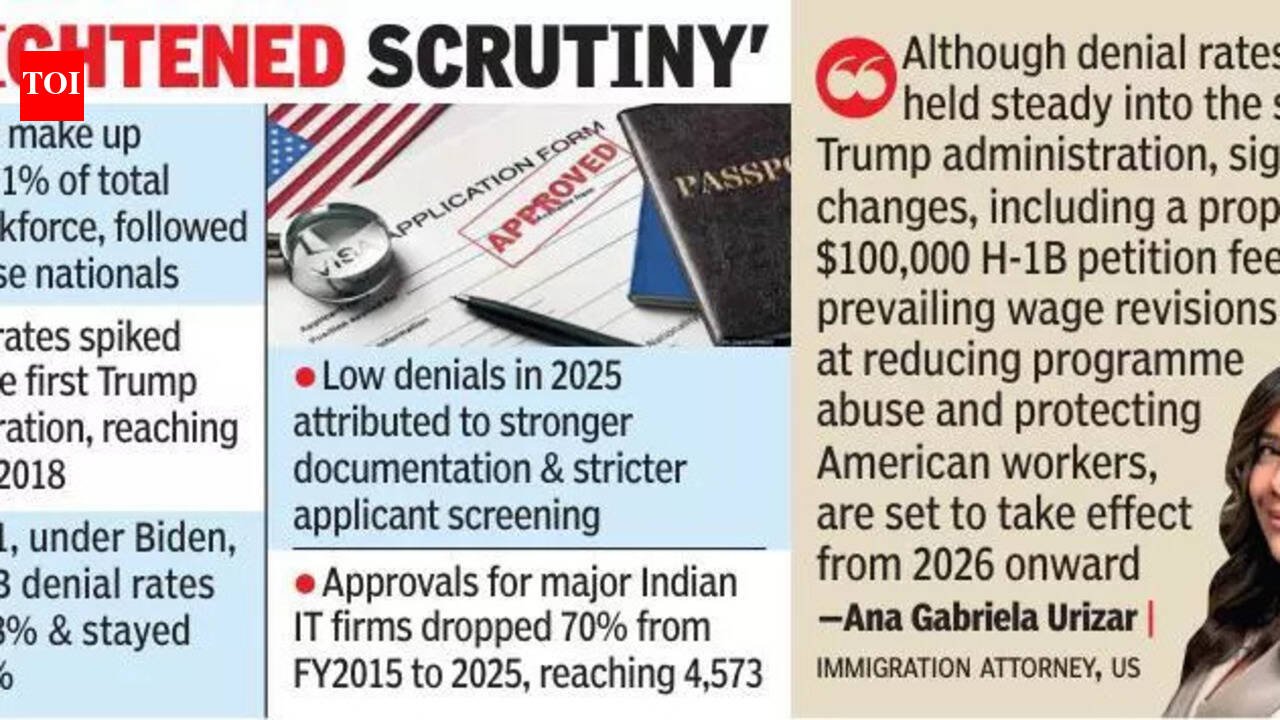
Hyderabad: The overall rejection rate for H-1B petitions remained at a historic low of around 3% in 2025, despite intense political debate surrounding the programme, according to recent analyses of US law firm data. Indians account for roughly 71% of the total H-1B workforce, followed by Chinese nationals.A report by US-based immigration law firm Manifest Law shows that denial rates for new H-1B petitions have fluctuated significantly over time. Between 2009 and the mid-2010s, denial rates largely remained in the single digits, falling to 4.8% in 2012 when adjudication standards were relatively stable.“That pattern changed during the first Trump administration, when the US Citizenship and Immigration Services (USCIS) increased scrutiny. As a result, the new-hire denial rate rose sharply from 7.8% in 2016 to a peak of 18.3% in 2018, remaining elevated at 17.5% in 2019,” said Haley Davidson, an immigration analyst at Manifest Law.However, by 2021, during the Biden administration, the denial rate for new H-1B hires had dropped to 2.8%, and it has remained below 3% every year since.“The major reason for the low denial rate is improved documentation by employers, with significantly stronger evidentiary packages, clearer job descriptions and stricter screening of applicants before filing petitions in 2025. This naturally results in fewer denials because petitions are increasingly submitted with USCIS adjudication trends in mind,” said Sachin Rajgire from Wynisco and Wynploy, an international recruiting agency.A report by the National Foundation for American Policy (NFAP), however, reveals a sharp fall in approvals for initial employment among major Indian IT outsourcing firms. Approvals for seven leading Indian-headquartered companies dropped to 4,573 in FY2025, a steep 70% decline from FY2015.Immigration experts say the divergence largely reflects differences in hiring models.“Large US tech companies such as Amazon, Microsoft, Google and Meta often sponsor H-1B workers for clearly defined in-house engineering roles with strong wage levels and well-documented specialty occupation requirements, which tend to align closely with USCIS expectations. By contrast, many global consulting firms rely more heavily on project-based placements or third-party client worksites, which historically have triggered additional scrutiny from USCIS,” said Ana Gabriela Urizar, an immigration attorney based in Washington.Another factor, experts say, is the growing tendency among US tech firms to recruit highly skilled graduates from American universities for specialised roles that meet higher wage thresholds. “In contrast, Indian IT services firms often use the H-1B programme to deploy workers to client sites, a model that has faced greater regulatory scrutiny,” Rajgire added.Applicants also reported heightened scrutiny in 2025 in the form of requests for additional information from US authorities, adding to the uncertainty surrounding the process. Some said their companies even discouraged them from applying.“I was so scared that I would be deported or laid off, so I thought that if I am in India with my family, it would at least keep me stress-free from the constant worry of scrutiny or getting laid off,” said Sathe S, a 28-year-old UI/UX designer working with an MNC in Hyderabad.“Although denial rates have held steady into the second Trump administration, significant changes, including a proposed $100,000 H-1B petition fee and prevailing wage revisions aimed at reducing programme abuse and protecting American workers, are set to take effect from 2026 onward. These changes could disrupt the relatively stable H-1B approval landscape,” Urizar added.MSID:: 129510568 413 |


