



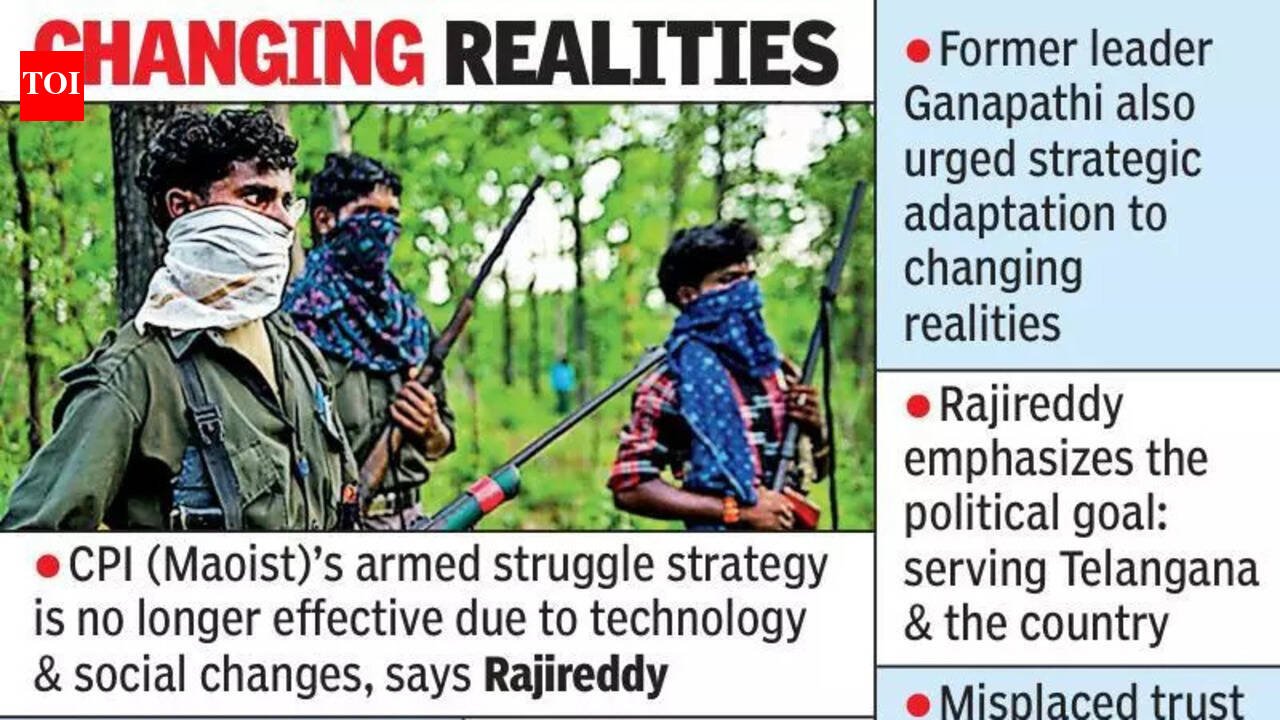
Hyderabad: A conversation with surrendered Maoist leader Malla Rajireddy, alias Sangram, offers a rare insight into the crisis within the CPI (Maoist). The senior functionary stated that the idea of seizing power through armed struggle is no longer workable in the present era.Pointing to the widespread use of smartphones and android devices among youth, he said the party can no longer organize or recruit as it once did. Rajireddy added that Operation Kagar dealt a severe blow to the organization, breaking its leadership chain and leaving the Central Committee unable to meet or choose a successor after the general secretary’s death due to a communication collapse across regional units. However, he emphasized that the outfit is not yet finished, expressing doubt over claims that it could be wiped out by March 31, as guerrilla squads and committee members continue to resist.Rajireddy also spoke of outreach from the govt side, saying an IB joint director informed them that Operation Kagar would be paused temporarily to facilitate talks with other revolutionaries. “The govt is trying, but it may not be possible to completely wipe out the organization by March 31. Guerrilla squads and committee members are still resisting. An IB joint director told us they would temporarily stop Operation Kagar to allow us to talk to other revolutionaries, but the operation has not actually stopped,” he said.Arrest, not surrenderRajireddy rejected the description of his arrest as a surrender, insisting he came out for a different purpose. “We did not come out to surrender. We came out to stay in the plains secretly and guide the party cadres. Within a few days of coming out, the Special Intelligence Bureau (SIB) arrested me in Hanamkonda. They are portraying that arrest as a surrender, but I want to clarify that we did not come out with the intention to surrender,” he said.He explained that he and Devji were picked up on the same day, though they moved separately. “I was arrested in Hanumakonda, and Devji was arrested in Hyderabad on the same day. I did not know when he came out, and he did not know when I did. We both decided to come out, but I arrived earlier and the other later; the SIB caught both of us on Feb 18 at 6.30 pm,” he said.Rajireddy linked his decision to come out to the pressure the party faced under Operation Kagar. He said politburo member Sonu wrote to him stating that the current military pressure made survival difficult and that it was time to think differently. “In that letter, he stated that surrender is the only way left. After seeing that letter, I decided I must go and meet him,” Rajireddy said.He added that he met Sonu in the last week of July and found that some sections of the leadership had sharply shifted their assessment. “Our adopted tactics were failing against the state, we were suffering heavy losses. Forests are turning red and, to stop this, surrender is the only path,” Rajireddy said.Operation Kagar & breakdown at the topRajireddy described Operation Kagar as the point at which the organization’s structure came under severe strain. Many top leaders were either killed in encounters or chose to surrender, weakening the party at multiple levels.He said the operation also broke communication links between Central Committee members spread across regions such as Odisha, Chhattisgarh, and Maharashtra, making meetings and coordination difficult. The communication collapse, he said, had consequences far beyond immediate operations.Rajireddy added that after the general secretary’s death in May 2021, the party could not even convene a meeting to elect a successor, reflecting not just losses on the ground but strategic paralysis at the top.He also referred to the surrender process involving other leaders. “It became clear in March that Mallojala Venugopal would surrender. Earlier in Jan, when his wife surrendered, she hinted he might follow. It seems his move was pre-planned. He made an understanding with the state and convinced those who agreed with him to surrender. He spoke to Satish and Sonu, and after they agreed, a statement was released in Sept to intensify the surrender process,” Rajireddy said.Why the old line no longer worksRajireddy said the party’s traditional line, including the theory of capturing power through the barrel of a gun, has run into changed ground realities. He noted that the spread of technology, especially smartphones and android devices among youth, altered social conditions and made it harder to organize in the old manner.He also pointed out that small-scale economic development and govt welfare programs affected recruitment, limiting the party’s ability to attract members as before. He offered an internal critique, stating that the party failed to analyze changing social and production relations in India, where comprador bureaucratic capitalism became dominant over traditional feudalism.Rajireddy added that even former top leader Ganapathi argued for a change in strategy. According to him, he met Ganapathi about two years ago, when the former leader was ill and seeking treatment, and heard the view that the party needed to adapt its strategy and tactics to a changing world.Even as he spoke of retreat from armed struggle, Rajireddy said the political objective remained. “We want to serve the people of Telangana and the country. We are ready to listen to their opinions and accept criticism. Our message is that nothing can be achieved without struggle; only organized strength allows us to achieve anything. If the govt permits us as a political party, we will certainly come forward,” he said.The conversation also highlighted internal disputes over the movement’s future and controversies around its functioning. Rajireddy cited the Hidma encounter as a case in which misplaced trust in contractors secretly working with state intelligence led to deaths. He also rejected allegations of caste-based dominance in the party, saying that while some classes may have had greater representation due to historical advantages, the party’s stated policy remained committed to caste annihilation.


