



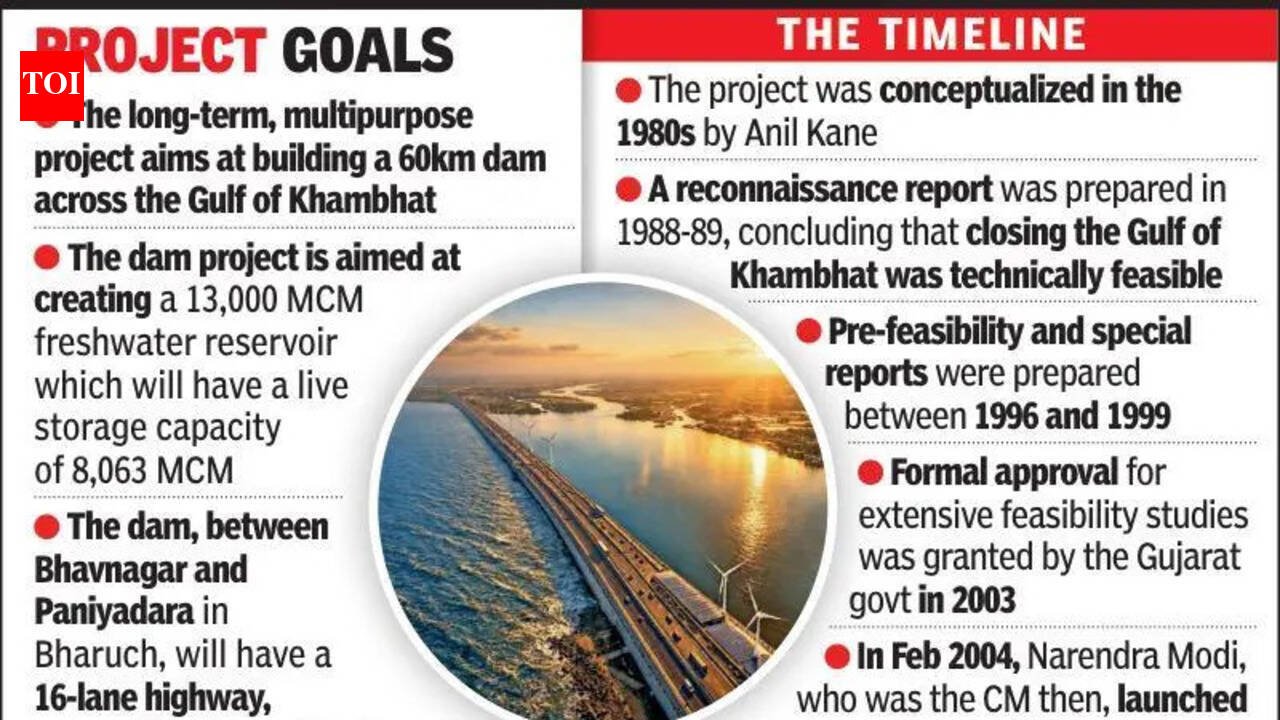
Gandhinagar: The Gujarat govt, along with the Centre, is likely to tie up with the Netherlands to develop the ambitious Kalpasar project. Conceived about four decades ago, it has still not taken off, despite a series of detailed project reports (DPRs) having been commissioned. According to the latest estimates, the total cost of the Kalpasar project has been pegged at Rs 1.57 lakh crore.The project envisages the creation of a 13,000 million cubic metre (MCM) freshwater reservoir in the Gulf of Khambhat by constructing a 60km dam between Bhavnagar and Bharuch. A 16-lane highway at the top of the dam will connect Saurashtra to South Gujarat, drastically reducing travel time between the two regions, while the freshwater stored in the reservoir will meet drinking water, irrigation, and industry needs.Top sources said that the Gujarat govt and the Centre are exploring the possibility of a strategic G2G (govt-to-govt) partnership, and development of a business model for the Kalpasar project. “A team of Dutch representatives met CM Bhupendra Patel and officials of the state administration earlier this week in Gandhinagar, where a presentation on the Kalpasar project was made,” a source said.“A proposal was mooted for the creation of an Indo-Dutch expert group for periodic design review, knowledge transfer and other aspects of partnership for development of the Kalpasar project,” the source added. Official sources said that, like the Narmada project, the Kalpasar project is proposed to benefit multiple states. “As far as Gujarat is concerned, the current per capita per year water availability in the state is 920 cubic metres, which is 54% of the adequate requirement of 1,700 cubic metres per capita per year. With no new water sources available, the water availability situation will become critical by 2047, and hence a decision has been taken to expedite the project,” a source told TOI.According to details provided by the state govt, an estimated 30,000 MCM of water flows annually into the sea without being stored. “A sustainable solution is essential to address future water requirements of the state, considering factors such as rapid industrial development and a growing urban population. With rapid improvement in urban living standards, the demand for water will continue to rise,” the source said.A number of rivers — Sabarmati, Mahi, Dhadhar, Narmada (via Diversion Canal), Wadhvan Bhogavo, Limbadi Bhogavo, Sukhbhadar, Utavali, Keri, Ghelo and Kalubhar — empty into the Gulf of Khambhat in the proposed area of the Kalpasar project.Regarding the studies conducted so far for the project, officials said that about 20 renowned national and international organisations have been engaged for their services, and to date, 51 studies have been completed and three are in progress. “These remaining studies are expected to be completed by June 2028,” an official said.


