



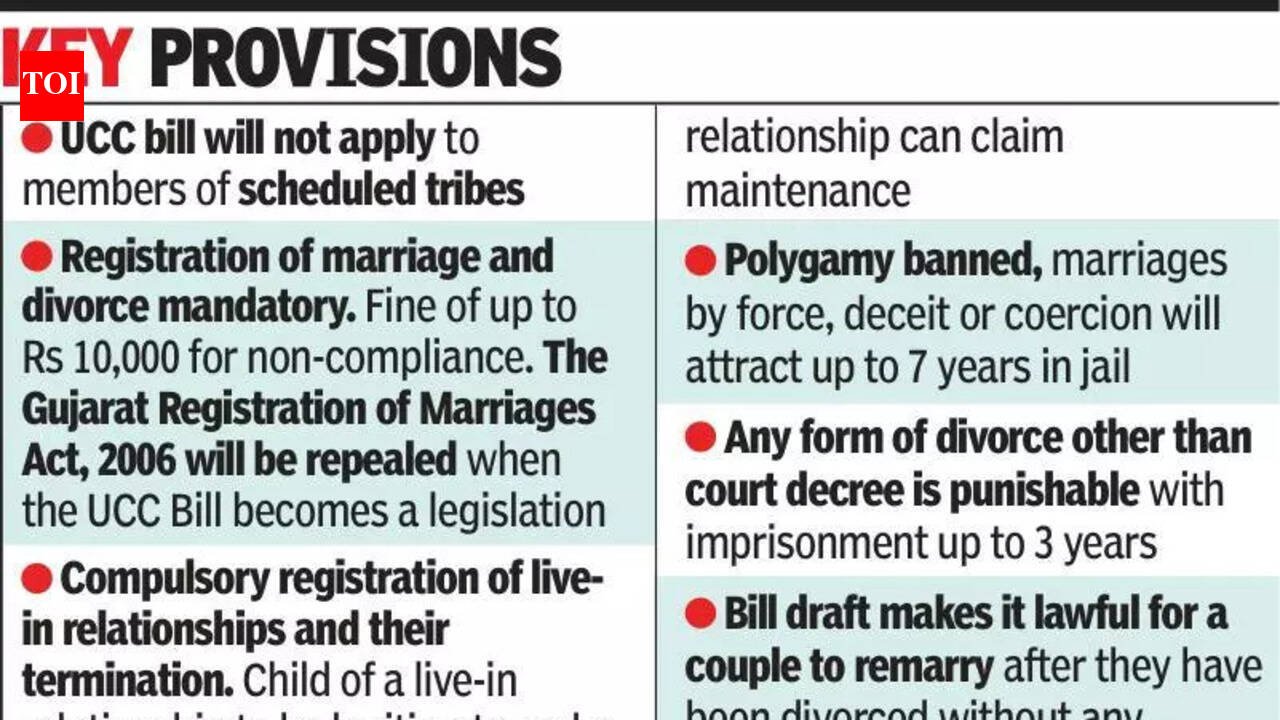
Gandhinagar: Gujarat assembly on Tuesday passed the Gujarat Uniform Civil Code Bill 2026, proposing a common legal framework to govern marriage, divorce, succession and live-in relationships irrespective of religion or community.With BJP enjoying an overwhelming majority of 161 out of 182 seats in assembly, the bill was passed with a majority vote after several members expressed their views on the proposed legislation.Gujarat became the second Indian state after Uttarakhand to pass a bill to enforce a uniform civil code, even as none of the provisions of the UCC bill will apply to members of scheduled tribes (STs).Tabling the bill in the house, chief minister Bhupendra Patel said that UCC is one of the key reforms that PM Narendra Modi is determined to enforce. “The key aim of introducing the bill is to ensure social harmony and national unity. The Supreme Court has also suggested that UCC will ensure women’s rights are secured,” the CM said.The bill proposes mandatory registration of marriage and divorce, with a fine of up to Rs 10,000 for non-compliance. All live-in relationships will have to be compulsorily registered, and termination of such relationships will also have to be notified. Any child of a live-in relationship shall be a legitimate child of the couple. A woman who is deserted by her live-in partner will be entitled to claim maintenance, the bill said.Polygamy has been banned, and marriages by coercion or force will attract imprisonment of up to seven years. Any form of divorce other than a court decree will be punishable by imprisonment of up to 3 years. The bill makes it lawful for a couple to remarry without any conditions after they are divorced, banning the practice of `halala’ in certain communities.Making a strong pitch for the legislation, deputy CM Harsh Sanghavi said that although India became independent in 1947, civil laws have continued to differ based on religion, community and caste.“This has led to significant disadvantages for women. The new law will create a uniform legal framework for marriage, inheritance and related matters,” he added.“This legislation is not aimed at any particular religion; it is intended for all citizens and guarantees equal rights under the law,” he noted.Sanghavi said that the bill was drafted after a comprehensive consultative process in which all sections of the society were heard, adding that the UCC panel received 20 lakh suggestions and recommendations while drafting the bill.“Marriages done by deceit, by using fake identity, have become a social evil. This has become an organised crime which has to be prevented, and even courts have directed to prevent such practices,” the deputy CM said. Sanghavi said, “Several countries, including France, Germany, Turkey, Nepal, Azerbaijan and those countries with a Muslim-majority population, have similar laws.”State Congress president and MLA Amit Chavda alleged that introduction of the bill was “politically motivated”. Chavda asked why the report of the Justice Ranjana Desai panel was not shared with MLAs for perusal before the bill was introduced in the assembly. He demanded that the bill be referred to a committee of MLAs and be introduced in the next assembly session, so that it can be studied by all MLAs.Congress MLA Shailesh Parmar said there is no clarity on whether the proposed legislation will include persons from other states who are living in Gujarat. “There is a lack of clarity on the issue of live-in relationships. The UCC bill must not come into conflict with constitutional rights of citizens,” he said.Speaking during the discussion, former Speaker of state assembly and BJP MLA Ramanlal Vora said, “Certain political parties follow the policy of minority appeasement, but ignore the rights of women from these communities. Instances of `love jihad’ are increasing because of the absence of a uniform civil code,” he said.Congress MLA Imran Khedawala said that he welcomed provisions of the bill where the practice of `halala’ has been banned. “Purely on a constitutional basis, I support the bill as it aims to secure the constitutional rights of women,” he said.A committee headed by retired Supreme Court judge Justice Ranjana Desai, formed by the state govt in Feb 2025 to assess the need for uniform civil code (UCC) and draft a bill for the same, submitted its final report to chief minister Bhupendra Patel on March 17. The govt tabled the bill on Tuesday, March 24.


