








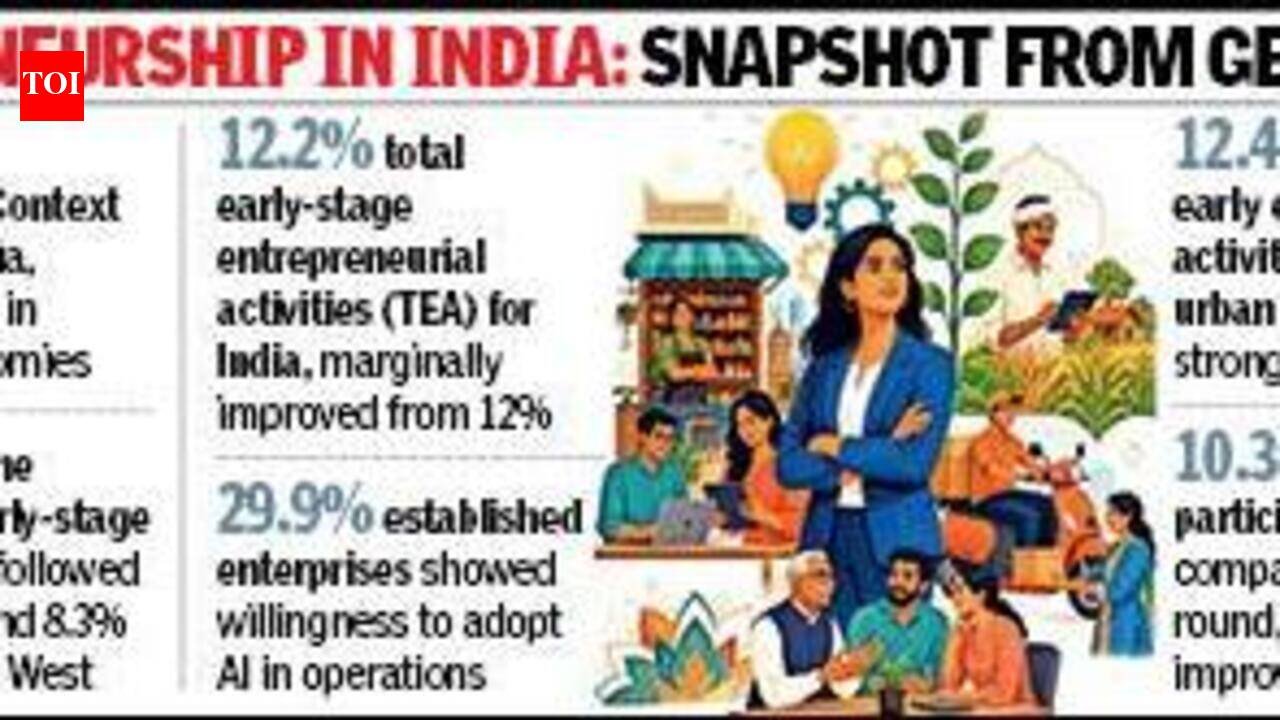
Ahmedabad: Gujarat’s reputation for “dhandho” is reflected in the India edition of the Global Entrepreneurship Monitor (GEM) report 2024-25, which tracks entrepreneurship activity across economies on multiple indicators. The report places Gujarat ahead of the national average on two key measures tied to entrepreneurship pipeline strength—perceived opportunities and entrepreneurial intentions.According to the authors, 83.6% of respondents across India perceived favourable entrepreneurial opportunities, while Gujarat registered a slightly higher 84.2%. On entrepreneurial intentions, the national figure stood at 27.8%, compared to 29.2% for Gujarat.Prof Amit Kumar Dwivedi of Entrepreneurship Development Institute of India (EDII), one of the three authors along with Prof Sunil Shukla and Prof Pankaj Bharti, said Gujarat posted favourable readings across most measured dimensions of entrepreneurial attitudes. “Respondents in the region report high levels of perceived opportunities, perceived capabilities and ease of starting a business. However, the relatively high level of fear of failure (75%) indicates a gap between positive perception of entrepreneurship and willingness to translate these perceptions into entrepreneurial action,” he said. He added, “Compared to last report’s ease of starting business at 82.5%, it has improved marginally at 83.4%.”At the national level, the report positions India second among 51 participating economies. Prof Shukla, director general of EDII and lead author, highlighted the jump in intent and India’s comparative standing among peer economies. “Entrepreneurial intentions increased significantly – from 19.5% in 2023-24 to 27.8% in 2024-25. Likewise, India’s early-stage entrepreneurial activity of 12.2% was higher than China (5.4%) and Egypt (5.2%) in a comparable GEM Level C group with GDP per capita of less than $25,000,” he said.The authors noted that GEM enables comparisons across a wide spread of economies “ranging from China and Canada to Thailand and Greece,” and observed that India followed a global pattern where a majority of entrepreneurship is oriented toward direct consumer markets rather than business-to-business activity.Prof Bharti said the report’s suggestions focus on lowering entry friction and broadening participation. “Some of the major suggestions included improving financial barriers, cultural and contextual factors promoting entrepreneurship culture, and enhancing women-led enterprises,” he said.


