



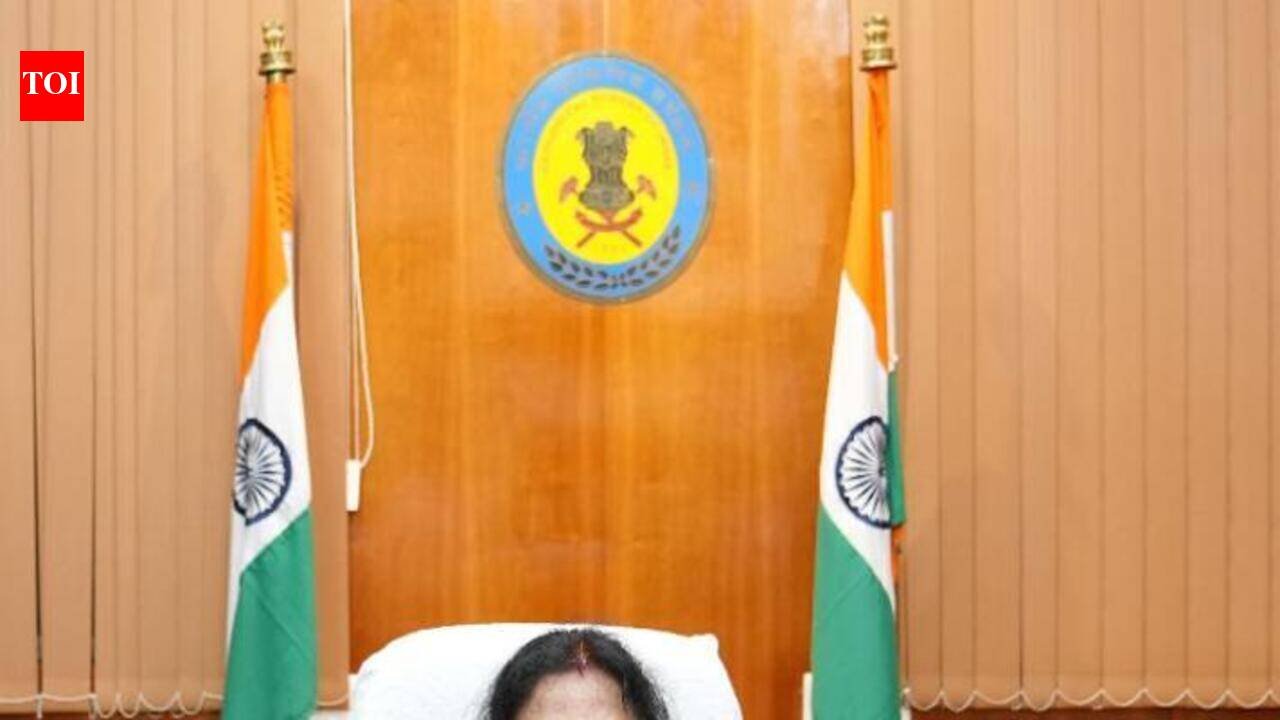
Kolkata: Varsha Ashok Aglawe on Monday assumed charge as the 54th director general of the Geological Survey of India (GSI), becoming the first woman to lead India’s premier geoscientific organisation in its 176-year history.She succeeds Asit Saha, who served as director general from July 27, 2024, to July 31, 2026. Aglawe previously served as additional director general and head of dept of GSI’s eastern region in Kolkata.A geoscientist with more than three decades of experience, Aglawe joined GSI in 1992 after serving with the Indian Bureau of Mines. During her career, she has held key scientific and administrative positions across GSI’s central, northern and eastern regions, as well as at its central headquarters.A specialist in palaeontology and palynology, Aglawe is known for her research on the late cretaceous-palaeocene sediments, the K-T boundary and the Satpura-Gondwana basins. Among her notable contributions is the identification of the Salbardi-Ghorpend region as a new dinosaur nesting site in central India. She has also participated in collaborative palaeontological research with the University of Michigan Museum of Paleontology in the United States and represented GSI in the Indian delegation to the Prospectors & Developers Association of Canada (PDAC) convention in Toronto in 2023.Besides her scientific work, she has played a significant role in strengthening GSI’s institutional capabilities. She established a modern palynology laboratory at the organisation’s northern region office in Lucknow and led multidisciplinary geoscientific programmes across the country.Outlining her priorities after assuming office, Aglawe said GSI would align its programmes with the Centre’s emphasis on critical mineral exploration and mineral security. She stressed the need to accelerate exploration of deep-seated and concealed mineral deposits through advanced geophysical investigations, fast-tracked exploration programmes and stronger laboratory infrastructure.She also identified offshore mineral exploration, natural hazard studies, glaciology, cutting-edge geoscientific research, scientific publications and capacity building for young geoscientists as key focus areas. Expressing confidence in the organisation’s scientific expertise and expanding technological capabilities, she said GSI was well placed to meet the country’s growing demand for critical and strategic minerals while supporting sustainable resource development through scientific excellence and innovation.Headquartered in Kolkata, the Geological Survey of India, established in 1851, functions under the ministry of mines and is India’s apex geoscientific organisation. Originally created to identify coal deposits for the railways, GSI today is responsible for geological mapping, mineral resource assessment, geophysical and marine surveys, natural hazard studies, glaciology, geoinformatics and maintaining the country’s national geoscientific database.


