



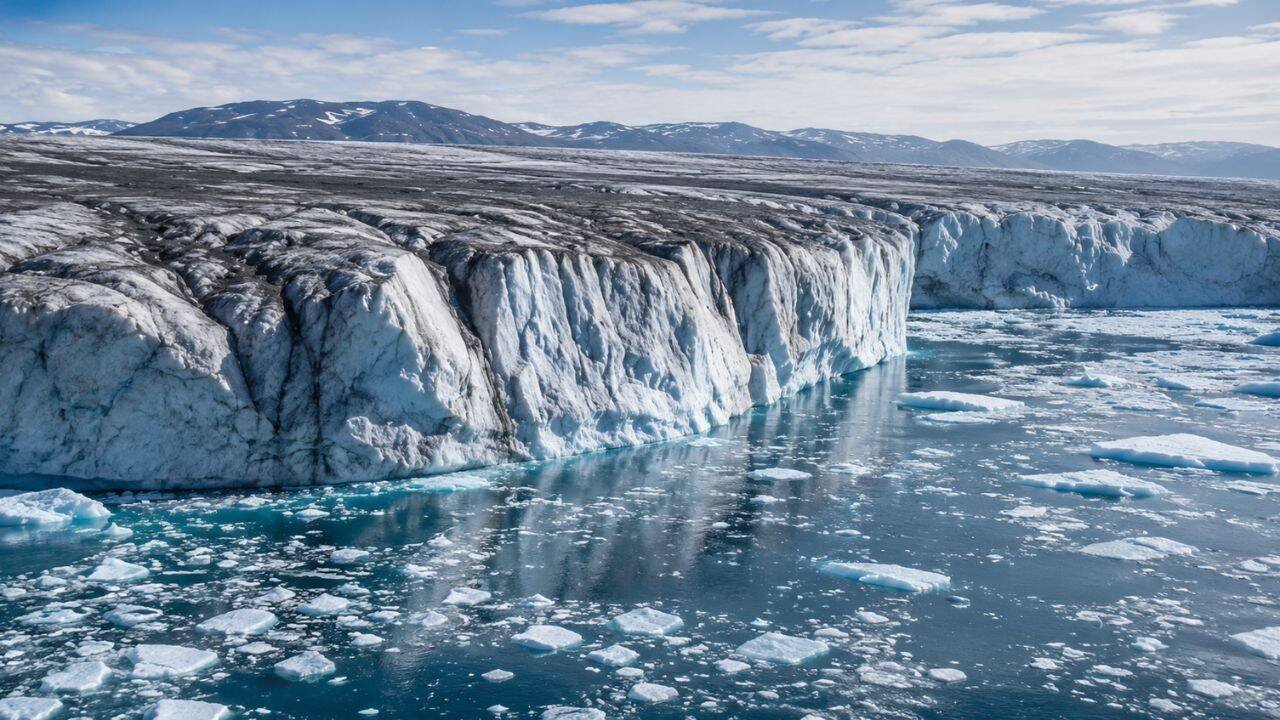
Greenland’s ice sheet lost an estimated 105 billion tonnes of ice during the 2024–25 season. On its own, that figure is large enough to attract attention. Yet the number is only part of what researchers have been watching. Across sections of the ice sheet, particularly during late summer, satellite images have revealed growing areas of darker ice where the surface no longer appears bright white. Dust, soot, wildfire smoke residues and other light-absorbing particles are becoming increasingly visible as seasonal snow retreats. What remains exposed underneath is older, darker ice that behaves very differently from fresh snow.Scientists have long known that darker surfaces absorb more solar energy. The concern now is not simply that Greenland is melting, but that parts of the ice sheet are becoming better at generating additional melt once the process begins. That shift has turned attention towards a feedback mechanism that may be accelerating changes across the Arctic.
How darkening ice is accelerating Greenland ice sheet melting
According to the study published in Nature, titled “Record-breaking Greenland ice sheet melt events under recent and future climate”, fresh snow is remarkably reflective. It sends much of the Sun’s incoming energy back into the atmosphere, helping the ice sheet remain relatively cool even during summer.As snow cover thins or disappears, that protective layer weakens. Dark particles that have accumulated over time become exposed, while pools of meltwater form across the surface. Compared with clean snow, both dirty ice and meltwater absorb substantially more heat.The result is a self-reinforcing cycle. More melting exposes more dark surfaces. Those darker surfaces absorb additional energy, which leads to further melting. Researchers refer to this process as the melt-albedo feedback, and it has become one of the most closely monitored features of Greenland’s changing surface conditions.Evidence from recent years suggests that this darkening is no longer confined to isolated pockets. During warm summers, extensive stretches of bare ice emerge, allowing the feedback to operate over much larger areas than in the past.
Extreme Greenland ice sheet melt events are becoming more frequent
The growing importance of surface darkening coincides with another trend: unusually intense melting episodes are occurring more frequently.As per the study, Greenland’s melt history found that many of the most severe melt events on record have occurred since 2000. Several of these events produced exceptionally high volumes of meltwater and affected areas that previously experienced limited summer melting.Some events have also lasted longer than expected. Scientists have observed melting extending further into the season, reaching periods of the year that historically remained relatively stable. Northern sections of the ice sheet, once considered less vulnerable to intense surface melting, are increasingly appearing in records of extreme events.What concerns researchers is that atmospheric conditions alone do not fully explain these changes. Even when weather patterns resemble those seen decades ago, present-day melt rates can be significantly higher because the ice sheet itself has changed. Warmer temperatures, expanded melt-prone zones and darker surfaces all appear to be amplifying the response.
Why Greenland’s 2024–25 ice melt season still matters to scientists
The 2024–25 season was not Greenland’s most severe year on record. Compared with some of the extreme summers experienced over the past two decades, it falls closer to the middle of the modern range.That is precisely why many scientists find it informative. A season does not need to break every record to reveal underlying changes. During relatively moderate years, the behaviour of the ice sheet can expose trends that might otherwise be overlooked. The appearance of widespread darkened ice is one example.According to the study, once snow cover retreats, deposited particles remain behind and continue to influence how much sunlight the surface absorbs. Wildfire smoke transported from distant regions can add to that burden. In some years, smoke originating thousands of kilometres away has been linked to reductions in surface reflectivity over parts of Greenland.This means that melting is increasingly shaped not only by local temperatures but also by processes occurring far beyond the Arctic. A warmer world produces more conditions that favour surface darkening, while darkening itself promotes additional melting.
Scientists warn of stronger Greenland ice sheet melt events this century
Researchers studying Greenland’s most extreme melt events have suggested that some climate models may not fully capture all of the processes that amplify melting. Surface darkening, atmospheric blocking patterns, rainfall on ice and evolving snow conditions can interact in ways that remain difficult to represent accurately.Recent modelling indicates that extreme melt events could become dramatically stronger later this century under high-emissions scenarios. The greatest increases are projected for northern parts of Greenland, regions that historically experienced less intense summer melting.The significance extends beyond Greenland itself. Meltwater entering the North Atlantic has implications for ocean circulation, sea-level rise and regional climate systems. Although considerable uncertainty remains about the pace of future change, scientists increasingly view the ice sheet not as a passive victim of warming but as a system containing its own amplifiers. The loss of 105 billion tonnes of ice in a single year is a measurable outcome. The darkening spreading across the surface may be the more important signal.


