



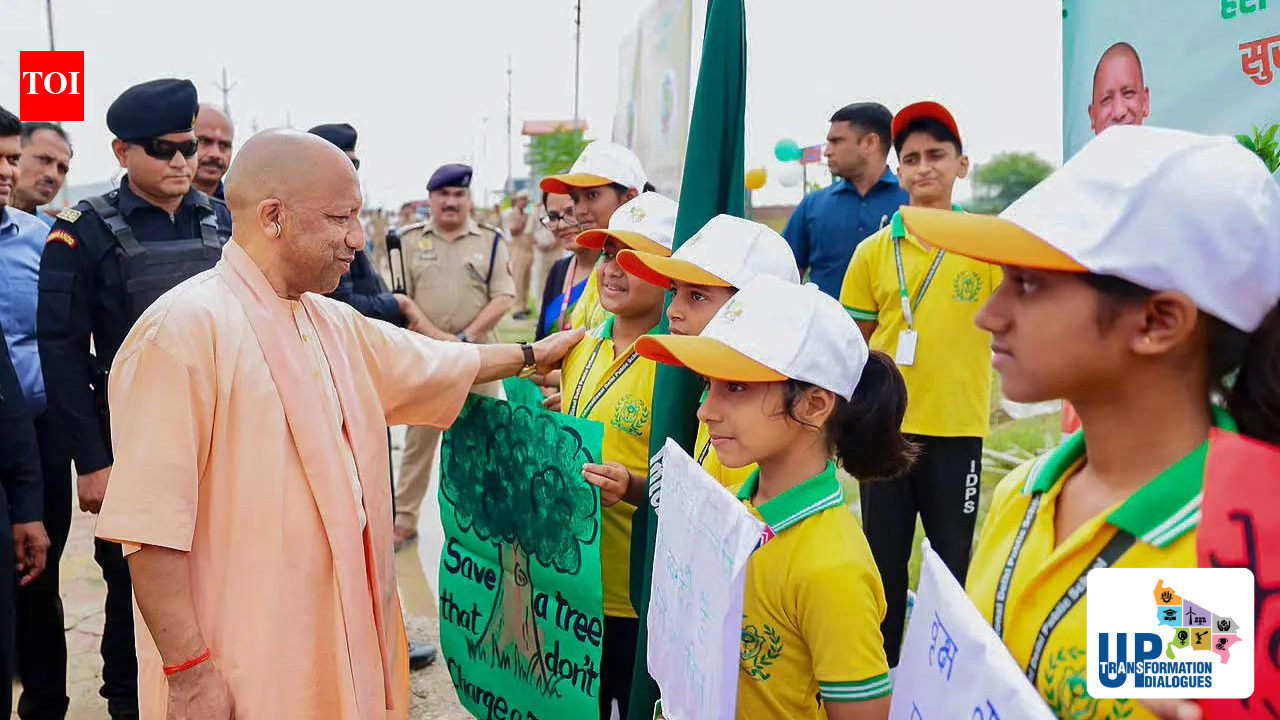
Uttar Pradesh has emerged as one of India’s leading states in promoting afforestation and environmental conservation through sustained policy interventions, record-breaking plantation drives and community participation. Although the state accounts for nearly 17 percent of India’s population, its forest cover has historically remained below the national average because of intensive agriculture, urbanisation and high population density. Recognising the ecological and economic importance of increasing green cover, the Government of Uttar Pradesh has undertaken an ambitious programme of afforestation, social forestry, agro-forestry and biodiversity conservation since 2017.The state’s strategy has been unique in combining mass plantation campaigns with scientific monitoring, public participation, technological innovation and convergence among multiple government departments. The objective has not merely been to plant trees but to create sustainable green assets that improve environmental quality, conserve biodiversity, recharge groundwater, reduce pollution and provide livelihood opportunities.
Uttar Pradesh’s forest scenario
Uttar Pradesh has a geographical area of approximately 2.41 lakh square kilometres. Traditionally, the state’s recorded forest area has remained relatively low compared with the national average because a large proportion of land is devoted to agriculture. Consequently, expanding tree cover outside forests has become a key strategy for improving the state’s ecological balance.According to the India State of Forest Report (ISFR) 2023 published by the Forest Survey of India, Uttar Pradesh registered an increase of 559.19 square kilometres in forest and tree cover compared with the previous assessment. This was among the highest increases recorded by any state in the country. The report indicates that continuous plantation efforts, agro-forestry and urban greening initiatives have significantly contributed to this growth.While the overall forest and tree cover now approaches nearly 10 percent of the state’s geographical area, the government has set an ambitious target of raising green cover to 15 percent by 2030, in line with India’s commitments under global climate agreements.
Record-breaking plantation campaigns
The most visible feature of Uttar Pradesh’s green movement has been its annual mega plantation drives. Every monsoon season, millions of citizens—including students, government employees, village communities, NGOs, industries and voluntary organisations—participate in large-scale tree plantation programmes.Since 2017, more than 240 crore saplings have reportedly been planted across the state under various afforestation campaigns. Each year has witnessed increasingly ambitious targets and better planning.Some notable plantation drives include:– Plantation of over 22 crore saplings in 2019.– More than 25 crore saplings in 2020.– Around 30 crore saplings in 2021.– Massive plantation campaigns exceeding 36 crore saplings during 2024-25These drives involve more than 35 government departments, educational institutions, panchayats, self-help groups and local communities, making them true mass movements rather than isolated government programmes.Scientific planning instead of symbolic plantationOne of the important changes witnessed over the past nine years has been the shift from symbolic plantation to scientific afforestation.The Forest Department now prepares district-wise plantation plans based on local ecology, rainfall, soil conditions and water availability. Native species are preferred over exotic varieties to improve biodiversity and ensure higher survival rates.Species such as neem, peepal, banyan, shisham, arjun, jamun, mango, amla, bamboo, teak, karanj and various fruit-bearing trees are planted depending upon local climatic conditions.The government also ensured that the plantation should be undertaken not only in forest lands but also along:– National and state highways– Expressways– Canal banks– Riverbanks– Railway corridors– Schools and colleges– Gram Sabha lands– Urban parks– Industrial estates– Panchayat landsThis diversified approach has significantly increased tree cover outside traditional forest areas.
Technology-driven monitoring
A major innovation introduced during recent years has been the extensive use of technology to improve transparency and survival.Plantation sites are geo-tagged using GPS-based applications. Satellite imagery, mobile applications and periodic inspections enable authorities to monitor plantation status.Unlike earlier years, success is increasingly measured not merely by the number of saplings planted but by their survival and growth.According to official assessments, the survival rate of plantations has improved substantially, with recent evaluations reporting survival rates of around 86–87 percent, while many individual plantation sites have reported survival rates exceeding 90 percent.This shift from quantity to quality represents one of the major improvements in afforestation management.
Public participation becomes a people’s movement
Perhaps the greatest strength of Uttar Pradesh’s afforestation programme has been public participation. Every plantation campaign undertaken by the state government mobilises School students, NCC and NSS volunteers, Self-Help Groups, Farmer organisations, Religious institutions, Resident welfare associations, Industrial units, Government departments and Panchayati Raj institutions. Campaigns such as “Ek Ped Maa Ke Naam” have further strengthened emotional and social participation by encouraging every citizen to plant a tree in honour of their mother. Similarly, Van Mahotsav celebrations have become annual festivals promoting environmental awareness among children and youth.
Agro-forestry benefits farmers
Recognising that agricultural land occupies nearly three-fourths of Uttar Pradesh’s area, the government has promoted agro-forestry as an important means of expanding green cover. Farmers are encouraged to grow timber and fruit trees along field boundaries and on marginal lands.Species such as poplar, eucalyptus, bamboo, teak, shisham and fruit trees provide additional income while improving soil fertility and reducing erosion. Agro-forestry also diversifies farm income and helps farmers cope with climate variability. The simplification of transit rules for several tree species has further encouraged commercial tree cultivation.
Green corridors along expressways
The construction of modern expressways has been accompanied by large-scale plantation programmes. Green belts have been developed along:– Purvanchal Expressway– Bundelkhand Expressway– Gorakhpur Link Expressway– Ganga Expressway– Agra-Lucknow ExpresswayLakhs of trees have been planted on medians, service roads and adjoining areas to reduce dust pollution, improve aesthetics and create carbon sinks. These green corridors also provide habitats for birds and small wildlife.
River rejuvenation through plantation
Afforestation has become an integral component of river conservation programmes. Large-scale plantations have been undertaken along the banks of:– River Ganga– Yamuna– Gomti– Saryu– Rapti– Ghaghara– Hindon– Betwa– KenTrees stabilise riverbanks, reduce soil erosion, improve groundwater recharge and help maintain ecological balance.Special plantation programmes have also been undertaken around wetlands and ponds created under the Amrit Sarovar Mission.
Urban greening
Rapid urbanisation has increased pressure on cities such as Lucknow, Kanpur, Noida, Ghaziabad, Agra, Prayagraj and Varanasi. To address urban environmental challenges, municipal corporations have undertaken:– Development of city forests– Miyawaki forests in selected locations– Avenue plantation– Green parks– Biodiversity parks– Eco-restoration of urban lakesProjects such as the rejuvenation of Kukrail, expansion of biodiversity parks and development of urban forests in the state capital of Lucknow illustrate the increasing emphasis on urban ecology.
Biodiversity conservation
Afforestation has complemented wildlife conservation. The state has strengthened habitat management in protected areas including:– Dudhwa Tiger Reserve– Katarniaghat Wildlife Sanctuary– Pilibhit Tiger Reserve– National Chambal Sanctuary– Hastinapur Wildlife SanctuaryImproved habitat quality has supported populations of tigers, leopards, elephants, swamp deer, gharials, dolphins and numerous bird species. Plantation around wildlife corridors has also improved habitat connectivity.
Climate change mitigation
Increasing green cover plays a crucial role in mitigating climate change. Trees absorb atmospheric carbon dioxide, improve air quality and regulate local temperatures.They also:– Reduce urban heat islands.– Improve rainfall infiltration.– Recharge groundwater.– Prevent soil erosion.– Reduce dust pollution.– Moderate extreme weather impacts.These environmental services are becoming increasingly valuable as climate variability intensifies.
Livelihood generation
Afforestation programmes have generated employment under various government schemes. Nursery development, plantation, maintenance and protection provide seasonal employment to rural communities. Women’s Self-Help Groups have increasingly participated in raising nurseries and supplying quality seedlings. The plantation economy also supports bamboo cultivation, medicinal plants, lac cultivation and minor forest produce, creating supplementary income opportunities.
Recognition at the national level
Uttar Pradesh’s plantation campaigns have attracted national attention because of their scale.The Forest Survey of India’s successive reports indicate a steady increase in tree cover despite high population density.The state has emerged as one of the country’s leading performers in annual plantation drives and in expanding tree cover outside traditional forest areas.Its experience demonstrates that even densely populated agricultural states can improve environmental sustainability through sustained policy support and community participation.
The road ahead
The government’s target of increasing green cover to 15 percent by 2030 will require continued investment in afforestation, agro-forestry and urban greening. The future priorities charted out by Yogi government include Strengthening community-managed forests. Expanding bamboo and medicinal plantations,Increasing green belts around industrial clusters, Restoring degraded forest lands, Enhancing carbon sequestration, Promoting climate-resilient landscapes and Encouraging greater participation by youth and educational institutions.Integration with schemes such as the National Mission for Green India, CAMPA, Namami Gange and MGNREGA can further accelerate progress.The last nine years have marked a significant phase in Uttar Pradesh’s environmental journey. Through record-breaking plantation drives, scientific monitoring, public participation and innovative conservation strategies, the state has substantially enhanced its green cover and strengthened ecological resilience. The planting of over 240 crore saplings, the 559.19 sq km increase in forest and tree cover recorded in ISFR 2023, improved plantation survival rates and the expansion of agro-forestry and urban greening collectively reflect sustained progress.While challenges remain in protecting natural forests and ensuring long-term survival of plantations, Uttar Pradesh has demonstrated that environmental conservation can be integrated with development, rural livelihoods and climate action. As the state works toward its goal of 15 percent green cover by 2030, continued community participation, scientific management and ecological restoration will be essential to building a greener, healthier and more sustainable future for generations to come.


