






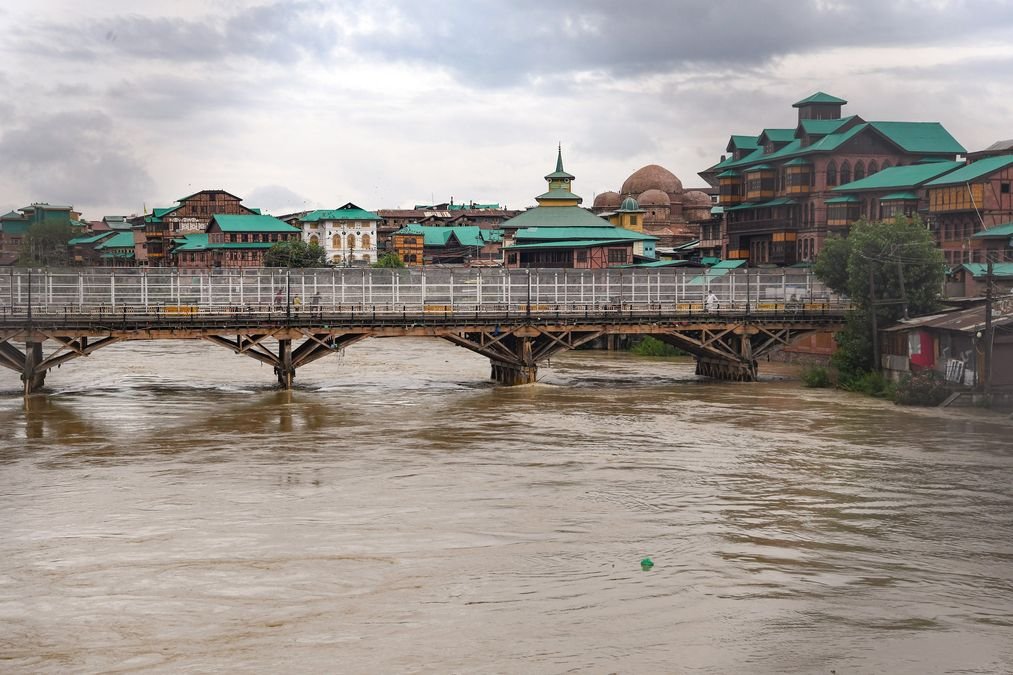
Srinagar, Jul 27: More than a century after the Great Flood of 1903 and twelve years after the devastating deluge of 2014, the Jhelum continues to dictate the Valley’s fortunes, reviving an age-old question: has Kashmir learnt enough from its history?
The recent rise in the Jhelum was nowhere near the catastrophic levels witnessed in September 2014. Improved flood forecasting, extensive dredging, stronger embankments and restoration of the Flood Spill Channel helped authorities prevent a repeat of the devastation that submerged large parts of Srinagar and south Kashmir twelve years ago. Yet, the flood scare demonstrated how quickly anxiety returns in a Valley where every spell of heavy rain still evokes memories of homes submerged, families displaced and livelihoods destroyed.
History suggests those fears are deeply rooted. According to historians and scientific records, Kashmir has witnessed dozens of major floods over the last millennium.
Figures accessed by the Rising Kashmir suggest that the earliest documented flood dates back to 879 AD, when a massive landslide near Baramulla blocked the Jhelum, inundating vast parts of the Valley. Since the beginning of the twentieth century alone, Kashmir has experienced at least 25 to 30 significant floods, including those in 1903, 1905, 1909, 1928, 1948, 1950, 1957, 1959, 1992, 1996, 2006 and 2014.
Among them, the Great Flood of 1903 stands as a defining moment in Kashmir’s modern history. Triggered by nearly three days of relentless rain, the Jhelum burst its banks and transformed Srinagar into what British travellers described as “a vast lake”. The disaster prompted Maharaja Pratap Singh’s administration to construct the Flood Spill Channel, a visionary engineering project designed to divert excess flood water away from the city.
For more than a century, the Flood Spill Channel stood as a reminder that every flood had to be answered with preparedness rather than complacency.
Noted historian, poet and cultural chronicler Zareef Ahmad Zareef says Kashmir’s civilisation has always evolved around the Jhelum.
“The Jhelum is not merely a river; it is the soul of Kashmir. It has given life to our civilisation, our trade and our culture, but it has also reminded us time and again that nature cannot be ignored. Our elders used to say, ‘Vyeth chu meharbaan ti qaharbaan’—the Jhelum can be both benevolent and destructive,” Zareef said.
He believes the Valley slowly forgot the lessons that earlier generations had learnt through hardship.
“Old Srinagar respected the river. Houses, ghats and neighbourhoods were built with an understanding of the Jhelum’s behaviour. The city grew alongside the river, not over its floodplains. Over the decades, we occupied wetlands, narrowed natural drainage channels and encroached upon spaces where floodwaters once spread harmlessly. The river has not changed as much as our relationship with it has,” he said.
Recalling the aftermath of the 1903 flood, Zareef said the Dogra rulers acted decisively. “When Maharaja Pratap Singh ordered the construction of the Flood Spill Channel after the 1903 flood, it showed that rulers had learnt from history. The tragedy is that we later neglected the very infrastructure that was built to protect us,” he added.
If the 1903 flood changed the way Kashmir managed rivers, the 2014 flood changed the way it viewed disasters.
Dr Tauseef Bhat, a climate expert, told Rising Kashmir that large-scale dredging, strengthening of embankments and restoration of the Flood Spill Channel have considerably improved our flood management capability. “Despite two days of continuous rainfall, the river remained within manageable limits, and the flood peak crossed Srinagar without causing major inundation,” he said. “Flood management cannot stop after one project. Rivers are dynamic, rainfall patterns are changing, and infrastructure requires continuous maintenance. Preparedness has to evolve with changing climatic conditions,” he said.
Environmentalist Dr Tanvir Ahmad Khan said the gradual disappearance of wetlands has weakened Kashmir’s natural flood defences. “Wetlands are nature’s flood insurance. Every hectare of wetland lost means less space to store floodwater. Kashmir’s wetlands once functioned like giant sponges, absorbing excess water during heavy rainfall. Their degradation has increased pressure on the Jhelum and raised flood risks across the Valley,” he said.
For Zareef Ahmad Zareef, the message from history is unmistakable: “Every generation in Kashmir has faced floods. The river has always warned us. The question is not whether the Jhelum will rise again, but whether we will remember the lessons it has been teaching us for centuries.”


