



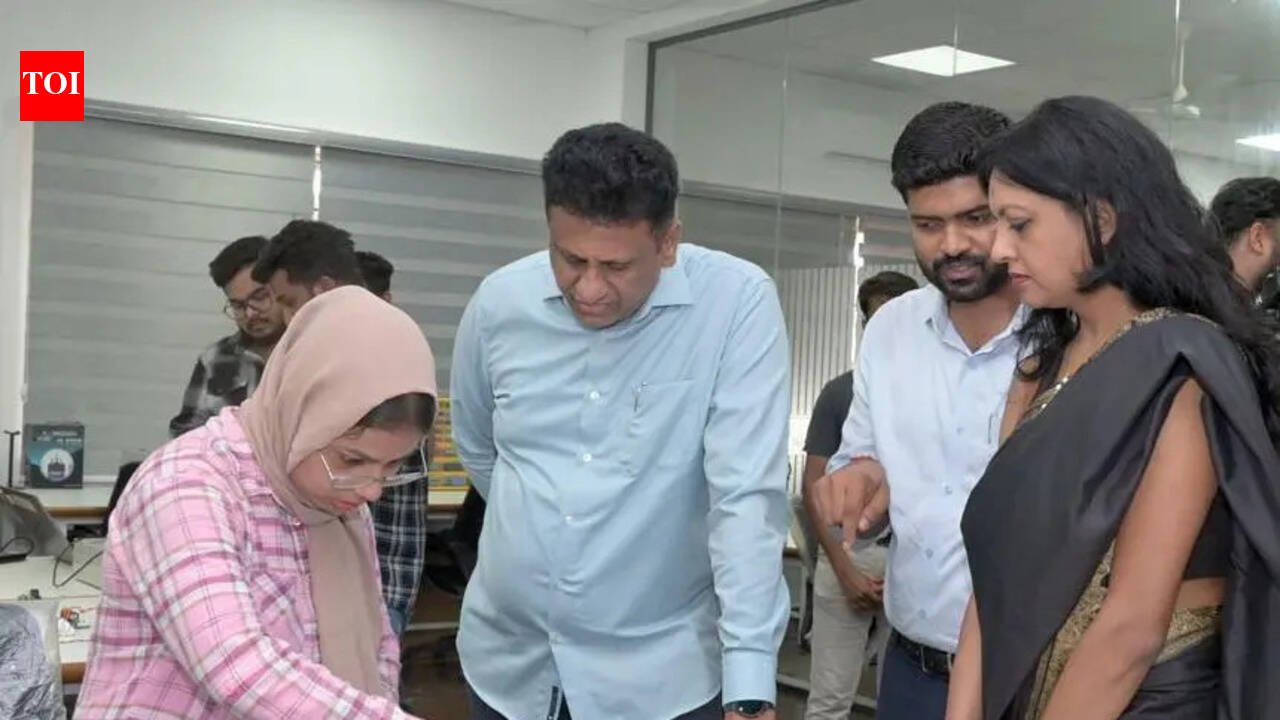
Mangaluru: Higher education minister MC Sudhakar on Friday said the state govt is preparing to cap student intake for computer science and allied engineering programmes, citing a widening mismatch between the number of graduates produced and the availability of jobs in an increasingly volatile technology market.Sudhakar was speaking after inaugurating Mphasis AI and Robotics Lab at The Sahyadri College of Engineering and Management, which was launched in association with Mphasis Foundation. He said student preference has shifted sharply towards computer science-linked courses, largely driven by expectations of higher salary packages, while traditional branches such as civil, mechanical and automobile engineering have seen declining demand. He said the govt is concerned that many institutions have rapidly expanded multiple programmes carrying computer science labels, often with overlapping curricula, leading to “thousands and thousands” of seats in some private colleges and private universities.Linking the proposed cap to employment uncertainty, the minister pointed to disruption from artificial intelligence and a broader slowdown that has affected hiring and triggered layoffs globally. He said the state cannot allow unchecked expansion that could leave large numbers of graduates without jobs.To operationalise the policy, the govt has constituted a committee led by Prof Sowmyanarayanan Sadagopan, former head of the International Institute of Information Technology, Bangalore (IIIT-B). The panel includes members from the Indian Institute of Science, Bengaluru, academia and industry, along with representation from Visvesvaraya Technological University (VTU). Based on the committee’s recommendations, the govt has framed rules and issued a govt order to regulate future expansion.Under the proposed framework, new engineering colleges would be permitted to start with an intake of 60 students per speciality. Over four years, a single computer science-related course could expand to a maximum intake of 180. Institutions will be allowed to offer up to five computer science-related courses, but with an overall ceiling of 900 seats across those programmes.Further expansion will be tied to quality benchmarks. If an institution seeks to increase intake beyond 180 after four years, it will need National Board of Accreditation (NBA) accreditation. Only after securing accreditation would it be allowed to add 60 seats in a year, followed by another 60 the next year, up to a maximum of 300 per course. Even then, the combined cap of 900 seats across computer science-related programmes would remain in place.For institutions that already have very large intakes, Sudhakar said the govt intends to enforce compliance through a transition period. Colleges will be required to obtain NBA accreditation within two years, failing which the state will cut sanctioned seats. He said the govt anticipates legal challenges but plans to proceed.Sudhakar also cited constraints in faculty availability and infrastructure, arguing that rapid seat expansion strains student-teacher ratios and classroom capacity, and risks diluting academic quality. He added that the committee has recommended curriculum changes to integrate AI and emerging technologies into core branches such as mechanical, electrical and civil engineering, as part of an effort to strengthen traditional disciplines while regulating computer science intake.


