



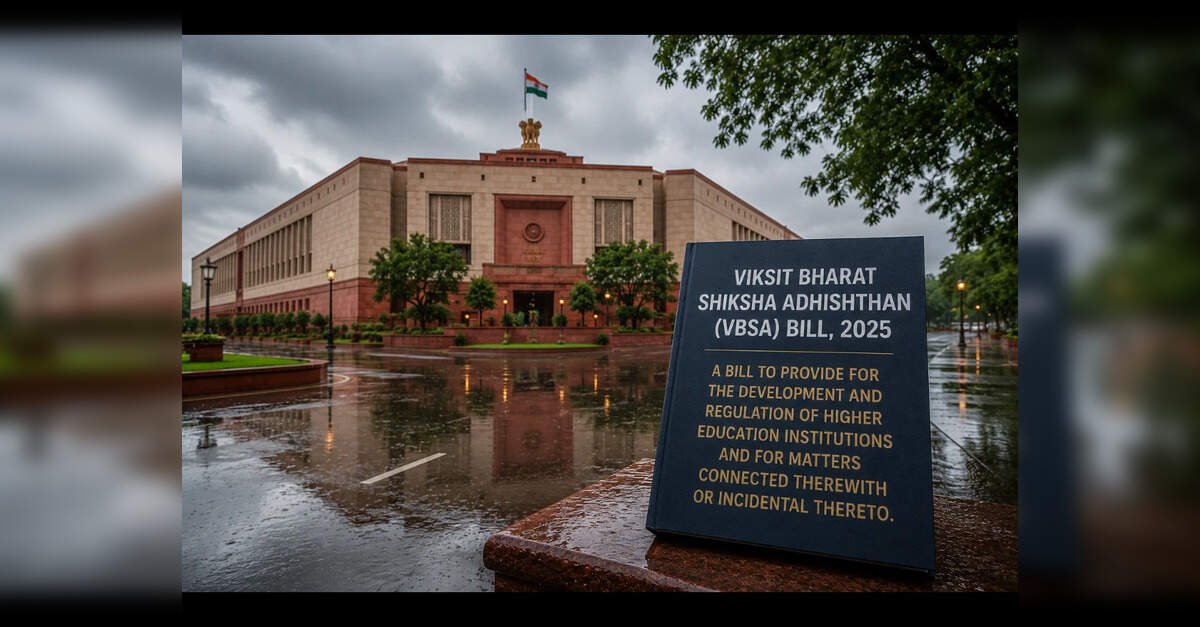
New Delhi: The Viksit Bharat Shiksha Adhishthan (VBSA) Bill, 2025, one of the Centre’s most significant higher education reform proposals, is unlikely to be taken up during the ongoing Monsoon Session of Parliament after the Joint Parliamentary Committee (JPC) examining the legislation postponed its meeting to adopt the draft report.
The committee was scheduled to meet on July 20 to adopt its report before presenting it to Parliament. However, the meeting has been cancelled, delaying the panel’s recommendations and making it unlikely that the Bill will be introduced for consideration and passage during the current session.
Introduced in the Lok Sabha in December 2025 by Union Education Minister Dharmendra Pradhan, the Bill proposes replacing the University Grants Commission (UGC), the All India Council for Technical Education (AICTE) and the National Council for Teacher Education (NCTE) with a single umbrella regulator, the Viksit Bharat Shiksha Adhishthan. The proposed framework envisages three separate councils for regulation, accreditation and academic standards.
Since its introduction, the Bill has drawn representations from Opposition parties, state governments and higher education institutions on various provisions relating to institutional autonomy, regulatory oversight and the role of states. PRS Legislative Research has also observed that while the Bill seeks to streamline regulation, some of its provisions may not significantly enhance institutional autonomy and, in certain respects, could reduce the autonomy currently available to higher education institutions.
Among the key issues raised before the JPC is the applicability of the proposed law to Institutes of National Importance such as IITs, IIMs, IISERs and IIITs. Several stakeholders have sought explicit statutory safeguards for these institutions, while the government has maintained that Clause 49 of the Bill adequately protects their autonomy through regulations to be framed under the proposed law.
The Bill has also prompted concerns from some states over the extent of centralisation proposed under the new regulatory framework. Questions have been raised regarding state representation in the proposed councils and the balance between institutional autonomy and regulatory oversight.
The proposed legislation provides for a graded penalty framework for regulatory violations, while legal and medical education remain outside its ambit. Funding of higher education institutions would continue to be handled separately by the Ministry of Education.
Before the scheduled meeting was postponed, the draft report had flagged the need to ensure that the exercise of regulatory powers does not compromise institutional autonomy and that penalties under the proposed law are not imposed arbitrarily. The committee has consulted 114 stakeholders during its examination of the Bill.
The JPC is expected to reschedule its meeting to finalise the report. The revised timeline for submitting the report and the government’s plans for introducing the Bill in Parliament are yet to be announced.


