





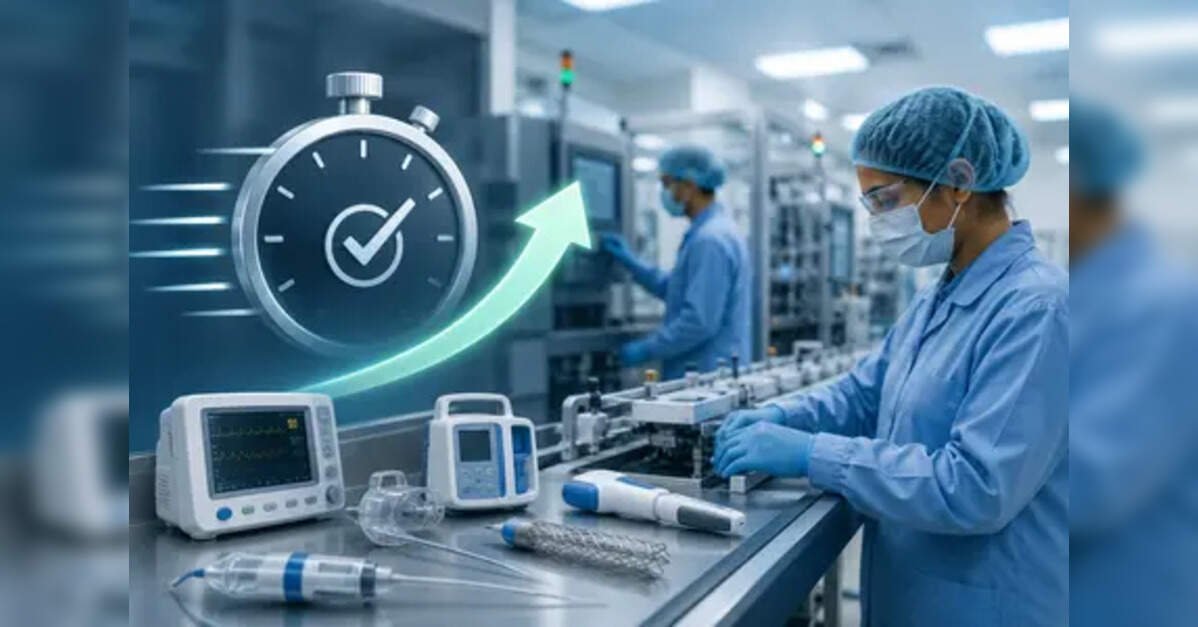
The Union Ministry of Health and Family Welfare has proposed amendments to the Medical Devices Rules, 2017, aimed at simplifying regulatory requirements, improving transparency and facilitating faster market access for eligible medical devices.
The proposed reforms cover three key areas including outsourced sterilisation of medical devices, testing fees and recognition of the European Union as a stringent regulatory jurisdiction for purposes of waiving certain clinical investigation requirements.
Under the proposed amendment to Rule 44, manufacturers using outsourced sterilisation facilities will no longer need to obtain a separate loan licence under Rule 25, provided the sterilisation facility itself holds a valid licence under the Medical Devices Rules, 2017.
Currently, manufacturers that do not have an in-house sterilisation facility are required to obtain a separate loan licence for sterilisation activities. The government said the proposed change is expected to reduce compliance requirements, documentation, approval timelines and associated costs, while allowing manufacturers to use specialised sterilisation facilities more efficiently.
The proposed changes also introduce a Ninth Schedule prescribing uniform fees for testing medical devices at Medical Device Testing Laboratories.
The move is intended to establish a standardised fee structure across laboratories and reduce variations and ambiguity in testing charges. According to the government, predictable testing fees could also help minimise disputes and promote more equitable treatment of manufacturers and importers.
A further change has been proposed to Rule 63, which governs the waiver of clinical investigation requirements for certain medical devices without predicate devices.
The European Union is proposed to be added to the list of recognised stringent regulatory jurisdictions. The provision currently recognises the United States, United Kingdom, Australia, Canada and Japan.
The inclusion of the EU could enable eligible medical devices that have already received approval in the European Union to access the Indian market faster, while reducing regulatory requirements and timelines for manufacturers and importers, according to the ministry.
“The reforms are expected to simplify regulatory processes, reduce compliance costs, enhance transparency and predictability, and facilitate the timely availability of advanced and innovative medical devices in the country,” the release noted.


