


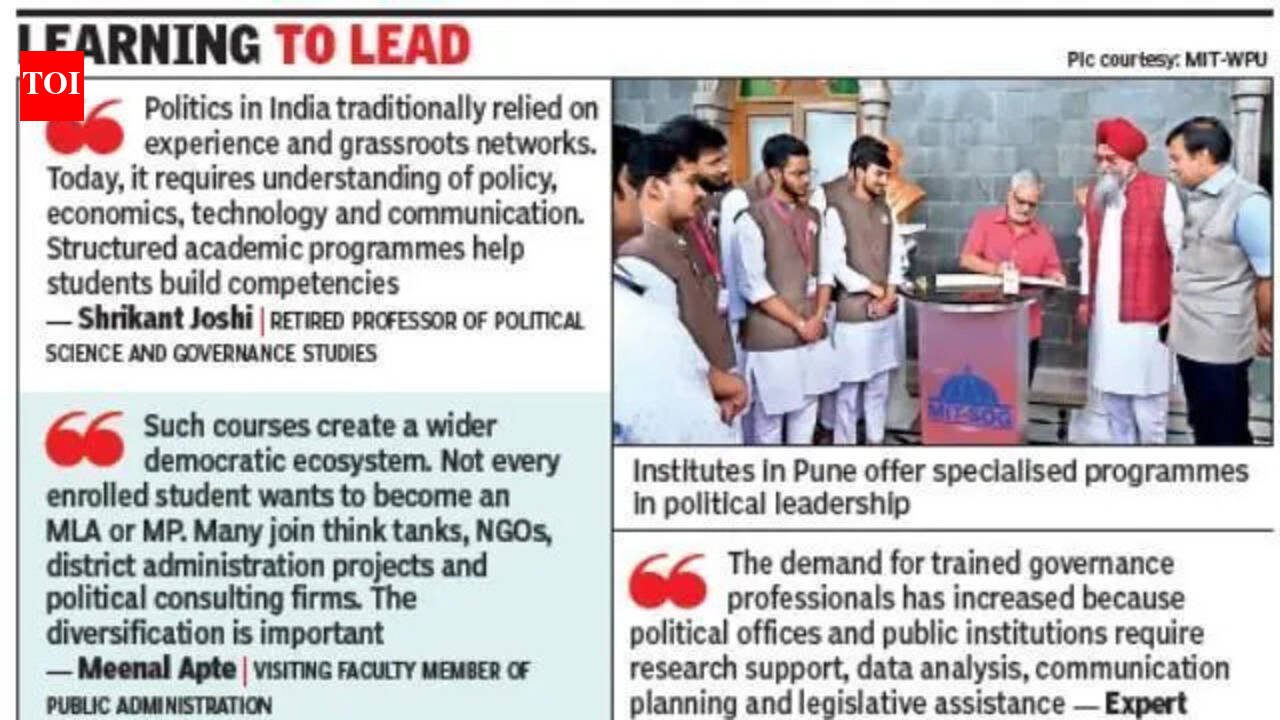
Pune: Institutes in Pune are increasingly offering specialised programmes in political leadership, governance and public policy amid growing interest in students who want to engage in public life beyond conventional electoral politics.Governance education includes legislative research and political consulting to grassroots leadership and public policy advisory roles. It is an emerging career pathway for youngsters interested in politics and administration. Students and alumni said such niche education helps create structured career opportunities in a field once dependent on informal political exposure.“Earlier, politics was seen as electoral participation only. During my course, I realised governance involves research, communication, policy drafting and constituency management,” said postgraduate student of political leadership in Pune Anagha Kulkarni, who now works with a policy research organisation.Soham Deshmukh, an alumnus of MIT School of Governance, works as a legislative assistant in Mumbai. He said governance education had given him a direct exposure to legislative functioning. “We studied how assemblies function, how policy decisions are debated and how public communication works. It made politics feel more institutional and less abstract.”Another student, Rutuja Patil, said young people are increasingly looking to the field as a professional space. “Many want to work in public systems without contesting elections. There are opportunities in research, governance consulting and development communication,” she said.Among the institutions shaping the trend is MIT School of Government, which recently completed 21 years. It is one of the early institutes in India to introduce structured political leadership education. The institute offers programmes focused on governance, constitutional studies, public administration, campaign management and legislative processes.Executive president of MIT World Peace University Rahul Karad said governance education is relevant in a rapidly evolving democracy. “There is need for trained individuals who understand constitutional values, policymaking and public systems. Our focus has been to create informed and ethically driven leadership through experiential learning and legislative exposure,” he said.Karad further said such institutions can act as knowledge bridges between young citizens and democratic institutions. “Students develop a deeper understanding of public accountability and policymaking when exposed to governance processes early,” he said.Retired SPPU faculty members said governance education would gradually make political systems professional .“Politics in India traditionally relied on experience and grassroots networks. Today, it requires understanding of policy, economics, technology and communication. Structured academic programmes help students build competencies,” said Shrikant Joshi, retired professor of political science and governance studies.Meenal Apte, visiting faculty member of public administration, said such courses create a wider democratic ecosystem. “Not every enrolled student wants to become an MLA or MP. Many join think tanks, NGOs, district administration projects and political consulting firms. The diversification is important,” she said.Experts also said the demand for trained governance professionals has increased because political offices and public institutions require research support, data analysis, communication planning and legislative assistance.One frequently cited example from MIT-SOG alumni is the journey of Sumit Wankhede, MLA of Arvi constituency, and Heman Ogale, MLA of Shrirampur. They transitioned from classrooms to public office, studying governance before entering active politics.
