



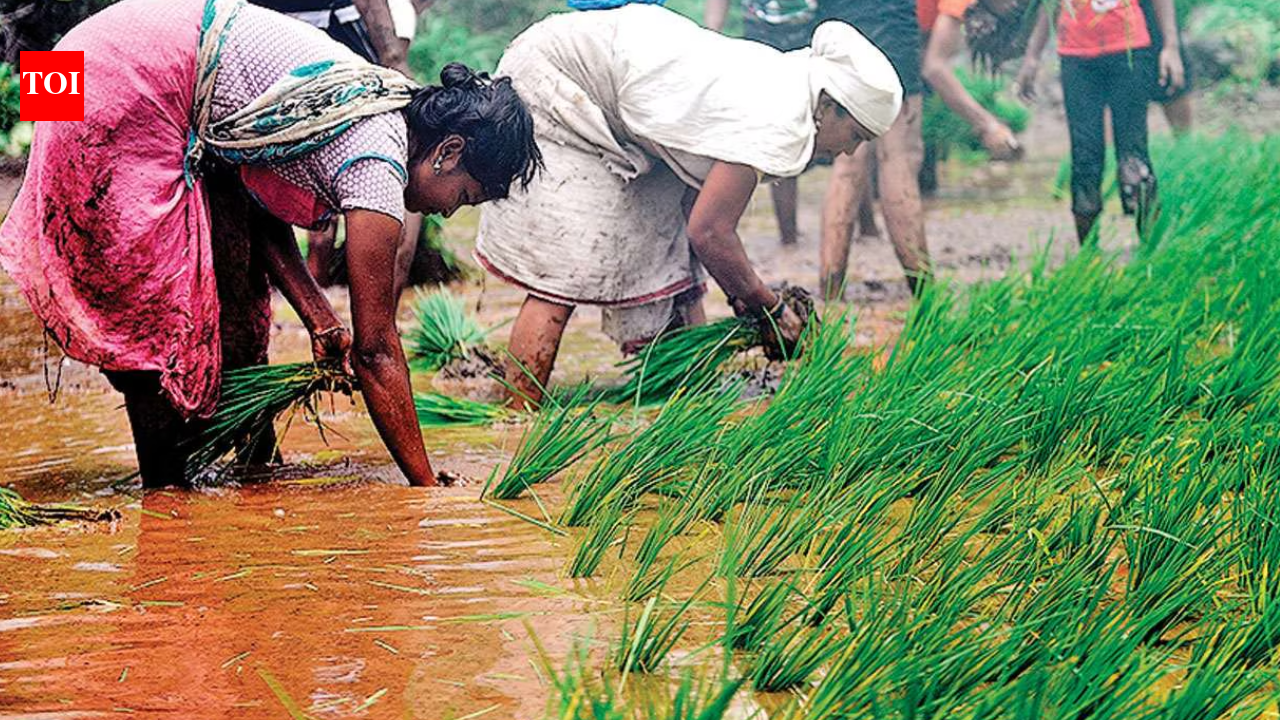
HYDERABAD: Telangana’s monsoon has once again highlighted a growing challenge confronting rain-fed agriculture: It is no longer the total rainfall alone that determines crop prospects, but when, where and how that rainfall is received.Despite widespread showers in the final week of June helping the state recover from an early rainfall deficit and bringing seasonal precipitation close to normal levels, kharif cultivation has lagged sharply. Sowing covered about 33 lakh acres this year, down from nearly 39 lakh acres during the same period last year, underscoring how erratic rainfall can disrupt agricultural activity even in a season that eventually records adequate rain.Rainfall variability refers to changes in the timing, frequency, intensity and spatial distribution of rainfall rather than the cumulative amount received during a season. Scientists say these fluctuations are increasingly influencing agricultural outcomes across Telangana.Until the last week of June, more than half of the state’s districts were facing rainfall deficits, delaying sowing over large areas. Successive monsoon systems then transformed the situation within days, bringing widespread rainfall and narrowing deficits.“This year, 10 to 15 per cent of sowing took place. In this context, we are recommending short-duration crops like pulses to choose, as the rainfall distribution has not been suitable for cultivation yet,” said G Rajasekhar, agriculture scientist at Centre for Sustainable Agriculture.Highlighting the growing risks, the Hyderabad-based ICAR-Central Research Institute for Dryland Agriculture, in its recent agrometeorological advisories, has stressed that spatial and temporal rainfall variability now plays a critical role in rain-fed farming.The institute has cautioned that prolonged dry spells and uneven rainfall distribution can reduce crop performance even in years with normal seasonal rainfall. It has urged states to prepare district-specific contingency plans rather than depend solely on seasonal rainfall forecasts.One of the clearest indicators of rainfall variability is the number of rainy days. Two monsoon seasons may receive identical rainfall totals but produce very different outcomes if the rain is spread over 50 days in one year and only 20 days in another. Well-distributed rainfall helps maintain soil moisture, supports germination and reduces crop stress. In contrast, intense rainfall concentrated within a short period often runs off before crops can effectively use the water.Scientists also closely monitor consecutive dry days, which measure the longest uninterrupted period with little or no effective rainfall. For farmers, this can be one of the most critical indicators. Dry spells lasting 10 to 15 days immediately after sowing can hinder germination, force re-sowing and reduce yields in crops such as cotton, soybean, maize and pulses. In many cases, crop losses occur despite the season ultimately recording normal rainfall.Another important measure is consecutive wet days, or prolonged periods of continuous rainfall. While moderate wet spells improve soil moisture and groundwater recharge, extended rainfall can cause waterlogging, delay field operations and increase the risk of pest attacks and fungal diseases.“Rainfall intensity is equally significant. A district may receive 100 mm of rainfall, but when most of it is concentrated within a few hours, much of the water is lost as surface runoff rather than absorbed into the soil profile. The same quantity of rainfall, distributed over several days, delivers substantially greater agronomic benefits,” climate expert Y Ramesh said.Scientists also warn against a ‘false onset’ of the monsoon. Farmers often begin sowing after the first widespread showers, only to face extended dry spells that expose young seedlings to moisture stress. The result is frequently re-sowing, higher cultivation costs and delays in the crop cycle.As rainfall patterns become increasingly erratic, experts say managing variability—not just measuring rainfall totals—will be crucial to sustaining agricultural productivity in Telangana.


